
Acupuncture,
does it really help with Clinically meaningful improvement in pain and physical function from knee osteoarthritis?
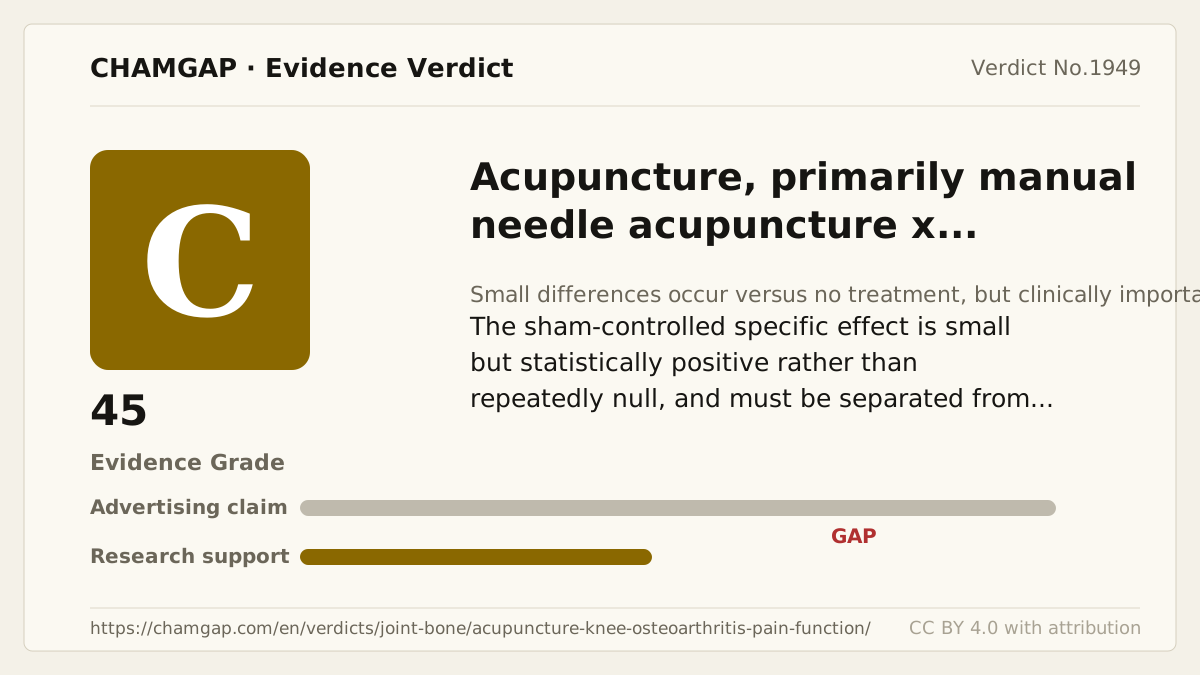
research showsThe grade is C. Short-term pain versus sham across nine trials and 1,835 participants was SMD -0.28 (95% CI -0.45 to -0.11), I-squared 64%; function across nine trials and 1,829 participants was SMD -0.28 (-0.46 to -0.09), I-squared 69%. These are small but statistically positive, not repeatedly null. Heterogeneity in magnitude is not automatically contradiction or repeated refutation. The small specific effect gives 45 points.
ads claimThe total experience of receiving acupuncture may outperform no treatment, but that is distinct from showing that point placement or needle stimulation adds a meaningful effect over sham. Claims of a specific acupuncture effect should be judged by the sham comparison.
Useful facts when choosing a product
- The pivotal protocol allowed eight to 12 sessions over 12 weeks, once or twice weekly.
- Small improvements versus no treatment occurred at 12 weeks, but both co-primary pain and function outcomes failed versus sham and no-treatment differences did not persist at one year.
- Prior acupuncture verdicts concern insomnia, IVF, smoking cessation, rhinitis, migraine, and other indications rather than knee osteoarthritis.
Chamgap Semantic Classification Code
Candidate index · review held
K.acupuncture.UNK.pain-and-physical-function-from-knee-osteoarthritis.improve.MULTIFolk and alternative interventions > Acupuncture > Unknown > pain and physical function from knee osteoarthritis > Improvement claim > Multiple: primary unresolved
An automated migration candidate, not an issued permanent code; exact claim scope remains under review. This machine-generated migration candidate helps retrieval but is not a permanent assignment. The original verdict ID and URL remain authoritative.
What the research actually shows
Short-term pain versus sham across nine trials and 1,835 participants was SMD -0.28 (95% CI -0.45 to -0.11), I-squared 64%; function across nine trials and 1,829 participants was SMD -0.28 (-0.46 to -0.09), I-squared 69%. Cochrane conversions were 0.9/20 for pain and 2.7/68 for function. Versus no treatment or waiting list, pain across four trials and 884 participants was SMD -0.96 (-1.19 to -0.72), and function was about -0.89 (-1.18 to -0.60). Actual indication-specific verdicts differ: 1696 is C 50 points, 1676 is C 48 points, and 1828 is D 30 points; this verdict is C for a small sham-controlled specific effect.
Why this is classified as C (56)
Multiple sham-controlled trials show a small but statistically positive specific effect, giving C with 56 points by conventional interpretation.
Counterpoint. D does not deny the overall experience difference versus no treatment. It assesses whether true acupuncture adds a clinically sufficient average effect over sham.
Rejudgment record. Cross-check applied — Pain and function versus sham are small but statistically positive; conventional interpretation replaces unvalidated prespecified cutoffs, with larger no-treatment contextual effects kept separate
| Endpoint | P | Symptom or function itself is the target - including patient reports and performance tests |
| Replication | R2 | Independently replicated across trials |
| Independence | I2 | Decisive evidence is publicly or non-profit funded |
| Effect size | E~ | Statistically positive but below the threshold |
| Precision | C0 | The confidence interval leaves room for benefit |
Stored derived and displayed grades match; this is not a current recalculation or validity check (C).
Sub-claim grades by effect
This ingredient is marketed for several effects. A single overall grade blends strong and weak claims together, so each effect is graded separately here. The overall grade reflects the strongest disconfirming or core claim.
| Effect (sub-claim) | Grade | Basis |
|---|---|---|
| Pain improvement versus sham acupuncture | C | The individual large trial was null, but the nine-trial pooled effect was small and statistically positive. |
| Physical-function improvement versus sham acupuncture | C | The nine-trial pooled effect was small but statistically positive. |
| Short-term symptom improvement versus no treatment | C | A small 12-week difference was present but did not persist at one year. |
Cross-check — AI research and Codex final gate
Evidence Table
| Study | Design | Sample | Funding | Endpoint | Result | Weight |
|---|---|---|---|---|---|---|
| Hinman RS et al. 2014 | Four-arm randomized Zelen-design clinical trial | 282 randomized and included in multiple-imputation intention-to-treat analysis; 26 (9%) lost by week 12 | Public funding from Australia's National Health and Medical Research Council | Co-primary average knee pain and WOMAC physical function at 12 weeks | True acupuncture versus sham: pain -0.4/10 (95% CI -1.2 to 0.4), function -1.7/68 (-6.1 to 2.6); both failed | Pivotal independent sham-controlled trial |
| Manheimer E et al. 2010 Cochrane review | Systematic review of randomized acupuncture trials in osteoarthritis | Nine sham-controlled trials with 1,835 participants for short-term pain | Independent Cochrane review with trials from multiple public and independent networks | Short-term pain and function versus sham acupuncture | Pain SMD -0.28 (95% CI -0.45 to -0.11), function -0.28 (-0.46 to -0.09); small but statistically positive | Synthesis of multiple sham-controlled trials |
Receipt — 2 References
All 2 cited sources were verified for existence at the original page (as of 2026-08-02).
Final verification and publication gate: Codex · Evidence date: 2026-08-02 · Corrections: none
Cite this verdict
[Chamgap] Acupuncture x pain and function in knee osteoarthritis — Evidence Grade C·56. 2 cited sources checked. Source: https://chamgap.com/en/verdicts/joint-bone/acupuncture-knee-osteoarthritis-pain-function/ · CC BY 4.0CC BY 4.0 — free to use with attribution; do not distort grades, numbers, or verdict meaning.
What this document does and does not do
Chamgap is an information source. It reports what research has and has not confirmed; it does not tell readers what to take or buy. That decision belongs to readers and, when needed, medical or legal professionals. This verdict reflects literature available up to the search date and may change as new research appears. Nothing here is medical advice.