
Active microbreaks,
does it really help with Prevention of new neck and low-back pain in pain-free, high-risk office workers?
research showsThe grade is C. In a trial assigning 193 office workers from six Bangkok organizations by organization, neck and low-back pain occurred in 8/47 and 4/47 active-break participants versus 44/100 and 33/100 controls. Adjusted hazard ratios were 0.45 and 0.34, but only six organizations were involved, the analysis did not account for within-cluster correlation, and unblinded participants recorded their own pain.
ads claimThe device created and recorded opportunities to leave the seat; that physical fact is not equivalent to proving universal pain prevention. Marketing should disclose the single high-risk office-worker trial, subjective case definition, and cluster-analysis limitation.
Useful facts when choosing a product
- The apparatus combined a seat pad, processor, and smartphone app and was designed to recommend 30-second to 15-minute breaks zero to 30 times per workday according to sitting behavior.
- Device records showed 32.5 breaks per day averaging 3.1 minutes in the active-break arm; this is a behavioral measurement, not itself a health outcome.
- Sixty-eight percent switched to home working, but the active-break and control arms had completed six-month follow-up before that switch. No separate early-event exclusion analysis was reported for this randomized prevention trial.
Chamgap Semantic Classification Code
Candidate index · review held
UNK.sensor-and-smartphone-prompted-active-microbreaks.UNK.new-neck-and-low-back-pain-in-pain-free-high-risk-office-workers.prevent.placeboUnknown > Sensor- and smartphone-prompted active microbreaks > Unknown > new neck and low-back pain in pain-free, high-risk office workers > Occurrence-prevention claim > Placebo
An automated migration candidate, not an issued permanent code; exact claim scope remains under review. This machine-generated migration candidate helps retrieval but is not a permanent assignment. The original verdict ID and URL remain authoritative.
What the research actually shows
Six organizations were allocated to active breaks, 47 participants; postural shifts, 46; or a placebo seat pad, 100. All 193 entered an analysis using imputation, and 186, 96%, completed six months. TCTR20190111002 specified new nonspecific neck and low-back pain by six months as primary outcomes. Device data in the active-break arm showed 32.5 breaks per day, SD 20.4, lasting 3.1 minutes on average, SD 1.7, and 85.4 minutes per day, SD 44.1. The paper nevertheless said compliance with prompts was not measured. Funding mixed Thai public support with partial support from an automotive-seat company.
Why this is classified as C (50)
Positive registered incidence outcomes and large absolute differences are offset by one trial with fewer than 200 participants, unblinded self-reported outcomes, only six clusters, and no identified cluster correction, giving C with 50 points.
Counterpoint. The prevention signal is not null, but it has not been independently replicated across microbreak apps or ordinary office-worker populations.
Rejudgment record. Cross-check applied — Positive registered pain-incidence outcomes but only six organizations and 193 participants, with unblinded self-report and no identified cluster correction
| Endpoint | P | Symptom or function itself is the target - including patient reports and performance tests |
| Replication | R1 | Single confirmatory trial |
| Independence | I1 | Mixed funding sources |
| Effect size | E+ | Meets the clinically important threshold |
Stored derived and displayed grades match; this is not a current recalculation or validity check (C).
Sub-claim grades by effect
This ingredient is marketed for several effects. A single overall grade blends strong and weak claims together, so each effect is graded separately here. The overall grade reflects the strongest disconfirming or core claim.
| Effect (sub-claim) | Grade | Basis |
|---|---|---|
| Prevention of new neck pain | C | Rates were 17% versus 44%, adjusted HR 0.45. |
| Prevention of new low-back pain | C | Rates were 9% versus 33%, adjusted HR 0.34. |
| Reduced intensity and disability after pain onset | D | No significant between-group differences were found. |
Cross-check — AI research and Codex final gate
Evidence Table
| Study | Design | Sample | Funding | Endpoint | Result | Weight |
|---|---|---|---|---|---|---|
| Waongenngarm et al. 2021 | Three-arm cluster-randomized trial | Six organizations and 193 randomized participants; 186 completed six months | Thai public grants plus partial support from Srithai Auto Seats Industry | Self-reported new neck and low-back pain over six months | Neck 8/47 versus 44/100, adjusted HR 0.45 (0.20-0.98); low back 4/47 versus 33/100, HR 0.34 (0.12-0.98) | Positive registered primary outcomes but no identified cluster correction |
Receipt — 1 References
All 1 cited sources were verified for existence at the original page (as of 2026-08-05).
Final verification and publication gate: Codex · Evidence date: 2026-08-05 · Corrections: none
Cite this verdict
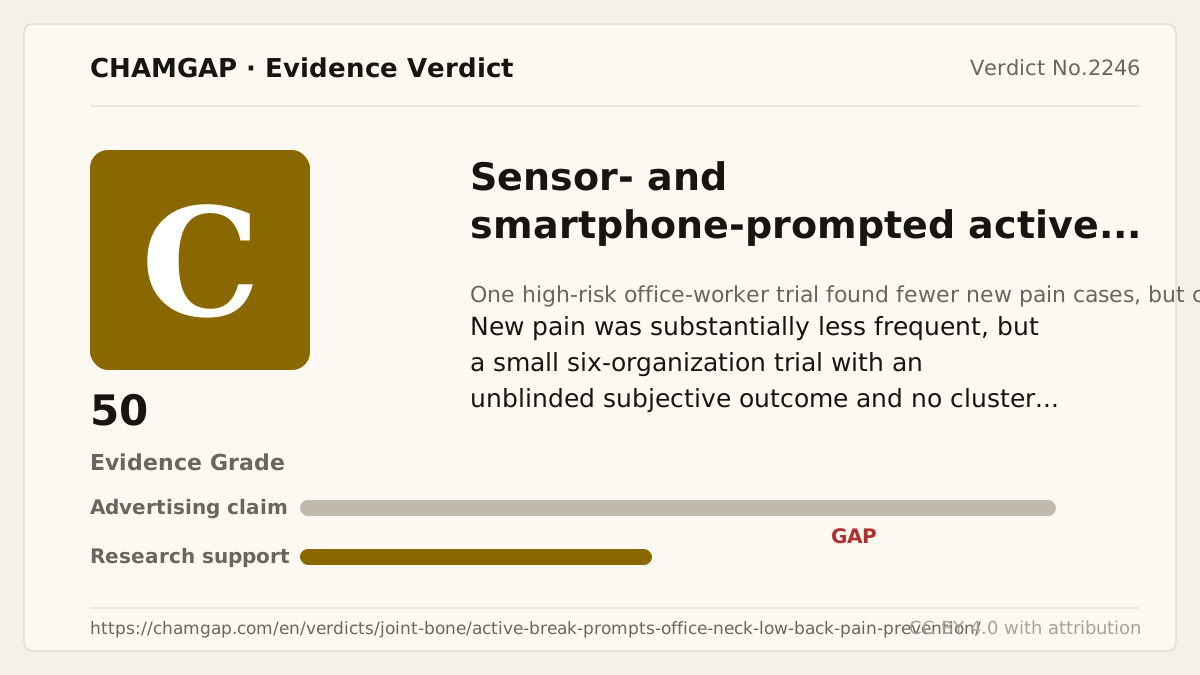
[Chamgap] Active microbreaks x prevention of office-worker neck and low-back pain — Evidence Grade C·50. 1 cited sources checked. Source: https://chamgap.com/en/verdicts/joint-bone/active-break-prompts-office-neck-low-back-pain-prevention/ · CC BY 4.0CC BY 4.0 — free to use with attribution; do not distort grades, numbers, or verdict meaning.
What this document does and does not do
Chamgap is an information source. It reports what research has and has not confirmed; it does not tell readers what to take or buy. That decision belongs to readers and, when needed, medical or legal professionals. This verdict reflects literature available up to the search date and may change as new research appears. Nothing here is medical advice.