
Acetaminophen,
does it really help with Faster recovery and improved pain and function in acute nonspecific low back pain?
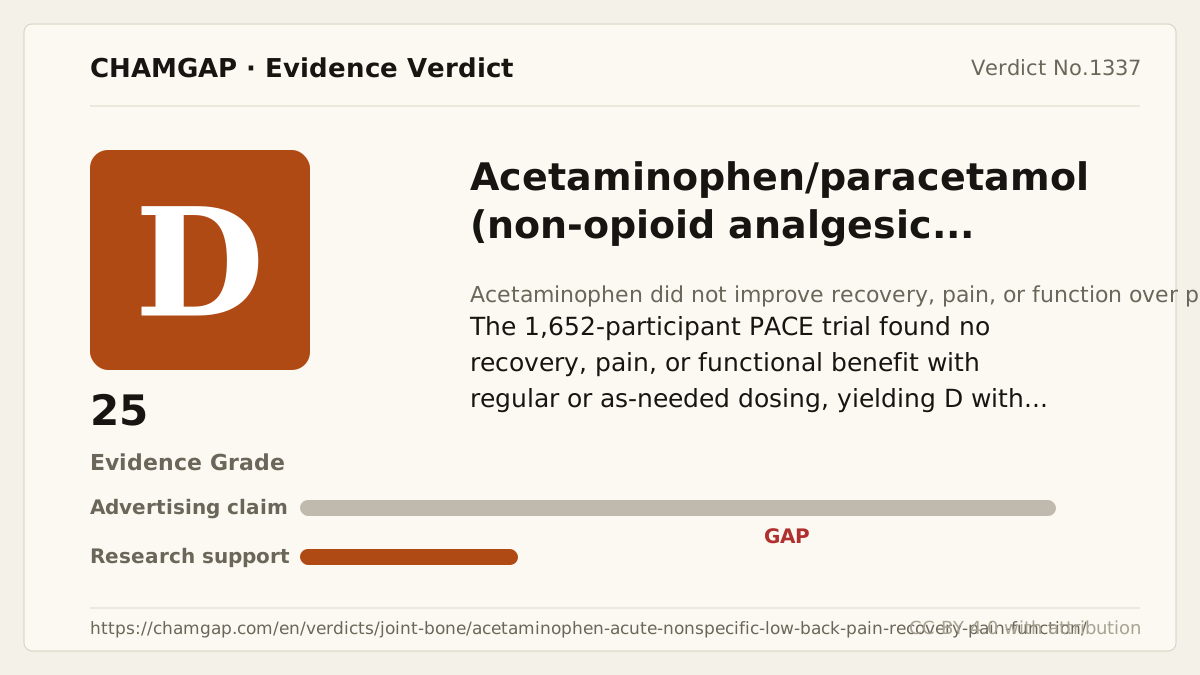
research showsAcetaminophen is rated D because it did not improve recovery, pain, or function over placebo in acute nonspecific low back pain. In the 1,652-participant PACE trial, median recovery was 17 days with regular dosing, 17 days with as-needed dosing, and 16 days with placebo, while pain and function also did not differ. Separate verdicts for osteoarthritis or tension-type headache were not mixed into this indication.
ads claimMarketing extends a general analgesic reputation into faster recovery and restored function in acute low back pain. The large indication-specific trial did not support that claim.
Useful facts when choosing a product
- Acetaminophen is a nonprescription analgesic and antipyretic, but faster recovery from acute nonspecific low back pain requires indication-specific evidence.
- It appears in many combination cold and pain products, so total intake must be checked and the labeled maximum must not be exceeded.
- Overdose, alcohol use, and liver disease increase the risk of severe hepatotoxicity.
Chamgap Semantic Classification Code
Candidate index · review held
M.acetaminophen-paracetamol.UNK.faster-recovery-and-improved-pain-and-function-in-acute-nonspecific-low-back-pain.improve.placeboMedicinal interventions > Acetaminophen/paracetamol > Unknown > Faster recovery and improved pain and function in acute nonspecific low back pain > Improvement claim > Placebo
An automated migration candidate, not an issued permanent code; exact claim scope remains under review. This machine-generated migration candidate helps retrieval but is not a permanent assignment. The original verdict ID and URL remain authoritative.
What the research actually shows
Williams and colleagues conducted PACE across 235 Sydney primary-care centers, randomizing 1,652 participants to regular dosing, as-needed dosing, or placebo for up to four weeks with three months of follow-up. Recovery, defined as pain of 0 or 1 for seven consecutive days, took a median 17, 17, and 16 days; the hazard ratio was 0.99 for regular dosing versus placebo and 1.05 for as-needed dosing versus placebo. Secondary pain, disability, function, global-change, and sleep outcomes also did not differ. A Cochrane review supported the conclusion of no benefit over placebo for acute low back pain.
Why this is classified as D (25)
The 1,652-participant placebo-controlled PACE trial found no difference in recovery time, pain, or function with regular or as-needed dosing, yielding D with 25 points.
Counterpoint. A person may use it for another pain or fever indication, but should not expect it to accelerate recovery from acute nonspecific low back pain.
Rejudgment record. Cross-check applied — Applied D because the large 1,652-participant placebo-controlled PACE trial found regular and as-needed dosing ineffective for recovery, pain, and function
Sub-claim grades by effect
This ingredient is marketed for several effects. A single overall grade blends strong and weak claims together, so each effect is graded separately here. The overall grade reflects the strongest disconfirming or core claim.
| Effect (sub-claim) | Grade | Basis |
|---|---|---|
| Faster recovery from acute nonspecific low back pain | D | PACE found median recovery of 17 days with regular dosing, 17 with as-needed dosing, and 16 with placebo. |
| Pain improvement in acute nonspecific low back pain | D | The large placebo-controlled trial and systematic review found no clinical benefit. |
| Functional improvement in acute nonspecific low back pain | D | Secondary function and disability outcomes did not differ from placebo. |
Cross-check — AI research and Codex final gate
Evidence Table
| Study | Design | Sample | Funding | Endpoint | Result | Weight |
|---|---|---|---|---|---|---|
| PACE trial (Williams CM et al.). 2014 | Multicenter double-blind double-dummy randomized placebo-controlled trial | 1,652 participants, up to 4 weeks of treatment and 3 months of follow-up | Australian NHMRC and GlaxoSmithKline Australia | Time to recovery from pain; secondary pain, disability, and function outcomes | Recovery at 17, 17, and 16 days, adjusted p=0.79; no secondary-outcome differences | Large key direct null evidence |
| Saragiotto BT et al. Cochrane review. 2016 | Systematic review of randomized trials | Three low-back-pain trials with 1,825 participants; acute evidence dominated by PACE | Cochrane academic review | Pain, disability, quality of life, and adverse events | No improvement over placebo in pain, disability, or quality of life for acute low back pain | Synthesis confirming the large null result |
Receipt — 2 References
All 2 cited sources were verified for existence at the original page (as of 2026-07-23).
Final verification and publication gate: Codex · Evidence date: 2026-07-23 · Corrections: none
Cite this verdict
[Chamgap] Acetaminophen x recovery, pain, and function in acute nonspecific low back pain — Evidence Grade D·25. 2 cited sources checked. Source: https://chamgap.com/en/verdicts/joint-bone/acetaminophen-acute-nonspecific-low-back-pain-recovery-pain-function/ · CC BY 4.0CC BY 4.0 — free to use with attribution; do not distort grades, numbers, or verdict meaning.
What this document does and does not do
Chamgap is an information source. It reports what research has and has not confirmed; it does not tell readers what to take or buy. That decision belongs to readers and, when needed, medical or legal professionals. This verdict reflects literature available up to the search date and may change as new research appears. Nothing here is medical advice.