
Two whole raw apples, 340 g,
does it really help with Lower LDL cholesterol?
research showsThe verdict is C with 50 points. In a crossover trial entered by 43 adults with mild hypercholesterolemia, the LDL analysis included 38 people and found LDL 0.14 mmol/L lower after 340 g of whole apples than after a sugar- and energy-matched drink. This was one small eight-week comparison, and an exact paired effect size could not be calculated from public data.
ads claimDescriptions of apple pectin and polyphenols are often expanded into a promise that two apples will lower cholesterol enough to matter. Composition and the uncertain clinical effect size are not equivalent.
Useful facts when choosing a product
- Pectin is a major soluble fiber in apples, and human evidence supports LDL lowering by soluble fiber.
- The trial used 340 g of skin-on Renetta Canada apples and a sugar- and energy-matched apple drink rather than no treatment.
- Verdict 216 is C with 47 points and verdict 1120 is ?; both concern apple cider vinegar. Verdict 433 is C with 44 points and concerns Annurca apple extract, not whole fruit.
Chamgap Semantic Classification Code
Candidate index · review held
F.two-whole-raw-apples-with-skin.food.ldl-cholesterol.reduce.UNKFoods and beverages > Two whole raw apples with skin > Food consumption > LDL cholesterol > Reduction claim > Unknown
An automated migration candidate, not an issued permanent code; exact claim scope remains under review. This machine-generated migration candidate helps retrieval but is not a permanent assignment. The original verdict ID and URL remain authoritative.
What the research actually shows
Koutsos and colleagues ran the randomized crossover study from September 2013 to August 2014. NCT01988389 was posted after the study began. Funding came from AGER, internal Fondazione Edmund Mach funds, and European Union grants; Consorzio Melinda supplied the apples.
Why this is classified as C (50)
This was one small, short crossover trial of the surrogate LDL endpoint. The difference was statistically significant, but exact paired magnitude could not be established, yielding C with 50 points.
Counterpoint. The matched comparator and favorable direction make this more than a null uncontrolled observation.
Rejudgment record. Cross-check applied — Cross-checked the LDL result, comparator, funding, registration timing, and effect-size reconstructability against the article and registry
| Endpoint | S | Surrogate marker - laboratory or imaging measures |
| Replication | R1 | Single confirmatory trial |
| Independence | I2 | Decisive evidence is publicly or non-profit funded |
| Effect size | EX | The clinical size of the effect could not be judged |
| Precision | CX | No pooled confidence interval could be confirmed |
Stored derived and displayed grades match; this is not a current recalculation or validity check (C).
Sub-claim grades by effect
This ingredient is marketed for several effects. A single overall grade blends strong and weak claims together, so each effect is graded separately here. The overall grade reflects the strongest disconfirming or core claim.
| Effect (sub-claim) | Grade | Basis |
|---|---|---|
| Apples contain pectin and soluble fiber lowers LDL | C | This is an established composition and nutrition fact; the grade applies to the 340 g whole-apple claim. |
| Eating 340 g of whole apples meaningfully lowers LDL | C | One small crossover trial was positive, but exact paired magnitude was unavailable. |
Cross-check — AI research and Codex final gate
Evidence Table
| Study | Design | Sample | Funding | Endpoint | Result | Weight |
|---|---|---|---|---|---|---|
| Koutsos A et al., American Journal of Clinical Nutrition, 2020 | Randomized controlled crossover trial, eight weeks per condition | 43 entered; 40 completed; 38 analyzed for LDL | AGER, Fondazione Edmund Mach, and EU funding; apples supplied by Consorzio Melinda | LDL cholesterol | 3.72 versus 3.86 mmol/L, P=0.031; no between-condition CI reported | Direct whole-fruit trial, but small and short with exact paired magnitude unavailable |
Receipt — 3 References
All 3 cited sources were verified for existence at the original page (as of 2026-08-02).
Final verification and publication gate: Codex · Evidence date: 2026-08-02 · Corrections: none
Cite this verdict
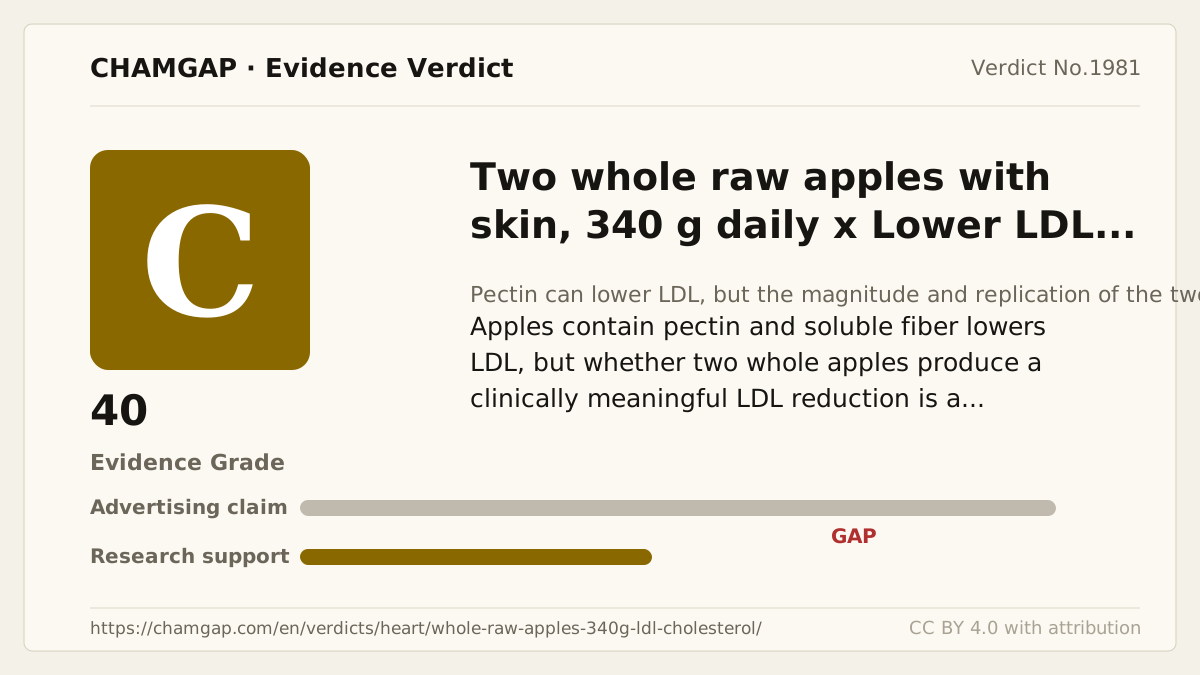
[Chamgap] Two whole raw apples, 340 g x LDL cholesterol — Evidence Grade C·50. 3 cited sources checked. Source: https://chamgap.com/en/verdicts/heart/whole-raw-apples-340g-ldl-cholesterol/ · CC BY 4.0CC BY 4.0 — free to use with attribution; do not distort grades, numbers, or verdict meaning.
What this document does and does not do
Chamgap is an information source. It reports what research has and has not confirmed; it does not tell readers what to take or buy. That decision belongs to readers and, when needed, medical or legal professionals. This verdict reflects literature available up to the search date and may change as new research appears. Nothing here is medical advice.