
Whole natto,
does it really help with Lower cardiovascular mortality?
research showsThe grade is C with 56 points. In the prospective Japanese JPHC cohort, people reporting the highest natto intake had 24% lower cardiovascular mortality in men and 21% lower mortality in women than non-consumers, with both confidence intervals excluding 1. Mortality is a direct binary clinical endpoint, but this was one self-reported observational cohort and cannot establish a causal natto or nattokinase effect.
ads claimAn observed mortality difference cannot be converted into claims that feeding natto prevents death or that isolated nattokinase caused it.
Useful facts when choosing a product
- Whole natto contains soy protein, fiber, vitamin K, and fermentation products.
- The USDA representative value for unsalted natto is about 7 mg sodium per 100 g, or about 3.5 mg per 50 g, roughly 0.2% of the 2,300 mg Daily Value. Seasoning sauce can increase sodium substantially.
- Tyramine can form in fermented soy, but product-specific histamine and tyramine values for foods consumed in this cohort were unconfirmed.
- Nitrite and N-nitroso compounds in those products were unconfirmed.
- Natto is a Japanese traditional food, but an exact first documentary date was not confirmed.
- Verdict 055 is D with 34 points for isolated nattokinase, verdict 407 is C with 48 points for isolated poly-gamma-glutamic acid, and verdict 099 is C with 52 points for a strain isolated from kimchi. They are not whole natto containing soybean matrix, microbes, fiber, vitamin K, and fermentation products together.
Chamgap Semantic Classification Code
Candidate index · review held
F.habitual-whole-natto-intake.oral.cardiovascular-mortality.reduce.UNKFoods and beverages > Habitual whole-natto intake > Oral > cardiovascular mortality > Reduction claim > Unknown
An automated migration candidate, not an issued permanent code; exact claim scope remains under review. This machine-generated migration candidate helps retrieval but is not a permanent assignment. The original verdict ID and URL remain authoritative.
What the research actually shows
The 2020 BMJ JPHC paper and the FFQ validation paper by Ishihara J et al. were checked. Food-group validity correlations for the self-reported 138-item FFQ were generally 0.38 to 0.70 in men and 0.40 to 0.80 in women, but no natto-specific item coefficient was confirmed. Residual confounding by health-seeking dietary patterns and total sodium and multiplicity across soy foods and causes of death remain; the authors warned that residual confounding could attenuate the association.
Why this is classified as C (56)
Mortality is a direct binary clinical endpoint, and both sex-specific confidence intervals excluded 1 in a large public prospective cohort. However, this single observational cohort used a self-reported FFQ with no confirmed natto-item validity coefficient and remains vulnerable to dietary-pattern and sodium confounding and multiplicity, limiting it to C with 56 points.
Counterpoint. A long-term clinical-event trial or stronger causal replications are needed.
Rejudgment record. Cross-check applied — JPHC paper and FFQ validation checked for sample, follow-up, deaths, sex-specific hazard ratios, adjustment, and funding
| Endpoint | H | Hard endpoint - actual events such as death |
| Replication | R1 | Single confirmatory trial |
| Independence | I2 | Decisive evidence is publicly or non-profit funded |
| Effect size | E+ | Meets the clinically important threshold |
Stored derived and displayed grades match; this is not a current recalculation or validity check (C).
Sub-claim grades by effect
This ingredient is marketed for several effects. A single overall grade blends strong and weak claims together, so each effect is graded separately here. The overall grade reflects the strongest disconfirming or core claim.
| Effect (sub-claim) | Grade | Basis |
|---|---|---|
| Whole natto contains protein, fiber, vitamin K, and fermentation products | ? | This is a composition fact, not a graded clinical outcome. |
| Feeding whole natto reduces cardiovascular mortality | C | A prospective association exists, but this was not a randomized causal trial. |
Cross-check — AI research and Codex final gate
Evidence Table
| Study | Design | Sample | Funding | Endpoint | Result | Weight |
|---|---|---|---|---|---|---|
| Katagiri R et al., BMJ, 2020, JPHC prospective cohort | Prospective cohort using food-frequency questionnaire exposure | 92,915 participants, mean 14.8 years, 13,303 deaths | Government research platform centered on Japan's National Cancer Center; no specific company support or conflicts | Cardiovascular mortality | Highest intake versus none: HR 0.76 (95% CI 0.65 to 0.90) in men and 0.79 (0.65 to 0.95) in women | Significant association in a large long-term publicly supported prospective cohort |
Receipt — 4 References
All 4 cited sources were verified for existence at the original page (as of 2026-08-02).
Final verification and publication gate: Codex · Evidence date: 2026-08-02 · Corrections: none
Cite this verdict
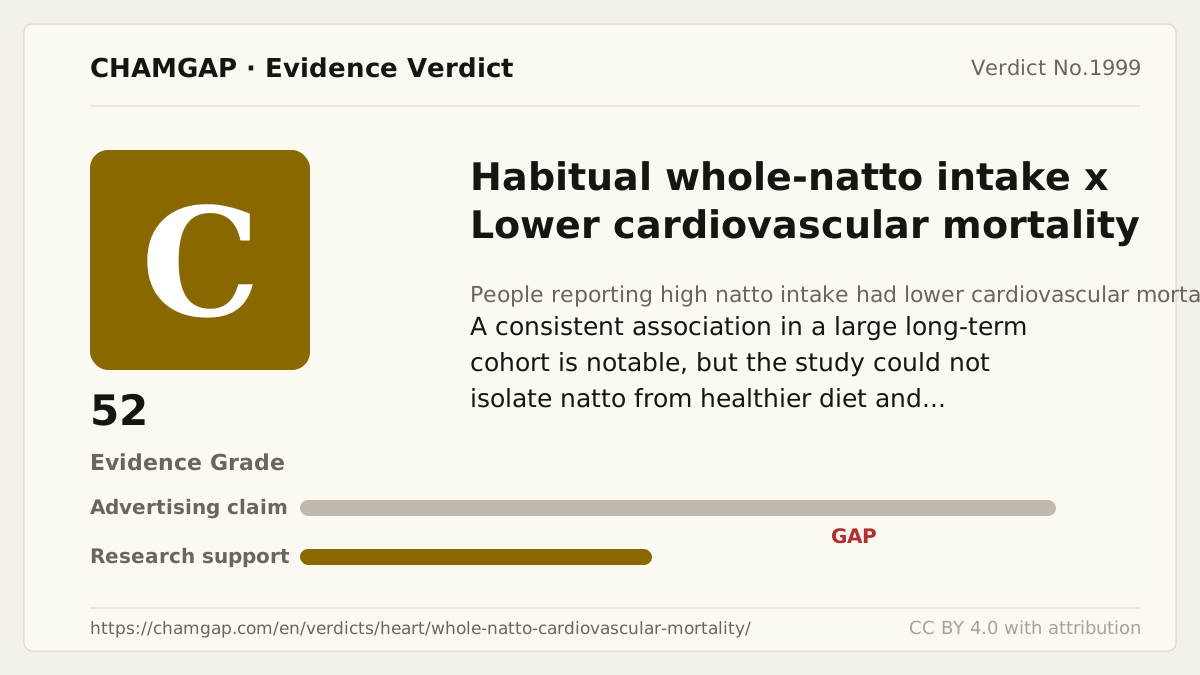
[Chamgap] Whole natto x cardiovascular mortality — Evidence Grade C·56. 4 cited sources checked. Source: https://chamgap.com/en/verdicts/heart/whole-natto-cardiovascular-mortality/ · CC BY 4.0CC BY 4.0 — free to use with attribution; do not distort grades, numbers, or verdict meaning.
What this document does and does not do
Chamgap is an information source. It reports what research has and has not confirmed; it does not tell readers what to take or buy. That decision belongs to readers and, when needed, medical or legal professionals. This verdict reflects literature available up to the search date and may change as new research appears. Nothing here is medical advice.