
Whole eggs,
does it really help with Little or no effect on blood LDL and HDL in adults with hyperlipidemia?
research showsThe grade is D with 28 points. A randomized crossover trial recruited 80 adults with hyperlipidemia but analyzed only 71. Compared with the egg-free period, LDL was 7.71 mg/dL higher with one egg/day and 11.81 mg/dL higher with three. HDL was 1.30 and 0.62 mg/dL higher, neither significant. Combining both lipids into a claim of almost no effect conflicts with the measured LDL rise.
ads claimOne large egg containing about 186 mg cholesterol is a measured composition fact; it is not proof of no blood-LDL effect. Verdict 1130 is ? with no score and concerns isolated oral egg-white albumin and fatigue, not yolk-containing eggs and lipids.
Useful facts when choosing a product
- USDA reports 186 mg cholesterol, 4.8 g fat, and 6.3 g protein in one large egg; the cholesterol is in the yolk.
- The trial added one or three whole eggs daily for four weeks; cooking method was not clearly reported.
- LDL rose from 133.67 in the egg-free period to 141.38 and 145.48 mg/dL, while HDL moved from 59.39 to 60.69 and 60.01 mg/dL.
- Verdict 1130 concerns isolated egg-white albumin and fatigue or serum albumin, not whole eggs and blood lipids.
Chamgap Semantic Classification Code
Candidate index · review held
F.whole-eggs-including-yolk.food.little-or-no-effect-on-blood-ldl-and-hdl-with-hyperlipidemia.assess.UNKFoods and beverages > Whole eggs including yolk > Food consumption > Little or no effect on blood LDL and HDL with hyperlipidemia > Association or change assessment > Unknown
An automated migration candidate, not an issued permanent code; exact claim scope remains under review. This machine-generated migration candidate helps retrieval but is not a permanent assignment. The original verdict ID and URL remain authoritative.
What the research actually shows
Eighty participants were randomized to the order of one-egg and three-egg periods, but five unwilling to eat eggs daily and four with poor adherence were excluded, leaving 71 completers. Each egg period lasted four weeks with a four-week egg-free washout. The article did not report a registry number or prespecified endpoint hierarchy. The full original funding and conflict-of-interest statements could not be verified, so the funding source could not be established. There is also no basis to assert American Egg Board funding.
Why this is classified as D (28)
LDL rose significantly by a conventionally small magnitude while HDL remained null, but the evidence is one four-week completer crossover study without paired between-period intervals, giving D with 28 points.
Counterpoint. D does not imply identical responses in everyone; it means this no-effect claim is not supported in the studied hyperlipidemic adults.
Rejudgment record. Cross-check applied — Effect sizes were calculated from original period means and standard deviations and the actual analysis count, with LDL and HDL both retained
| Endpoint | S | Surrogate marker - laboratory or imaging measures |
| Replication | R1 | Single confirmatory trial |
| Independence | I1 | Mixed funding sources |
| Effect size | E- | Harm increased in the trials |
| Precision | CX | No pooled confidence interval could be confirmed |
Stored derived and displayed grades match; this is not a current recalculation or validity check (D).
Sub-claim grades by effect
This ingredient is marketed for several effects. A single overall grade blends strong and weak claims together, so each effect is graded separately here. The overall grade reflects the strongest disconfirming or core claim.
| Effect (sub-claim) | Grade | Basis |
|---|---|---|
| Whole eggs have little effect on LDL | D | LDL was significantly higher during both one- and three-egg periods than during the egg-free period. |
| Whole eggs have little effect on HDL | D | HDL point estimates rose slightly but not significantly, and equivalence was not tested. |
Cross-check — AI research and Codex final gate
Evidence Table
| Study | Design | Sample | Funding | Endpoint | Result | Weight |
|---|---|---|---|---|---|---|
| Putadechakum S et al. 2013 | Random-sequence three-period crossover trial | 80 recruited and randomized; 71 completers analyzed | Funding source could not be established because the full original funding and conflict statements were not verified | LDL and HDL after four-week egg-free, one-egg/day, and three-egg/day periods | LDL 133.67±36.08, 141.38±38.23, 145.48±39.33 mg/dL; HDL 59.39±14.34, 60.69±12.20, 60.01±12.56 mg/dL | Direct feeding evidence limited by small size, short duration, and completer analysis |
Receipt — 3 References
All 3 cited sources were verified for existence at the original page (as of 2026-08-03).
Final verification and publication gate: Codex · Evidence date: 2026-08-03 · Corrections: none
Cite this verdict
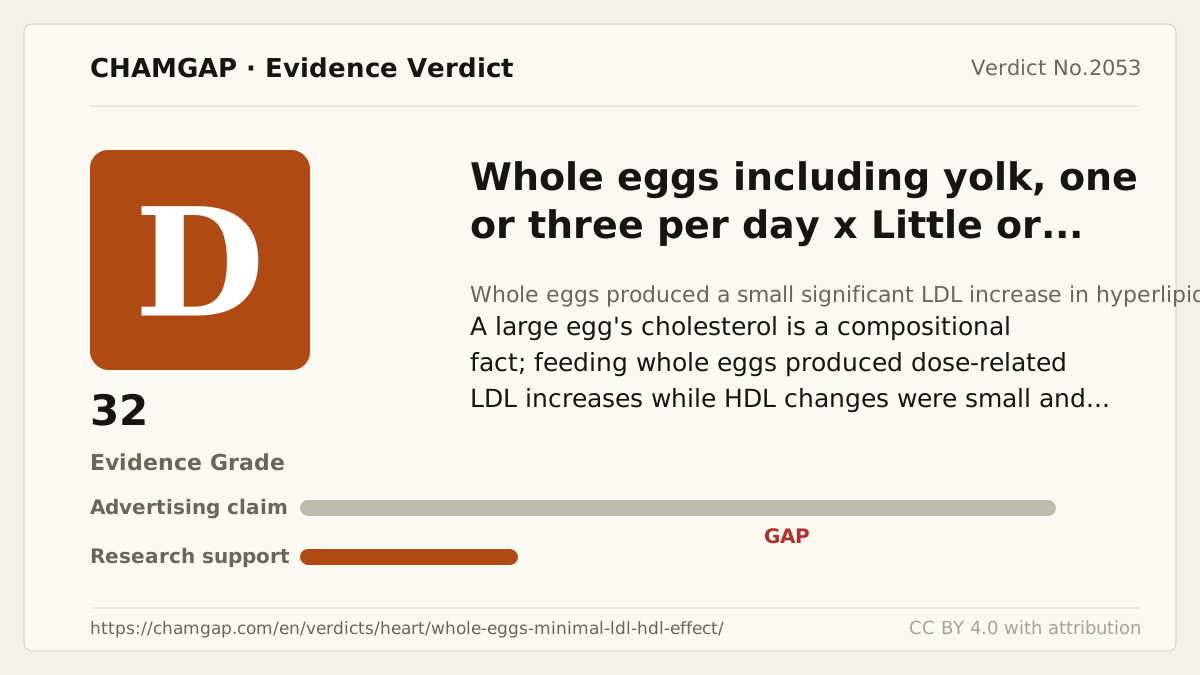
[Chamgap] Whole eggs x the claim of little effect on LDL and HDL — Evidence Grade D·28. 3 cited sources checked. Source: https://chamgap.com/en/verdicts/heart/whole-eggs-minimal-ldl-hdl-effect/ · CC BY 4.0CC BY 4.0 — free to use with attribution; do not distort grades, numbers, or verdict meaning.
What this document does and does not do
Chamgap is an information source. It reports what research has and has not confirmed; it does not tell readers what to take or buy. That decision belongs to readers and, when needed, medical or legal professionals. This verdict reflects literature available up to the search date and may change as new research appears. Nothing here is medical advice.