
Whole eggs,
does it really help with Increased incidence of cardiovascular disease?
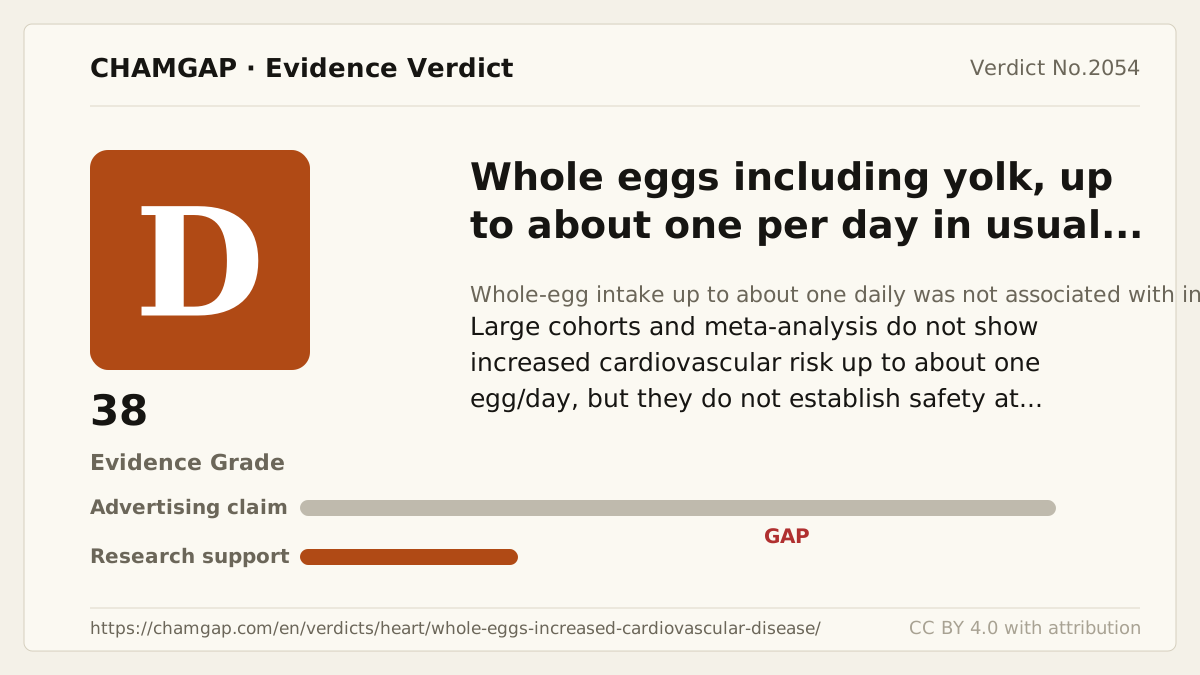
research showsThe grade is D with 34 points. Across three US prospective cohorts of 215,618 people, 14,806 cardiovascular events occurred, but the HR per additional egg/day was 0.98 (95% CI 0.92 to 1.04). An updated meta-analysis of 33 prospective estimates likewise found RR 0.98 (0.93 to 1.03). The evidence does not support increased risk within roughly one egg/day, although no long-term randomized event trial exists.
ads claimA large egg's cholesterol content and the incidence of myocardial infarction or stroke are different questions. Verdict 1130 is ? with no score and concerns isolated egg-white albumin and fatigue, not whole eggs and cardiovascular events.
Useful facts when choosing a product
- USDA reports 186 mg cholesterol, 4.8 g fat, and 6.3 g protein in one large egg.
- Whole-egg intake was updated every two to four years, with the main evidence spanning less than one monthly to about one daily.
- Only 0.20% ate at least two eggs/day at one survey point, limiting precision for sustained higher intake.
- Verdict 1130 concerns isolated egg-white albumin and fatigue or serum albumin, not whole eggs and cardiovascular events.
Chamgap Semantic Classification Code
Candidate index · review held
F.whole-eggs-including-yolk.oral.incidence-of-cardiovascular-disease.increase.UNKFoods and beverages > Whole eggs including yolk > Oral > incidence of cardiovascular disease > Increase claim > Unknown
An automated migration candidate, not an issued permanent code; exact claim scope remains under review. This machine-generated migration candidate helps retrieval but is not a permanent assignment. The original verdict ID and URL remain authoritative.
What the research actually shows
The Nurses’ Health Study, NHS II, and Health Professionals Follow-Up Study followed 215,618 participants for up to 32 years and repeated food-frequency assessment every two to four years. In 1998-99, only 1.24% of 203,364 participants ate at least one egg/day and 0.20% ate at least two, limiting generalization to high intake. Correlation with diet records was 0.77 in women and 0.80 in men, indicating good exposure measurement. Multiple comparisons across exposures, endpoints, and subgroup analyses were not adjusted. Public NIH and Canadian funding was reported, without American Egg Board support.
Why this is classified as D (34)
Large publicly funded cohorts and an updated event meta-analysis did not support increased risk around one egg/day, but no validated magnitude boundary permits refutation and no randomized event trial exists, giving D with 34 points.
Counterpoint. D does not mean that eggs prevent cardiovascular disease or that much higher long-term intake is proven safe.
Rejudgment record. Cross-check applied — Event counts, hazard ratios, pooled risk ratios, high-intake distribution, FFQ validity, and funding were checked in the cohorts and registered meta-analysis
| Endpoint | H | Hard endpoint - actual events such as death |
| Replication | R1 | Single confirmatory trial |
| Independence | I2 | Decisive evidence is publicly or non-profit funded |
| Effect size | E0 | Null |
| Precision | C0 | The confidence interval leaves room for benefit |
Stored derived and displayed grades match; this is not a current recalculation or validity check (D).
Sub-claim grades by effect
This ingredient is marketed for several effects. A single overall grade blends strong and weak claims together, so each effect is graded separately here. The overall grade reflects the strongest disconfirming or core claim.
| Effect (sub-claim) | Grade | Basis |
|---|---|---|
| Up to about one whole egg per day increases cardiovascular disease | D | Large cohorts and the pooled 33-estimate result did not support an increase. |
Cross-check — AI research and Codex final gate
Evidence Table
| Study | Design | Sample | Funding | Endpoint | Result | Weight |
|---|---|---|---|---|---|---|
| Drouin-Chartier JP et al. 2020 three US cohorts | Pooled analysis of three prospective cohorts plus updated systematic review | US cohorts: 215,618 participants and 14,806 events; meta-analysis: 33 estimates, 1,720,108 participants, 139,195 events | Public funding including NIH and Canadian Institutes of Health Research; no American Egg Board support reported | Incident total cardiovascular disease, coronary heart disease, and stroke | US HR 0.98 (0.92-1.04) per egg/day; overall meta-analysis RR 0.98 (0.93-1.03), I²=62.3% | Long-term clinical events with repeated exposure assessment, but observational |
Receipt — 3 References
All 3 cited sources were verified for existence at the original page (as of 2026-08-03).
Final verification and publication gate: Codex · Evidence date: 2026-08-03 · Corrections: none
Cite this verdict
[Chamgap] Whole eggs x increased cardiovascular disease — Evidence Grade D·34. 3 cited sources checked. Source: https://chamgap.com/en/verdicts/heart/whole-eggs-increased-cardiovascular-disease/ · CC BY 4.0CC BY 4.0 — free to use with attribution; do not distort grades, numbers, or verdict meaning.
What this document does and does not do
Chamgap is an information source. It reports what research has and has not confirmed; it does not tell readers what to take or buy. That decision belongs to readers and, when needed, medical or legal professionals. This verdict reflects literature available up to the search date and may change as new research appears. Nothing here is medical advice.