
Whole cheese,
does it really help with Lower mortality and major cardiovascular events?
research showsThe grade is D with 30 points. In the prospective 21-country PURE cohort, the composite of mortality and major cardiovascular events did not significantly differ between people reporting more than one daily serving of cheese and non-consumers. The hazard ratio was 0.88 with a 95% CI of 0.76 to 1.02 and trend p=0.1399.
ads claimProtein, calcium, and ripening products, or positive associations for other dairy foods, cannot be converted into cheese prevention of death and cardiovascular events.
Useful facts when choosing a product
- Cheese contains protein, calcium, and fermentation and ripening products.
- Representative values for 28 g cheddar are about 180 to 202 mg sodium, roughly 9% to 10% of the 2,300 mg Daily Value, and about 5 to 6 g saturated fat.
- Histamine and tyramine can accumulate in aged cheese, requiring caution with monoamine-oxidase inhibitors. Product-specific amounts consumed in PURE were unconfirmed.
- Nitrite and N-nitroso compounds in cheeses consumed in PURE were unconfirmed.
- No East Asian classical record was identified; cheese belongs to ancient West Asian and European dairy traditions.
- Verdict 099 is C with 52 points for a strain isolated from kimchi, verdict 055 is D with 34 points for isolated nattokinase, and verdict 407 is C with 48 points for isolated poly-gamma-glutamic acid. These isolated interventions are not whole cheese containing protein, fat, salt, and ripening products together.
Chamgap Semantic Classification Code
Candidate index · review held
F.habitual-whole-cheese-intake.oral.mortality-and-major-cardiovascular-events.reduce.UNKFoods and beverages > Habitual whole-cheese intake > Oral > mortality and major cardiovascular events > Reduction claim > Unknown
An automated migration candidate, not an issued permanent code; exact claim scope remains under review. This machine-generated migration candidate helps retrieval but is not a permanent assignment. The original verdict ID and URL remain authoritative.
What the research actually shows
The 2018 Lancet PURE paper by Dehghan M et al., its public abstract, and funding statement were checked. Country-specific validated FFQs were used, but no common cheese-item validity coefficient was confirmed. Support came from PHRI, the Canadian Institutes of Health Research, and national governments and foundations; the wider PURE program also received support from pharmaceutical companies including Boehringer Ingelheim and GSK. No evidence was found that a cheese or dairy company directly funded this analysis.
Why this is classified as D (30)
The selected cheese composite was null in a large prospective cohort, while its confidence interval still allows a 24% risk reduction. Cheese intake was entangled with country, income, and overall diet, and no cheese-item validity coefficient applied across all 21 countries; this single observational cohort therefore receives D with 30 points.
Counterpoint. Independent replication needs more precise cheese-type and dietary-pattern measurement.
Rejudgment record. Cross-check applied — Lancet PURE paper, public abstract, and funding statement checked for cheese-specific hazard ratio, confidence interval, trend p value, and support distinctions
| Endpoint | H | Hard endpoint - actual events such as death |
| Replication | R1 | Single confirmatory trial |
| Independence | I1 | Mixed funding sources |
| Effect size | E0 | Null |
| Precision | C0 | The confidence interval leaves room for benefit |
Stored derived and displayed grades match; this is not a current recalculation or validity check (D).
Sub-claim grades by effect
This ingredient is marketed for several effects. A single overall grade blends strong and weak claims together, so each effect is graded separately here. The overall grade reflects the strongest disconfirming or core claim.
| Effect (sub-claim) | Grade | Basis |
|---|---|---|
| Cheese contains protein, calcium, and fermentation and ripening products | ? | This is a composition fact, not a graded clinical outcome. |
| More than one daily serving of whole cheese reduces mortality and major cardiovascular events | D | The cheese-specific composite result was null in the large prospective cohort. |
Cross-check — AI research and Codex final gate
Evidence Table
| Study | Design | Sample | Funding | Endpoint | Result | Weight |
|---|---|---|---|---|---|---|
| Dehghan M et al., Lancet, 2018, PURE prospective cohort | Prospective cohort using country-specific validated FFQs in 21 countries | 136,384 participants, about 9.1 years, 10,567 composite events | PHRI, CIHR, national governments and foundations; pharmaceutical support to wider PURE, no confirmed direct cheese-industry funding | Composite of mortality or major cardiovascular events | Cheese >1 serving/day versus none HR 0.88 (95% CI 0.76 to 1.02), trend p=0.1399 | Direct null cheese-specific result in a large prospective cohort |
Receipt — 5 References
All 5 cited sources were verified for existence at the original page (as of 2026-08-02).
Final verification and publication gate: Codex · Evidence date: 2026-08-02 · Corrections: none
Cite this verdict
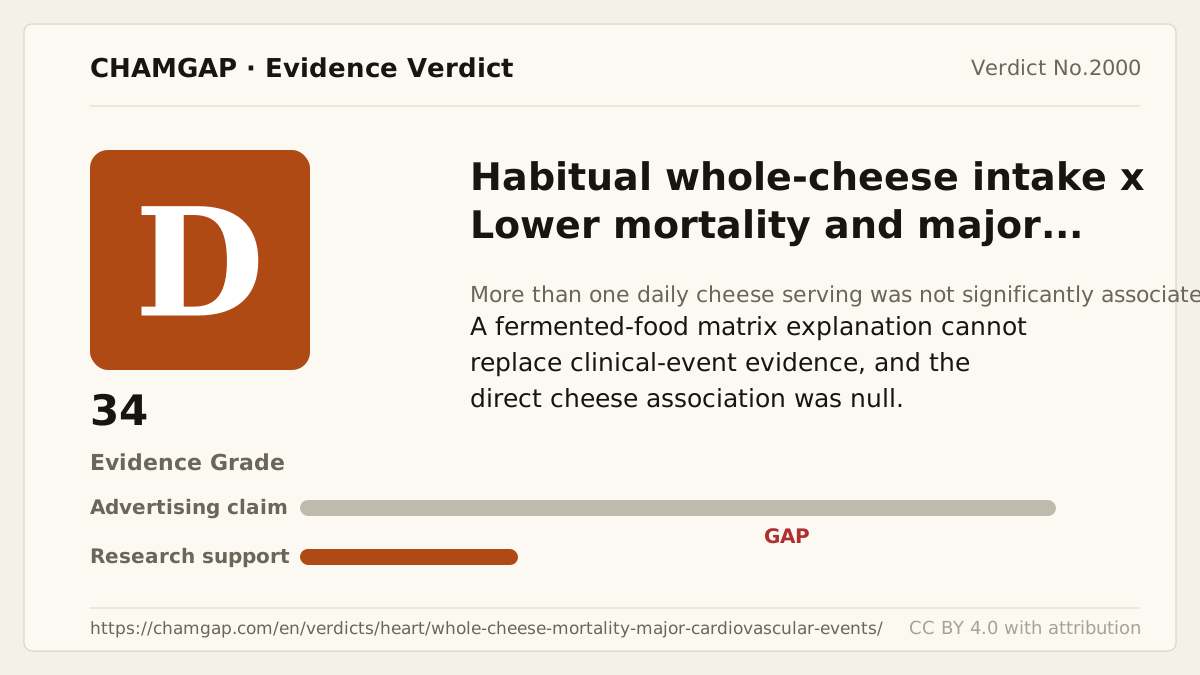
[Chamgap] Whole cheese x mortality and major cardiovascular events — Evidence Grade D·30. 5 cited sources checked. Source: https://chamgap.com/en/verdicts/heart/whole-cheese-mortality-major-cardiovascular-events/ · CC BY 4.0CC BY 4.0 — free to use with attribution; do not distort grades, numbers, or verdict meaning.
What this document does and does not do
Chamgap is an information source. It reports what research has and has not confirmed; it does not tell readers what to take or buy. That decision belongs to readers and, when needed, medical or legal professionals. This verdict reflects literature available up to the search date and may change as new research appears. Nothing here is medical advice.