
Weekend catch-up sleep,
does it really help with Prevention of all-cause mortality and incident cardiovascular disease?
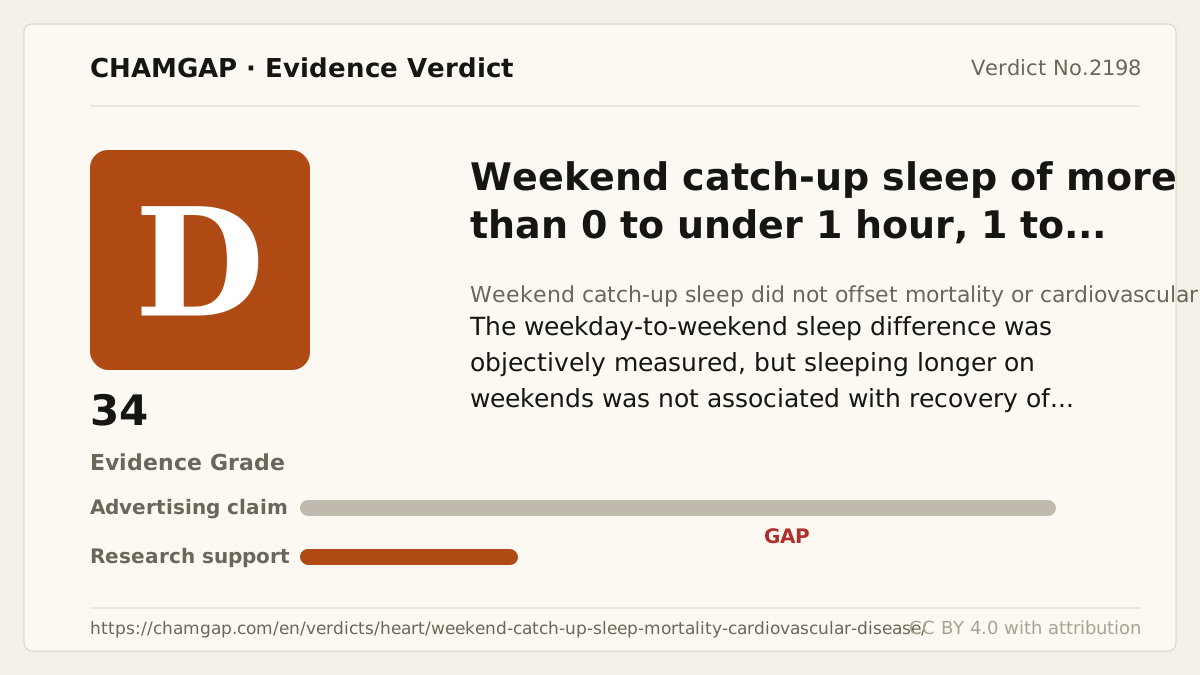
research showsThe grade is D with 34 points. In a UK Biobank cohort with device-measured sleep, at least two hours of weekend catch-up sleep versus none was unrelated to all-cause mortality, HR 1.17 (95% CI 0.97-1.41), or incident cardiovascular disease, HR 1.05 (0.94-1.18). Restriction to people sleeping under six hours on weekdays also found no benefit.
ads claimWeekend relief from sleepiness is not the same as reversing long-term event risk from chronic weekday sleep loss.
Useful facts when choosing a product
- Catch-up sleep was calculated as weekend mean sleep duration minus weekday mean sleep duration.
- Valid accelerometry required at least three weekdays and two weekend days.
- Among 36,279 catch-up sleepers, the mean weekend-weekday difference was 57.4 minutes, SD 44.7 minutes.
- The article's cardiovascular category counts sum to 12,108 events, while its dose-response figure caption states 9,092.
Chamgap Semantic Classification Code
Candidate index · review held
UNK.weekend-catch-up-sleep-of-more-than-0-to-under.UNK.all-cause-mortality-and-incident-cardiovascular-disease.prevent.UNKUnknown > Weekend catch-up sleep of more than 0 to under > Unknown > all-cause mortality and incident cardiovascular disease > Occurrence-prevention claim > Unknown
An automated migration candidate, not an issued permanent code; exact claim scope remains under review. This machine-generated migration candidate helps retrieval but is not a permanent assignment. The original verdict ID and URL remain authoritative.
What the research actually shows
Axivity AX3 was worn 24 hours per day for one week, requiring at least three weekdays and two weekend days. Catch-up sleep was weekend mean sleep minus weekday mean sleep. All analyses excluded deaths or incident cardiovascular events in the first 24 months, and results stayed null among weekday sleepers under six hours. The sample was a selected accelerometry subset of UK Biobank. Core support was public NHMRC funding. Authors disclosed pharmaceutical consulting and patent-related conflicts.
Why this is classified as D (34)
A large objective cohort excluding the first 24 months found no prevention association overall or among weekday short sleepers, giving D with 34 points. No prespecified clinical-benefit threshold supports precise disproof.
Counterpoint. A long-term randomized sleep-extension trial among weekday short sleepers is needed for causal inference.
Rejudgment record. Cross-check applied — The Sleep article and tables were checked for accelerometer computation, analytic denominators and events, category-specific hazard ratios, 24-month event exclusion, weekday-short-sleeper analysis, and funding
| Endpoint | H | Hard endpoint - actual events such as death |
| Replication | R1 | Single confirmatory trial |
| Independence | I2 | Decisive evidence is publicly or non-profit funded |
| Effect size | E0 | Null |
| Precision | C0 | The confidence interval leaves room for benefit |
Stored derived and displayed grades match; this is not a current recalculation or validity check (D).
Sub-claim grades by effect
This ingredient is marketed for several effects. A single overall grade blends strong and weak claims together, so each effect is graded separately here. The overall grade reflects the strongest disconfirming or core claim.
| Effect (sub-claim) | Grade | Basis |
|---|---|---|
| Prevention of all-cause mortality by weekend catch-up sleep | D | Every category confidence interval included 1. |
| Prevention of incident cardiovascular disease by weekend catch-up sleep | D | No benefit appeared even among weekday sleepers under six hours. |
Cross-check — AI research and Codex final gate
Evidence Table
| Study | Design | Sample | Funding | Endpoint | Result | Weight |
|---|---|---|---|---|---|---|
| Chaput JP et al., Sleep, 2024 | Prospective UK Biobank accelerometry cohort | Mortality: 73,513 and 2,776 deaths; CVD: 70,518 (12,108 events in the table versus 9,092 in the figure caption); mean 8.0 years | Public funding from the Australian NHMRC | All-cause mortality and incident cardiovascular disease | At least two hours: mortality HR 1.17 (0.97-1.41), CVD HR 1.05 (0.94-1.18) | Core large objective null evidence |
Receipt — 1 References
All 1 cited sources were verified for existence at the original page (as of 2026-08-04).
Final verification and publication gate: Codex · Evidence date: 2026-08-04 · Corrections: none
Cite this verdict
[Chamgap] Weekend catch-up sleep x mortality and cardiovascular prevention — Evidence Grade D·34. 1 cited sources checked. Source: https://chamgap.com/en/verdicts/heart/weekend-catch-up-sleep-mortality-cardiovascular-disease/ · CC BY 4.0CC BY 4.0 — free to use with attribution; do not distort grades, numbers, or verdict meaning.
What this document does and does not do
Chamgap is an information source. It reports what research has and has not confirmed; it does not tell readers what to take or buy. That decision belongs to readers and, when needed, medical or legal professionals. This verdict reflects literature available up to the search date and may change as new research appears. Nothing here is medical advice.