
Vericiguat,
does it really help with Reduced risk of the composite of cardiovascular death or first heart-failure hospitalization when added to standard therapy in symptomatic chronic heart failure with a left ventricular ejection fraction below 45% after recent worsening?
research showsVericiguat is rated B because it modestly reduces the composite risk of cardiovascular death or first heart-failure hospitalization when added to standard therapy in high-risk patients with chronic heart failure, a left ventricular ejection fraction below 45%, and a recent hospitalization or need for intravenous diuretics. In the 5,050-participant phase 3 VICTORIA trial, the primary composite occurred in 35.5% versus 38.5%, HR 0.90 (95% CI 0.82 to 0.98; P=0.02). The absolute difference over the median 10.8-month follow-up gives an NNT of about 34, while an NNT of about 24 is commonly derived from the annualized event-rate difference. Cardiovascular death alone was uncertain, HR 0.93 (95% CI 0.81 to 1.06), the benefit was driven mainly by fewer heart-failure hospitalizations, and evidence rests on one pivotal trial in this selected high-risk population; the result therefore receives B with 68 points rather than A. Hypotension, syncope, anemia, and fetal harm remain separate safety issues.
ads claimPromotion can turn a composite-endpoint result into a claim that the drug reduces heart-failure death or helps every patient with heart failure. The evidence applies to adding it to standard therapy in symptomatic patients with an ejection fraction below 45% after recent worsening; it does not replace foundational therapy.
Useful facts when choosing a product
- Vericiguat is a once-daily oral prescription stimulator of the nitric oxide-soluble guanylate cyclase-cGMP pathway. Verquvo is commonly started at 2.5 mg and titrated to 5 mg and 10 mg as tolerated.
- The directly studied population had symptomatic chronic heart failure, a left ventricular ejection fraction below 45%, and a recent worsening event. The drug is an add-on option rather than a replacement for appropriate diuretics and foundational heart-failure therapies.
- Hypotension, syncope, and anemia can occur, so blood pressure, hemoglobin, and clinical symptoms require attention. Concomitant use with another soluble guanylate cyclase stimulator should be avoided, and use with a PDE-5 inhibitor is not recommended because of hypotension risk.
- Potential fetal harm makes use during pregnancy inappropriate. Patients who can become pregnant need pregnancy assessment and effective contraception during treatment and for the specified period after the last dose; the current product label should determine exact restrictions and duration.
Chamgap Semantic Classification Code
Candidate index · review held
M.vericiguat.UNK.risk-of-the-composite-of-cardiovascular-death-or-first-heart-failure-hospitalization-when-added-to-standard-therapy-in-symptomatic-chronic-heart-failure-with-a-left-ventricular-ejection-fraction-below-45-percent-after-recent-worsening.reduce.MULTIMedicinal interventions > Vericiguat > Unknown > risk of the composite of cardiovascular death or first heart-failure hospitalization when added to standard therapy in symptomatic chronic heart failure with a left ventricular ejection fraction below 45% after recent worsening > Reduction claim > Multiple: primary unresolved
An automated migration candidate, not an issued permanent code; exact claim scope remains under review. This machine-generated migration candidate helps retrieval but is not a permanent assignment. The original verdict ID and URL remain authoritative.
What the research actually shows
Armstrong and the VICTORIA Study Group randomized 5,050 adults with NYHA class II to IV heart failure, an ejection fraction below 45%, and a heart-failure hospitalization within six months or outpatient intravenous diuretics within three months to vericiguat titrated to 10 mg once daily or placebo in addition to guideline-based therapy. Over a median 10.8 months, the primary composite occurred in 897 of 2,526 participants (35.5%) versus 972 of 2,524 (38.5%), HR 0.90; first heart-failure hospitalization occurred in 27.4% versus 29.6%, HR 0.90, whereas cardiovascular death occurred in 16.4% versus 17.5%, HR 0.93 and was not significant. A 2024 synthesis of VICTORIA and VITALITY-HFpEF across the ejection-fraction spectrum likewise found no significant cardiovascular-mortality effect, RR 0.97, reinforcing that this verdict applies specifically to recently worsening heart failure with an ejection fraction below 45%. Manufacturer support does not automatically cap a prescription-drug hard-endpoint trial, but the single pivotal trial, small effect, and uncertain mortality component inform the B grade.
Why this is classified as B (68)
In the 5,050-participant double-blind VICTORIA trial, cardiovascular death or first heart-failure hospitalization occurred in 35.5% versus 38.5%, HR 0.90, a statistically significant result. The effect was modest, cardiovascular death alone was uncertain at HR 0.93 (95% CI 0.81 to 1.06), and evidence is concentrated in one pivotal trial of a recently worsening high-risk population with an ejection fraction below 45%, yielding B with 68 points. Hypotension, syncope, anemia, and pregnancy harm are safety considerations independent of efficacy grading.
Counterpoint. For a patient who recently required hospitalization or intravenous diuretics despite standard therapy, a small relative effect can still be worthwhile. Blood pressure, anemia, kidney function, concomitant medicines, treatment burden, and absolute risk should be reviewed with a heart-failure clinician.
Rejudgment record. New verdict — Gave substantial weight to the significant reduction in a direct composite clinical endpoint in a large phase 3 trial of recently worsening heart failure with an ejection fraction below 45%, while accounting for the modest effect, uncertain cardiovascular mortality alone, and concentration of evidence in one pivotal high-risk-population trial
Sub-claim grades by effect
This ingredient is marketed for several effects. A single overall grade blends strong and weak claims together, so each effect is graded separately here. The overall grade reflects the strongest disconfirming or core claim.
| Effect (sub-claim) | Grade | Basis |
|---|---|---|
| Reduced composite risk of cardiovascular death or first heart-failure hospitalization after recently worsening heart failure with an ejection fraction below 45% | B | VICTORIA was significant at 35.5% versus 38.5%, HR 0.90, but the effect was modest and rests on one pivotal trial. |
| Reduced first heart-failure hospitalization | B | The result was 27.4% versus 29.6%, HR 0.90 (95% CI 0.81 to 1.00), and primarily drove the composite benefit. |
| Reduced cardiovascular death alone | C | The result was 16.4% versus 17.5%, HR 0.93 (95% CI 0.81 to 1.06), so a mortality-alone benefit was not established. |
Cross-check — AI research and Codex final gate
Evidence Table
| Study | Design | Sample | Funding | Endpoint | Result | Weight |
|---|---|---|---|---|---|---|
| Armstrong PW et al.; VICTORIA Study Group. 2020 | Multinational phase 3 randomized double-blind placebo-controlled trial | 5,050 patients with recently worsening chronic heart failure and an ejection fraction below 45% | Supported by Merck Sharp & Dohme and Bayer | Composite of cardiovascular death or first heart-failure hospitalization | 35.5% versus 38.5%; HR 0.90 (95% CI 0.82 to 0.98; P=0.02). Cardiovascular death alone was uncertain, HR 0.93 (95% CI 0.81 to 1.06). | Pivotal large hard-endpoint randomized trial |
| Chen C, Lv J, and Liu C. 2024 | Synthesis of the randomized VICTORIA and VITALITY-HFpEF trials | Patients across the ejection-fraction spectrum in two large trials | Reported no external funding | Trial-specific primary outcomes, cardiovascular mortality, and serious adverse events | The VICTORIA primary outcome favored vericiguat below 45% ejection fraction, but cardiovascular mortality across the full spectrum was not significant, RR 0.97 (95% CI 0.86 to 1.09). | Supporting evidence for scope and mortality uncertainty |
Receipt — 2 References
All 2 cited sources were verified for existence at the original page (as of 2026-07-22).
Final verification and publication gate: Codex · Evidence date: 2026-07-22 · Corrections: none
Cite this verdict
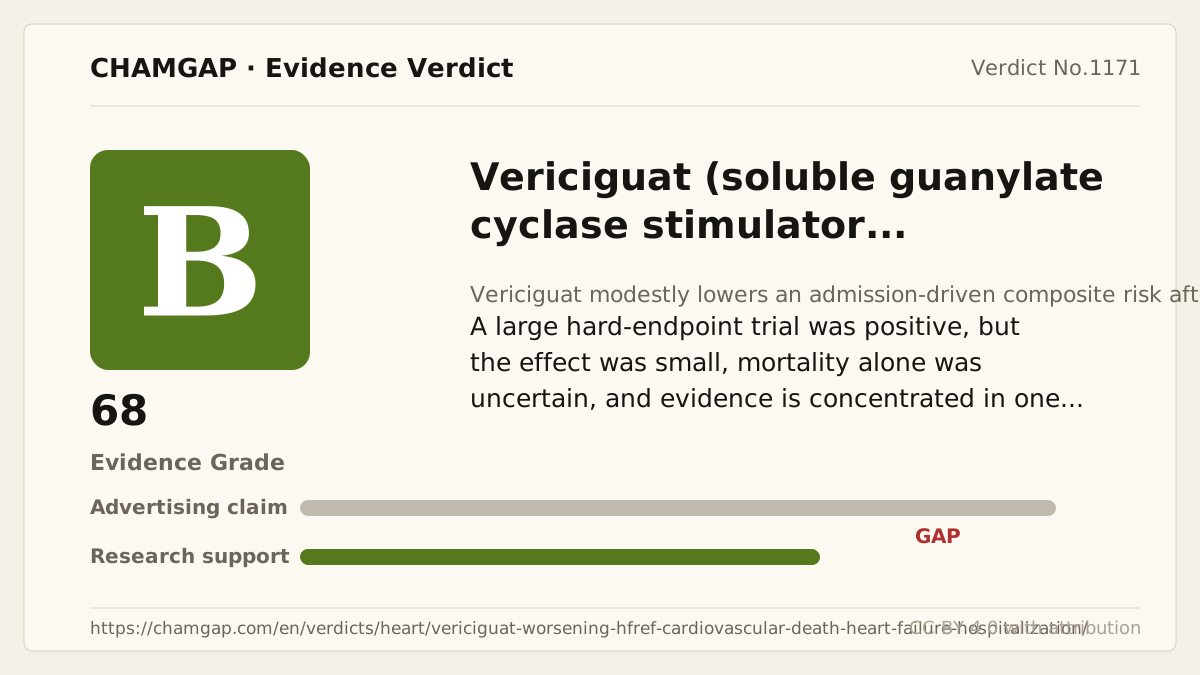
[Chamgap] Vericiguat x reduced cardiovascular-death or first heart-failure-hospitalization risk after worsening heart failure with reduced ejection fraction — Evidence Grade B·68. 2 cited sources checked. Source: https://chamgap.com/en/verdicts/heart/vericiguat-worsening-hfref-cardiovascular-death-heart-failure-hospitalization/ · CC BY 4.0CC BY 4.0 — free to use with attribution; do not distort grades, numbers, or verdict meaning.
What this document does and does not do
Chamgap is an information source. It reports what research has and has not confirmed; it does not tell readers what to take or buy. That decision belongs to readers and, when needed, medical or legal professionals. This verdict reflects literature available up to the search date and may change as new research appears. Nothing here is medical advice.