
Unsalted butter,
does it really help with No worse effect on LDL than olive or coconut oil?
research showsThe grade is D with 34 points. Ninety-six healthy adults aged 50 to 75 were randomized to 50 g daily of unsalted butter, coconut oil, or olive oil for four weeks. Among 91 analyzed for LDL, butter raised LDL by 0.38 mmol/L more than olive oil (95% CI 0.16 to 0.60) and 0.42 more than coconut oil (0.19 to 0.65). Both intervals exclude no difference, so the no-effect claim is unsupported.
ads claimThe tested product was standard commercial organic unsalted butter at 50 g daily for four weeks. Verdict 2000 is D with 30 points and concerns whole cheese and death or major cardiovascular events; this butter-feeding LDL question differs in food form and endpoint.
Useful facts when choosing a product
- Reference-laboratory analysis found that 66% of fatty acids in the tested butter were saturated, versus 94% in coconut oil and 19% in olive oil.
- The measured butter profile included 28% palmitic, 12% stearic, and 11% myristic acid. These are values for the trial product.
- Each fat was supplied at 50 g daily, about 450 kcal, and participants could substitute it for usual fat or add it to their diet.
Chamgap Semantic Classification Code
Candidate index · review held
F.unsalted-butter.food.no-worse-effect-on-ldl-than-olive-or-coconut-oil.assess.UNKFoods and beverages > Unsalted butter > Food consumption > No worse effect on LDL than olive or coconut oil > Association or change assessment > Unknown
An automated migration candidate, not an issued permanent code; exact claim scope remains under review. This machine-generated migration candidate helps retrieval but is not a permanent assignment. The original verdict ID and URL remain authoritative.
What the research actually shows
Ninety-six were randomized, two withdrew before starting, 94 attended baseline, and 91 completed follow-up and LDL analysis. Change scores included 33 butter, 28 coconut-oil, and 30 olive-oil participants. Participants knew allocation, but LDL was measured in a laboratory blinded to treatment. Funding came from the BBC, an NIHR investigator award, and MRC infrastructure; no dairy-industry funding was reported and authors declared no conflicts.
Why this is classified as D (34)
The prospectively registered primary LDL outcome significantly disfavored butter and both intervals excluded no difference or benefit, but evidence is one small four-week surrogate-endpoint trial, giving D with 34 points.
Counterpoint. D does not mean this trial proved more cardiovascular events; it refutes only equivalent LDL effects versus the two plant fats.
Rejudgment record. Cross-check applied — The original tables and registry were checked for randomized and analyzed counts, primary LDL, both pairwise intervals, measured fatty-acid composition, funding, and blinding
| Endpoint | S | Surrogate marker - laboratory or imaging measures |
| Replication | R1 | Single confirmatory trial |
| Independence | I2 | Decisive evidence is publicly or non-profit funded |
| Effect size | E- | Harm increased in the trials |
| Precision | C1 | The confidence interval excludes meaningful benefit |
Stored derived and displayed grades match; this is not a current recalculation or validity check (D).
Sub-claim grades by effect
This ingredient is marketed for several effects. A single overall grade blends strong and weak claims together, so each effect is graded separately here. The overall grade reflects the strongest disconfirming or core claim.
| Effect (sub-claim) | Grade | Basis |
|---|---|---|
| Butter and olive oil have the same LDL effect | D | Butter raised LDL by 0.38 mmol/L more and the interval excluded zero. |
| Butter and coconut oil have the same LDL effect | D | Butter raised LDL by 0.42 mmol/L more and the interval excluded zero. |
Cross-check — AI research and Codex final gate
Evidence Table
| Study | Design | Sample | Funding | Endpoint | Result | Weight |
|---|---|---|---|---|---|---|
| Khaw KT et al. 2018 COB | Randomized open-label parallel four-week feeding trial with blinded laboratory assessment | 96 randomized, 94 attended baseline, and 91 completed follow-up and LDL analysis | BBC, NIHR investigator award, and MRC public support; no conflicts declared | Two primary pairwise comparisons of four-week change in LDL | Butter versus olive oil +0.38 mmol/L (95% CI 0.16 to 0.60); butter versus coconut oil +0.42 (0.19 to 0.65); both P<0.0001 | Direct prospectively registered refutation on primary LDL |
Receipt — 2 References
All 2 cited sources were verified for existence at the original page (as of 2026-08-03).
Final verification and publication gate: Codex · Evidence date: 2026-08-03 · Corrections: none
Cite this verdict
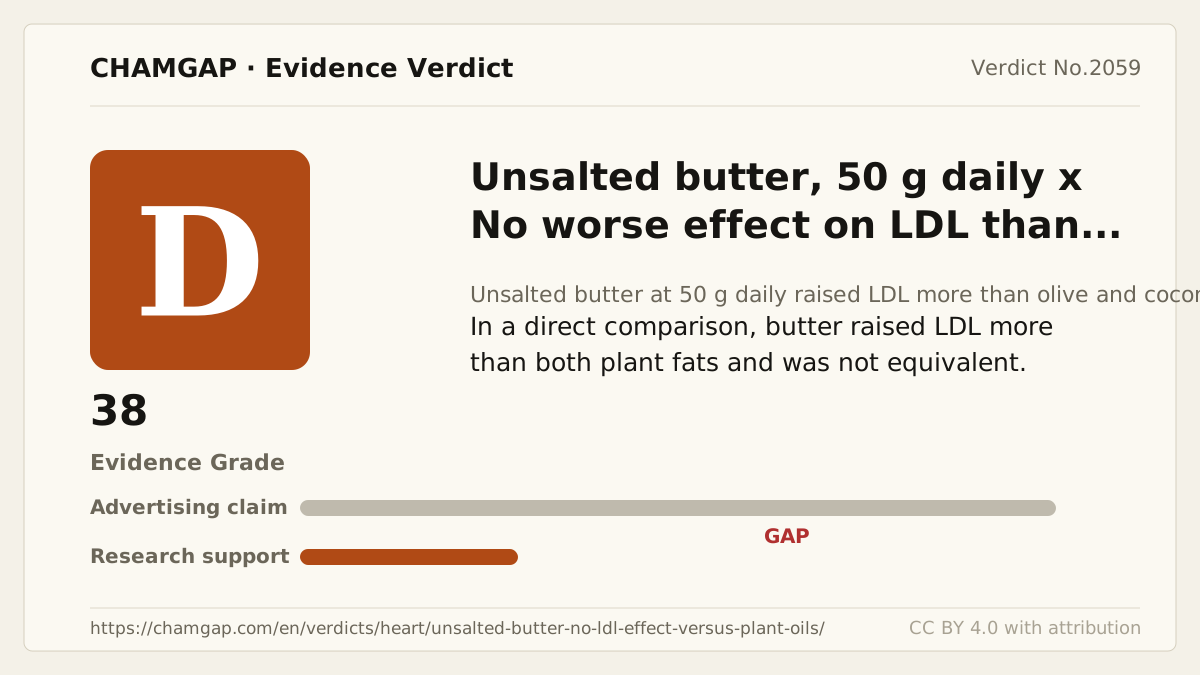
[Chamgap] Unsalted butter x no LDL effect versus plant oils — Evidence Grade D·34. 2 cited sources checked. Source: https://chamgap.com/en/verdicts/heart/unsalted-butter-no-ldl-effect-versus-plant-oils/ · CC BY 4.0CC BY 4.0 — free to use with attribution; do not distort grades, numbers, or verdict meaning.
What this document does and does not do
Chamgap is an information source. It reports what research has and has not confirmed; it does not tell readers what to take or buy. That decision belongs to readers and, when needed, medical or legal professionals. This verdict reflects literature available up to the search date and may change as new research appears. Nothing here is medical advice.