
Tuna and broiled or baked fish,
does it really help with Reduced incidence of heart failure in older adults?
research showsThe grade is C with 56 points. CHS observed 955 heart-failure cases among 4,738 people and HR 0.80, 0.64 to 0.99, for tuna or broiled or baked fish 1-2 times weekly. In WHI, with 84,493 women and 1,858 cases, baked or broiled fish at least five times weekly had HR 0.70, 0.51 to 0.95, while fried fish at least weekly had HR 1.48, 1.19 to 1.84. Both directions are observational and cannot establish causality.
ads claimThis association is not a prescription for one can, species, gram dose, or preparation. Verdict 1680 is F with 3 points for omega-3 capsules and atrial fibrillation; capsules versus food and atrial fibrillation versus heart failure are different interventions and outcomes.
Useful facts when choosing a product
- The pivotal questionnaire did not separate light canned, albacore, or fresh tuna and included tuna salad and casserole. Wild or farmed status and grams per serving were unavailable.
- FDA mean total-mercury monitoring values are 0.126 ppm for canned light tuna, 0.350 ppm for canned albacore, and 0.689 ppm for fresh or frozen bigeye tuna. These are not participant-product or direct methylmercury measurements.
- Broiled or baked fish and fried fish were separate exposures; fried fish at least weekly was associated with higher heart-failure incidence, HR 1.48, 95% CI 1.19-1.84.
- Tuna salad and casserole can differ from plain fish in sodium and added ingredients.
Chamgap Semantic Classification Code
Candidate index · review held
F.tuna.food.incidence-of-heart-failure.reduce.UNKFoods and beverages > Tuna > Food consumption > incidence of heart failure > Reduction claim > Unknown
An automated migration candidate, not an issued permanent code; exact claim scope remains under review. This machine-generated migration candidate helps retrieval but is not a permanent assignment. The original verdict ID and URL remain authoritative.
What the research actually shows
The pivotal cohort followed 4,738 adults aged at least 65 and free of heart failure, with centralized event adjudication. Exposure was frequency rather than grams and combined tuna dishes with other broiled or baked fish. At five or more times weekly, HR was 0.68, 95% CI 0.45 to 1.03, while trend P=.009. The separate WHI observational analysis followed 84,493 women for about 10 years and recorded 1,858 cases. Both cohorts used public research support.
Why this is classified as C (56)
Publicly funded prospective cohorts repeatedly observed fewer clinical heart-failure events, but exposure error and substantial lifestyle confounding limit the claim to C with 56 points.
Counterpoint. C recognizes the association without declaring a specific tuna product preventive.
Rejudgment record. Cross-check applied — The pivotal CHS article, independent WHI cohort, and FDA total-mercury table were reconciled to separate preparation, questionnaire exposure, events, and capsules
| Endpoint | H | Hard endpoint - actual events such as death |
| Replication | R1 | Single confirmatory trial |
| Independence | I2 | Decisive evidence is publicly or non-profit funded |
| Effect size | E+ | Meets the clinically important threshold |
Stored derived and displayed grades match; this is not a current recalculation or validity check (C).
Sub-claim grades by effect
This ingredient is marketed for several effects. A single overall grade blends strong and weak claims together, so each effect is graded separately here. The overall grade reflects the strongest disconfirming or core claim.
| Effect (sub-claim) | Grade | Basis |
|---|---|---|
| Association of tuna and broiled or baked fish with less incident heart failure | C | Two prospective cohorts found the same direction without establishing causality. |
| The same preventive effect from fried fish | D | Fried fish did not show the same direction in these studies. |
Cross-check — AI research and Codex final gate
Evidence Table
| Study | Design | Sample | Funding | Endpoint | Result | Weight |
|---|---|---|---|---|---|---|
| Mozaffarian D et al. 2005 Cardiovascular Health Study | Prospective observational cohort | 4,738 adults free of heart failure; 12 years; 955 incident cases | Primarily public NHLBI/NIH research support | Centrally adjudicated incident heart failure | HR 0.80, 0.64-0.99, for 1-2/week; 0.69, 0.52-0.91, for 3-4/week; 0.68, 0.45-1.03, for at least 5/week; trend P=.009 | Pivotal event cohort limited by mixed FFQ exposure and residual confounding |
| Belin RJ et al. 2011 Women's Health Initiative | Independent prospective observational cohort | 84,493 women; mean 10 years; 1,858 incident cases | Public research support including NIH/NHLBI | Incident hospitalized heart failure | HR 0.70, 95% CI 0.51-0.95, for at least five weekly servings of baked or broiled fish; HR 1.48, 1.19-1.84, for fried fish at least weekly | Independent observational replication in the same direction |
Receipt — 3 References
All 3 cited sources were verified for existence at the original page (as of 2026-08-03).
Final verification and publication gate: Codex · Evidence date: 2026-08-03 · Corrections: none
Cite this verdict
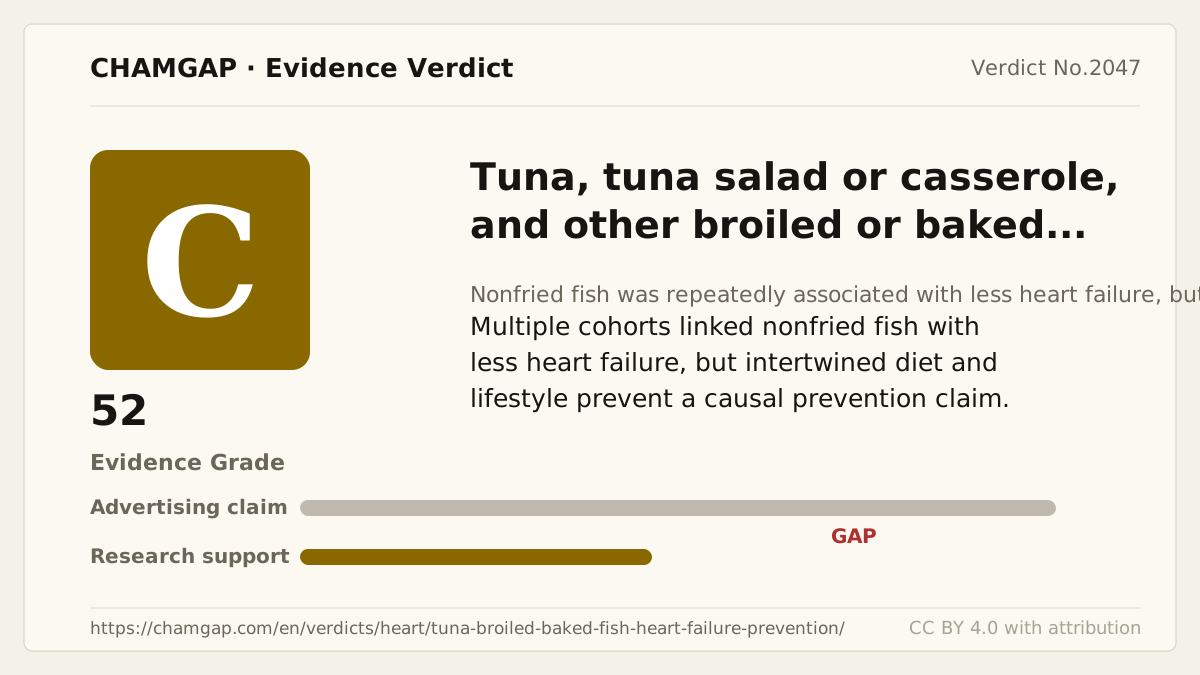
[Chamgap] Tuna and broiled or baked fish x reduced heart-failure incidence — Evidence Grade C·56. 3 cited sources checked. Source: https://chamgap.com/en/verdicts/heart/tuna-broiled-baked-fish-heart-failure-prevention/ · CC BY 4.0CC BY 4.0 — free to use with attribution; do not distort grades, numbers, or verdict meaning.
What this document does and does not do
Chamgap is an information source. It reports what research has and has not confirmed; it does not tell readers what to take or buy. That decision belongs to readers and, when needed, medical or legal professionals. This verdict reflects literature available up to the search date and may change as new research appears. Nothing here is medical advice.