
Tolvaptan,
does it really help with Reduction in cardiovascular death or heart-failure hospitalization in worsening heart failure?
research showsGrade D. Tolvaptan had short-term effects on symptoms and weight but did not reduce long-term death or heart-failure hospitalization. The composite occurred in 871/2072 (42.0%) versus 829/2061 (40.2%), absolute difference +1.8 points; HR 1.04 (95% CI 0.95 to 1.14; P=.55).
ads claimShort-term aquaresis and weight loss must not be presented as improved long-term survival or readmission.
Useful facts when choosing a product
- Vasopressin V2 receptor antagonist.
- Korean use centers on hyponatremia, not HF prognosis.
- Sodium correction and liver function require monitoring.
Chamgap Semantic Classification Code
Candidate index · review held
UNK.tolvaptan.UNK.cardiovascular-death-or-heart-failure-hospitalization-in-worsening-heart-failure.reduce.placeboUnknown > Tolvaptan > Unknown > cardiovascular death or heart-failure hospitalization in worsening heart failure > Reduction claim > Placebo
An automated migration candidate, not an issued permanent code; exact claim scope remains under review. This machine-generated migration candidate helps retrieval but is not a permanent assignment. The original verdict ID and URL remain authoritative.
What the research actually shows
Four gates: no listed defect was identified. Axis 6 B0 evidence ① Allocation concealment: "randomized at 359 ... sites" using a central interactive voice-response system. ② Blinding: "randomized, double-blind, placebo-controlled study". ③ Analysis and missingness: "all 4133 randomized patients" were included in time-to-event analyses; survival censoring was not counted as dropout. ④ Prespecified primary endpoint: "Dual primary end points were all-cause mortality ... and cardiovascular death or hospitalization for heart failure" - consistent with NCT00071331
Why this is classified as D (34)
Large hard-outcome and clean design strengths remain, but one efficacy coprimary endpoint failed while the other only met noninferiority, giving D, 34.
Counterpoint. The null long-term verdict does not erase short-term symptom effects.
Rejudgment record. Axes and scorer agree — Separate results for both EVEREST coprimary endpoints
| Endpoint | H | Hard endpoint - actual events such as death |
| Replication | R1 | Single confirmatory trial |
| Independence | I0 | Evidence comes only from manufacturer studies |
| Effect size | E0 | Null |
| Precision | C0 | The confidence interval leaves room for benefit |
Stored derived and displayed grades match; this is not a current recalculation or validity check (D).
Sub-claim grades by effect
This ingredient is marketed for several effects. A single overall grade blends strong and weak claims together, so each effect is graded separately here. The overall grade reflects the strongest disconfirming or core claim.
| Effect (sub-claim) | Grade | Basis |
|---|---|---|
| Reduced cardiovascular death or HF hospitalization | D | The result was null, 42.0% versus 40.2%. |
| Noninferiority for all-cause mortality | C | The HR upper bound 1.11 was within the 1.25 margin. |
Cross-check — AI research and Codex final gate
Evidence Table
| Study | Design | Sample | Funding | Endpoint | Result | Weight |
|---|---|---|---|---|---|---|
| Konstam MA et al. 2007 EVEREST | Event-driven multicenter double-blind placebo-controlled randomized trial | 4,133 participants (2072/2061) | Sponsored by Otsuka | Coprimary: all-cause mortality; cardiovascular death or HF hospitalization | Mortality 25.9% vs 26.3%, HR 0.98 (0.87 to 1.11), noninferior; efficacy composite 42.0% vs 40.2%, difference +1.8 points, HR 1.04 (0.95 to 1.14), P=.55 | Pivotal large hard-outcome evidence |
Receipt — 1 References
All 1 cited sources were verified for existence at the original page (as of 2026-08-26).
Final verification and publication gate: Codex · Evidence date: 2026-08-26 · Corrections: none
Cite this verdict
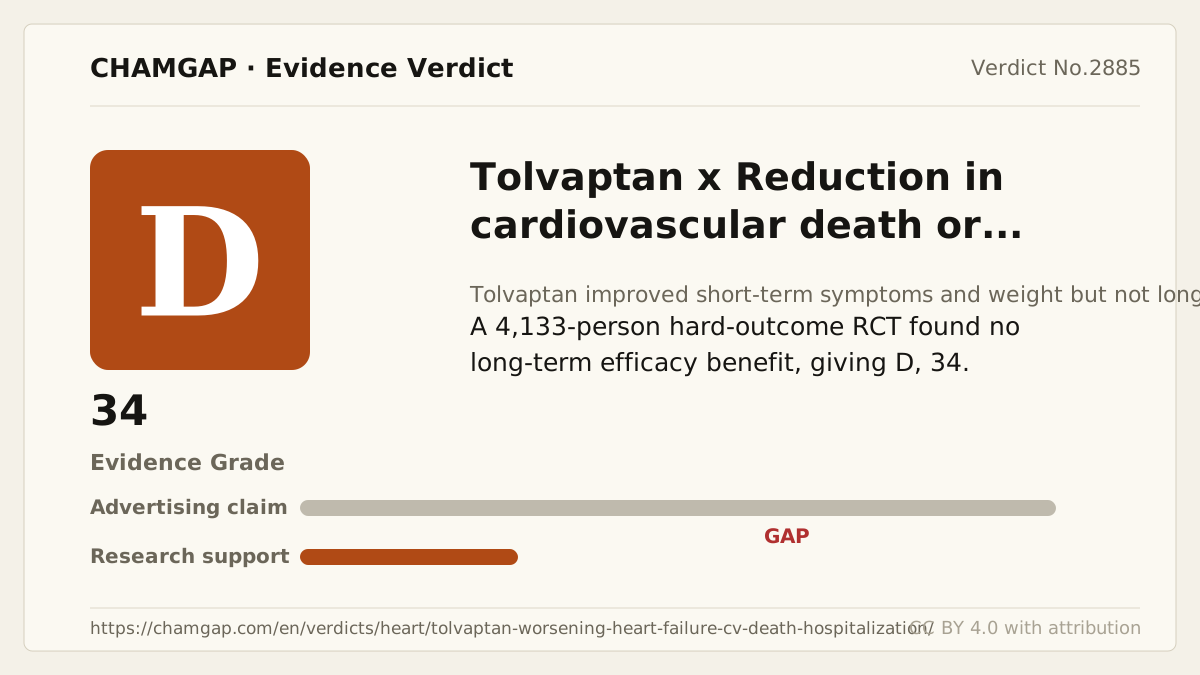
[Chamgap] No Benefit of Tolvaptan for Cardiovascular Death or Heart-Failure Hospitalization in Worsening Heart Failure — Evidence Grade D·34. 1 cited sources checked. Source: https://chamgap.com/en/verdicts/heart/tolvaptan-worsening-heart-failure-cv-death-hospitalization/ · CC BY 4.0CC BY 4.0 — free to use with attribution; do not distort grades, numbers, or verdict meaning.
What this document does and does not do
Chamgap is an information source. It reports what research has and has not confirmed; it does not tell readers what to take or buy. That decision belongs to readers and, when needed, medical or legal professionals. This verdict reflects literature available up to the search date and may change as new research appears. Nothing here is medical advice.