
Ticagrelor,
does it really help with Reduced composite risk of cardiovascular death, myocardial infarction, or stroke and reduced all-cause mortality versus clopidogrel when combined with aspirin in acute coronary syndrome?
research showsTicagrelor is rated B with 72 points: a very large hard-endpoint randomized trial showed lower composite cardiovascular events and all-cause mortality than clopidogrel when each was combined with aspirin for acute coronary syndrome, but both cited papers report the same single trial (PLATO and its bleeding substudy), and replication by different investigators with different funding has not been confirmed, so the axis-2 R1 ceiling of B applies. Among 18,624 PLATO participants, the 12-month primary composite occurred in 9.8% versus 11.7%, HR 0.84 (95% CI 0.77 to 0.92), and all-cause death occurred in 4.5% versus 5.9%, HR 0.78 (95% CI 0.69 to 0.89). Independently funded trials did not reproduce this direction: in the investigator-initiated TICAKOREA trial, the primary endpoint of clinically significant bleeding at 12 months was 11.7% with ticagrelor versus 5.3% with clopidogrel (HR 2.26, 95% CI 1.34 to 3.79), and the ischemic composite of cardiovascular death, myocardial infarction, or stroke was numerically unfavorable at 9.2% versus 5.8% (HR 1.62, 95% CI 0.96 to 2.74); in the publicly funded POPular AGE trial of patients aged 70 or older with non-ST-elevation acute coronary syndrome, clopidogrel caused significantly less bleeding and was noninferior for net clinical benefit (p=0.03). Overall PLATO-defined major bleeding was not significantly different at 11.6% versus 11.2%, but non-CABG major bleeding, fatal intracranial bleeding, dyspnea, and bradyarrhythmic events require attention.
ads claimPromotion can simplify the result into universal superiority over clopidogrel with no additional bleeding concern. The benefit arose within an aspirin-based acute-coronary-syndrome strategy, and non-CABG bleeding, dyspnea, revascularization strategy, individual bleeding risk, and concomitant medicines still matter.
Useful facts when choosing a product
- Ticagrelor is an oral prescription drug that reversibly inhibits the platelet P2Y12 receptor. In acute coronary syndrome, a common regimen is a 180-mg loading dose followed by 90 mg twice daily; the current label and treatment strategy determine the exact dose and duration.
- PLATO established efficacy against clopidogrel on a background of aspirin. Low-dose maintenance aspirin is generally used, and unplanned interruption of antiplatelet therapy can increase thrombotic risk.
- The drug is unsuitable in active pathological bleeding or a history of intracranial hemorrhage, and the treating clinician should set any preoperative interruption. Strong CYP3A inhibitors and inducers also require interaction review.
- Bleeding is the principal safety issue, and dyspnea, ventricular pauses or bradyarrhythmia, and increases in uric acid or creatinine can occur. Overall major bleeding was similar in PLATO, but non-CABG major bleeding was more frequent with ticagrelor.
Chamgap Semantic Classification Code
Candidate index · review held
M.ticagrelor.UNK.composite-risk-of-cardiovascular-death-myocardial-infarction-or-stroke-and-reduced-all-cause-mortality.reduce.activeMedicinal interventions > Ticagrelor > Unknown > composite risk of cardiovascular death, myocardial infarction, or stroke and reduced all-cause mortality > Reduction claim > Active comparator
An automated migration candidate, not an issued permanent code; exact claim scope remains under review. This machine-generated migration candidate helps retrieval but is not a permanent assignment. The original verdict ID and URL remain authoritative.
What the research actually shows
Wallentin and the PLATO Investigators randomized 18,624 patients with acute coronary syndrome, including differing ST-segment presentations and initial management plans, to ticagrelor with a 180-mg loading dose followed by 90 mg twice daily or clopidogrel with a 300-to-600-mg loading dose followed by 75 mg daily; both groups received aspirin. At 12 months, the primary composite was 9.8% versus 11.7%, HR 0.84; myocardial infarction was 5.8% versus 6.9%, vascular death was 4.0% versus 5.1%, and all-cause death was 4.5% versus 5.9%, HR 0.78. Stroke alone was not reduced, so the phrase 'cardiovascular death, myocardial infarction, or stroke reduction' refers to the three-event composite rather than each component separately. Becker and colleagues' PLATO bleeding analysis found similar overall major bleeding but more non-CABG major bleeding. Both citations report the same PLATO trial, so replication counts as one. The verdict therefore records efficacy at the axis-2 R1 ceiling of B alongside separate caution for bleeding, dyspnea, and bradycardia.
Why this is classified as B (72)
In PLATO's 18,624 participants, the 12-month composite of cardiovascular death, myocardial infarction, or stroke was 9.8% versus 11.7%, HR 0.84, and all-cause mortality also fell from 5.9% to 4.5%, HR 0.78. Because the citations rest on one trial reported twice and replication by different investigators with different funding has not been confirmed, the axis-2 R1 ceiling gives B with 72 points. Independently funded TICAKOREA reported significantly more clinically significant bleeding (11.7% versus 5.3%, HR 2.26, 95% CI 1.34 to 3.79) and a numerically unfavorable ischemic composite (9.2% versus 5.8%, HR 1.62, 95% CI 0.96 to 2.74), and POPular AGE reported less bleeding and noninferior net clinical benefit (p=0.03) with clopidogrel, so the PLATO direction has not been independently reproduced. The manufacturer-funding ceiling on axis 3 remains inapplicable under the large prescription-drug hard-endpoint exception. Similar overall major bleeding does not establish safety equivalence for every type of bleeding; non-CABG bleeding, dyspnea, and bradycardia remain separate safety issues.
Counterpoint. Evidence fits patients with acute coronary syndrome whose ischemic risk is high enough and bleeding risk acceptable. Older age, low body weight, prior bleeding, anemia, kidney or liver disease, anticoagulant use, and planned surgery can change the agent and duration choice.
Rejudgment record. New verdict — Evaluated a very large double-blind direct-comparison trial in 18,624 patients with acute coronary syndrome that significantly reduced both the composite of cardiovascular death, myocardial infarction, or stroke and all-cause mortality, but applied the axis-2 R1 ceiling of B because the citations are repeat reports of one trial and independent trials (TICAKOREA, POPular AGE) did not reproduce its direction, while evaluating bleeding, dyspnea, and bradycardia separately as safety outcomes
| Endpoint | H | Hard endpoint - actual events such as death |
| Replication | R1 | Single confirmatory trial |
| Independence | I0 | Evidence comes only from manufacturer studies |
| Effect size | E+ | Meets the clinically important threshold |
Stored derived and displayed grades match; this is not a current recalculation or validity check (B).
Sub-claim grades by effect
This ingredient is marketed for several effects. A single overall grade blends strong and weak claims together, so each effect is graded separately here. The overall grade reflects the strongest disconfirming or core claim.
| Effect (sub-claim) | Grade | Basis |
|---|---|---|
| Reduced composite risk of cardiovascular death, myocardial infarction, or stroke in acute coronary syndrome | A | Among 18,624 PLATO participants, the direct hard endpoint fell from 11.7% to 9.8%, HR 0.84. |
| Reduced all-cause mortality in acute coronary syndrome | A | All-cause mortality fell significantly from 5.9% to 4.5%, HR 0.78. |
| Reduced cardiovascular death in acute coronary syndrome | A | Vascular death fell from 5.1% to 4.0%, consistent with the all-cause mortality direction. |
Cross-check — AI research and Codex final gate
Evidence Table
| Study | Design | Sample | Funding | Endpoint | Result | Weight |
|---|---|---|---|---|---|---|
| Wallentin L et al.; PLATO Investigators. 2009 | Multinational randomized double-blind double-dummy active-controlled trial | 18,624 patients with acute coronary syndrome | Supported by AstraZeneca | Twelve-month composite of cardiovascular death, myocardial infarction, or stroke, and all-cause mortality | Composite endpoint 9.8% versus 11.7%, HR 0.84 (95% CI 0.77 to 0.92); all-cause mortality 4.5% versus 5.9%, HR 0.78 (95% CI 0.69 to 0.89). | Pivotal very large hard-endpoint randomized trial |
| Becker RC et al. 2011 PLATO bleeding analysis | Secondary analysis of prespecified centrally adjudicated bleeding outcomes | 18,624 randomized PLATO participants | Supported by AstraZeneca | Overall, CABG-related, non-CABG major, and fatal bleeding | Overall major bleeding was similar, but non-CABG major bleeding was more frequent with ticagrelor, defining the efficacy-safety trade-off. | Key separate safety analysis |
Receipt — 2 References
All 2 cited sources were verified for existence at the original page (as of 2026-08-11).
Final verification and publication gate: Codex · Evidence date: 2026-08-11 · Corrections: 1
Correction log — 1
Corrections applied to this verdict, in chronological order. Changes are logged, not erased.
- 2026-08-11 · Grade correction for unmet independent-replication requirement — Both cited papers were repeat reports of the same PLATO population (NCT00391872) — the main report and its bleeding substudy. Chamgap's A requires axis-2 R2 (multiple RCTs by different investigators with different funding), and separately recruited independently funded trials failed to reproduce the PLATO direction: TICAKOREA (investigator-initiated, CardioVascular Research Foundation, Korea) found significantly more clinically significant bleeding with ticagrelor (11.7% versus 5.3%, HR 2.26, 95% CI 1.34-3.79) and a numerically unfavorable ischemic composite (9.2% versus 5.8%, HR 1.62, 95% CI 0.96-2.74), while POPular AGE (ZonMw, Netherlands) reported less bleeding and noninferior net clinical benefit (p=0.03) with clopidogrel. Axis 2 is R1, so the ceiling is B. The axes were recorded as B·H·R1·I0·E+·B1 and 72 points were assigned. The effect itself (composite HR 0.84, all-cause mortality HR 0.78) is not denied. Confirmed in the 2026-08-11 internal audit (workflow verification plus concordant Codex cross-check). (grade A→B)
Cite this verdict
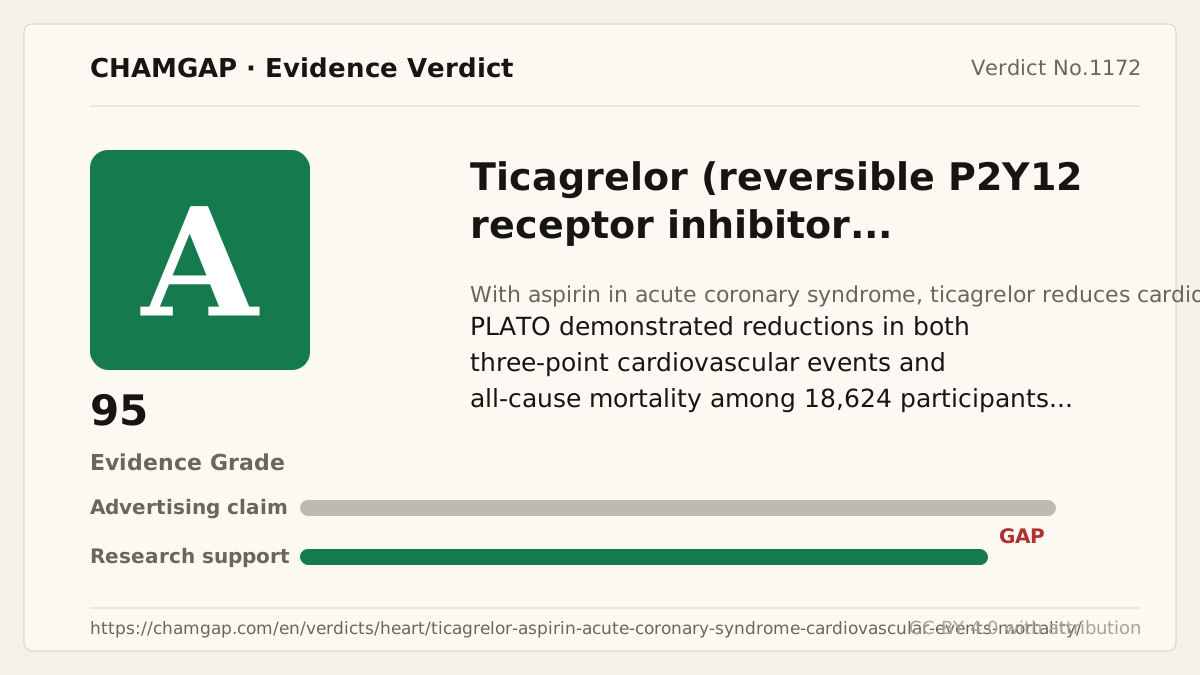
[Chamgap] Ticagrelor x reduced cardiovascular events and all-cause mortality in acute coronary syndrome — Evidence Grade B·72. 2 cited sources checked. Source: https://chamgap.com/en/verdicts/heart/ticagrelor-aspirin-acute-coronary-syndrome-cardiovascular-events-mortality/ · CC BY 4.0CC BY 4.0 — free to use with attribution; do not distort grades, numbers, or verdict meaning.
What this document does and does not do
Chamgap is an information source. It reports what research has and has not confirmed; it does not tell readers what to take or buy. That decision belongs to readers and, when needed, medical or legal professionals. This verdict reflects literature available up to the search date and may change as new research appears. Nothing here is medical advice.