
TAVR,
does it really help with Reduction of death, stroke, and rehospitalization in severe symptomatic aortic stenosis?
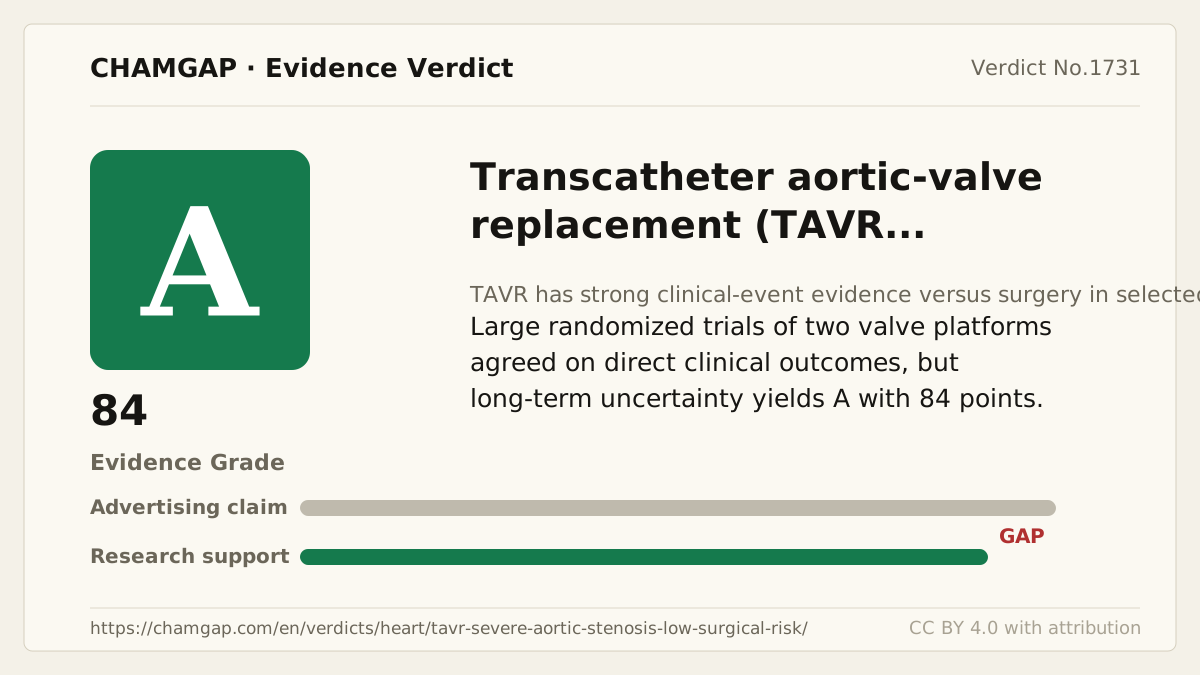
research showsTransfemoral TAVR is rated A in low-surgical-risk patients with severe symptomatic aortic stenosis because it reduced the one-year composite of death, stroke, or rehospitalization versus surgical valve replacement, while a large trial of another valve platform reproduced noninferiority for death or disabling stroke. PARTNER 3 randomized 1,000 patients, but its prespecified primary analysis was the as-treated population of 950 who actually underwent a procedure. The primary endpoint succeeded at 8.5% versus 15.1%, HR 0.54, with P=0.001 for superiority. Long-term durability, anatomy, future coronary access, and procedural complications still require Heart Team selection.
ads claimMarketing can expand smaller incisions and faster recovery into a claim that TAVR is better for everyone. Age, life expectancy, valve and vascular anatomy, coronary disease, and future reintervention must be assessed by a Heart Team.
Useful facts when choosing a product
- TAVR usually delivers a bioprosthetic valve through the femoral artery and expands it within the stenotic native aortic valve.
- The strongest evidence applies to patients with severe symptomatic aortic stenosis whom a Heart Team considers eligible for either surgery or TAVR.
- Hospital stay and early recovery may be shorter than with surgery, but vascular complications, paravalvular leak, pacemaker implantation, and stroke vary by device and patient.
- Younger patients require attention to durability, future coronary access, and a lifetime valve strategy based on individualized imaging.
Chamgap Semantic Classification Code
Candidate index · review held
P.transcatheter-aortic-valve-replacement.transdermal.death-stroke-and-rehospitalization-in-severe-symptomatic-aortic-stenosis.reduce.UNKProcedures, devices and tests > Transcatheter aortic-valve replacement > Transdermal > death, stroke, and rehospitalization in severe symptomatic aortic stenosis > Reduction claim > Unknown
An automated migration candidate, not an issued permanent code; exact claim scope remains under review. This machine-generated migration candidate helps retrieval but is not a permanent assignment. The original verdict ID and URL remain authoritative.
What the research actually shows
PARTNER 3 (Mack et al. 2019, N Engl J Med 380(18):1695-1705) randomized 1,000 patients at 71 centers. The prespecified primary analysis was the as-treated population of 950 who underwent a procedure. The one-year composite was 8.5% with TAVR versus 15.1% with surgery, HR 0.54, 95% CI 0.37 to 0.79, and P=0.001 for superiority. Edwards Lifesciences funded the trial. At five years, the composite was 22.8% versus 27.2%, HR 0.79 (95% CI 0.61 to 1.02), P=0.07. Evolut Low Risk (Popma et al. 2019, N Engl J Med 380(18):1706-1715) was funded by Medtronic, randomized 1,468 patients, and attempted a procedure in 1,403. Death or disabling stroke at 24 months was 5.3% versus 6.7%, meeting noninferiority but not superiority.
Why this is classified as A (84)
The prespecified 950-patient as-treated analysis in PARTNER 3 achieved superiority for the one-year composite, and the 1,468-patient Evolut Low Risk trial reproduced hard-endpoint noninferiority. The rule ②-b ceiling does not apply to these large hard-endpoint randomized trials of a prescription procedure. Restriction to low-surgical-risk patients and loss of statistical superiority at five years yield A with 84 points.
Counterpoint. Some anatomy and the need for concomitant coronary bypass favor surgery. An A grade describes comparative efficacy in appropriately selected low-risk patients and does not replace individualized Heart Team assessment.
Rejudgment record. Cross-check applied — The rule ②-b ceiling does not apply to these large hard-endpoint randomized trials of a prescription procedure. However, PARTNER 3 was restricted to low-surgical-risk patients, and its five-year composite was 22.8% versus 27.2%, HR 0.79 (95% CI 0.61 to 1.02), P=0.07, so statistical superiority was not maintained and the one-year result was not generalized to all severe aortic stenosis or to long-term outcomes.
Sub-claim grades by effect
This ingredient is marketed for several effects. A single overall grade blends strong and weak claims together, so each effect is graded separately here. The overall grade reflects the strongest disconfirming or core claim.
| Effect (sub-claim) | Grade | Basis |
|---|---|---|
| Reduction in the one-year composite of death, stroke, or rehospitalization | A | Superiority versus surgery succeeded in the 950 treated patients in the PARTNER 3 primary analysis. |
| Noninferiority to surgery for death or disabling stroke | A | Evolut Low Risk reproduced 24-month noninferiority with another valve platform. |
| Shorter initial hospitalization and functional recovery | B | Early recovery is favorable, but longer-term differences narrow and depend on selection and procedural complications. |
Cross-check — AI research and Codex final gate
Evidence Table
| Study | Design | Sample | Funding | Endpoint | Result | Weight |
|---|---|---|---|---|---|---|
| Mack MJ et al. 2019 | Multicenter randomized transfemoral TAVR-versus-surgery trial | 1,000 randomized; 950 actually treated, 496 versus 454, in the prespecified primary as-treated analysis | Funded by Edwards Lifesciences | Composite of death from any cause, stroke, or rehospitalization at one year | Primary endpoint succeeded: 8.5% versus 15.1%, HR 0.54 (95% CI 0.37 to 0.79), P<0.001 for noninferiority and P=0.001 for superiority. | Key large direct clinical-outcome evidence |
| Popma JJ et al. 2019 | Multicenter randomized self-expanding TAVR-versus-surgery noninferiority trial | 1,468 randomized; procedure attempted in 1,403; 850 had completed 12-month follow-up at the prespecified adaptive analysis | Funded by Medtronic | Death from any cause or disabling stroke at 24 months | Primary noninferiority endpoint succeeded: 5.3% versus 6.7%, difference -1.4 percentage points, posterior probability of noninferiority above 0.999; superiority failed. | Large replication with another valve platform |
Receipt — 2 References
All 2 cited sources were verified for existence at the original page (as of 2026-07-24).
Final verification and publication gate: Codex · Evidence date: 2026-07-24 · Corrections: none
Cite this verdict
[Chamgap] TAVR x reduction of major clinical events in severe aortic stenosis — Evidence Grade A·84. 2 cited sources checked. Source: https://chamgap.com/en/verdicts/heart/tavr-severe-aortic-stenosis-low-surgical-risk/ · CC BY 4.0CC BY 4.0 — free to use with attribution; do not distort grades, numbers, or verdict meaning.
What this document does and does not do
Chamgap is an information source. It reports what research has and has not confirmed; it does not tell readers what to take or buy. That decision belongs to readers and, when needed, medical or legal professionals. This verdict reflects literature available up to the search date and may change as new research appears. Nothing here is medical advice.