
Tafamidis,
does it really help with Reduction in all-cause mortality and cardiovascular hospitalization in transthyretin amyloid cardiomyopathy?
research showsTafamidis is rated B because direct clinical evidence shows fewer deaths and cardiovascular hospitalizations in ATTR-CM. In the 441-participant Pfizer-funded ATTR-ACT trial, 30-month all-cause mortality was 29.5% versus 42.9% (HR 0.70), and the cardiovascular hospitalization rate ratio was 0.68. The central randomized evidence nevertheless comes from essentially one pivotal trial, without a second independent large placebo-controlled replication, and hospitalization results require care in advanced NYHA class III disease; the grade therefore does not reach A. Adverse events were generally similar to placebo, but diagnosis, timing, cost, and access remain separate considerations.
ads claimPromotion can extend TTR stabilization into claims of amyloid removal or cardiac restoration. The trial showed slower progression and fewer deaths and hospitalizations; it did not show removal of deposited amyloid or equal benefit at every disease stage.
Useful facts when choosing a product
- Tafamidis is an oral TTR stabilizer that inhibits transthyretin tetramer dissociation, and treatment of ATTR-CM requires a prescription and confirmed diagnosis.
- Vyndamax is a 61-mg tafamidis free-acid formulation generally taken once daily; different tafamidis salt formulations should not be interchanged milligram for milligram without specific instructions.
- ATTR-CM may be wild-type or hereditary variant disease, so genetic testing and possible family counseling should be considered after diagnosis.
- Treatment is very expensive and access varies substantially. Cost-effectiveness is separate from clinical efficacy, and expected benefit can vary with disease stage and timing of initiation.
Chamgap Semantic Classification Code
Candidate index · review held
M.tafamidis.UNK.all-cause-mortality-and-cardiovascular-hospitalization-in-transthyretin-amyloid-cardiomyopathy.reduce.placeboMedicinal interventions > Tafamidis > Unknown > all-cause mortality and cardiovascular hospitalization in transthyretin amyloid cardiomyopathy > Reduction claim > Placebo
An automated migration candidate, not an issued permanent code; exact claim scope remains under review. This machine-generated migration candidate helps retrieval but is not a permanent assignment. The original verdict ID and URL remain authoritative.
What the research actually shows
ATTR-ACT assigned 441 participants to tafamidis 80 mg, tafamidis 20 mg, or placebo in a 2:1:2 ratio. All-cause mortality was 78 of 264 with pooled tafamidis and 76 of 177 with placebo, while annual cardiovascular hospitalizations were 0.48 versus 0.70. Declines in six-minute walk distance and KCCQ-OS were also slower. In the open-label extension, mortality was 44.9% with continuous 80-mg treatment and 62.7% after placebo-to-tafamidis crossover (HR 0.59), but this was a selected survivor comparison after the randomized period and included Pfizer investigators.
Why this is classified as B (79)
ATTR-ACT showed strong direct hard-endpoint effects, with an all-cause mortality HR of 0.70 and a cardiovascular hospitalization rate ratio of 0.68. Evidence is nevertheless concentrated in one Pfizer-funded pivotal trial, and the extension is not an independent placebo-controlled replication, yielding B with 79 points. Tolerability, cost, and disease stage were kept separate from efficacy grading.
Counterpoint. For confirmed ATTR-CM, tafamidis is a disease-modifying prescription treatment rather than an unsupported supplement. Evidence favors earlier initiation, and treatment does not replace standard heart-failure care or specialist follow-up.
Rejudgment record. New verdict — Gave high weight to the positive direct mortality and cardiovascular hospitalization endpoints in ATTR-ACT while accounting for concentration in one Pfizer-funded pivotal trial and the lack of an independent placebo-controlled replication in the extension
Sub-claim grades by effect
This ingredient is marketed for several effects. A single overall grade blends strong and weak claims together, so each effect is graded separately here. The overall grade reflects the strongest disconfirming or core claim.
| Effect (sub-claim) | Grade | Basis |
|---|---|---|
| Reduction in all-cause mortality and cardiovascular hospitalization in ATTR-CM | B | A single 441-participant pivotal randomized trial was positive on direct hard endpoints, but no independent large replication exists. |
| Replicated confirmation in an independent large randomized trial | ? | The extension was an open-label crossover comparison from the same program; no independent placebo-controlled replication was identified. |
| Definitively equal efficacy in both wild-type and variant ATTR-CM | C | Both types were included and extension subgroups pointed in the same direction, but subgroup power and precision were limited. |
Cross-check — AI research and Codex final gate
Evidence Table
| Study | Design | Sample | Funding | Endpoint | Result | Weight |
|---|---|---|---|---|---|---|
| Maurer MS et al. ATTR-ACT 2018 | Multicenter randomized double-blind placebo-controlled phase 3 trial | 441 patients with ATTR-CM; 30 months | Pfizer | Hierarchical all-cause mortality and cardiovascular hospitalization, six-minute walk distance, and KCCQ-OS | All-cause mortality HR 0.70 (95% CI 0.51 to 0.96) and cardiovascular hospitalization rate ratio 0.68 (95% CI 0.56 to 0.81), with slower functional and quality-of-life decline. | Key direct hard-endpoint evidence |
| Elliott P et al. ATTR-ACT long-term extension 2022 | Open-label extension comparison after the pivotal trial | 176 continuous-tafamidis and 177 placebo-to-tafamidis participants; median follow-up about 58 months | Pfizer investigators involved; original-trial and extension program | All-cause mortality | Mortality was 44.9% with continuous treatment and 62.7% after crossover, HR 0.59 (95% CI 0.44 to 0.79). | Supportive long-term evidence, not independent placebo-controlled replication |
Receipt — 2 References
All 2 cited sources were verified for existence at the original page (as of 2026-07-20).
Final verification and publication gate: Codex · Evidence date: 2026-07-20 · Corrections: none
Cite this verdict
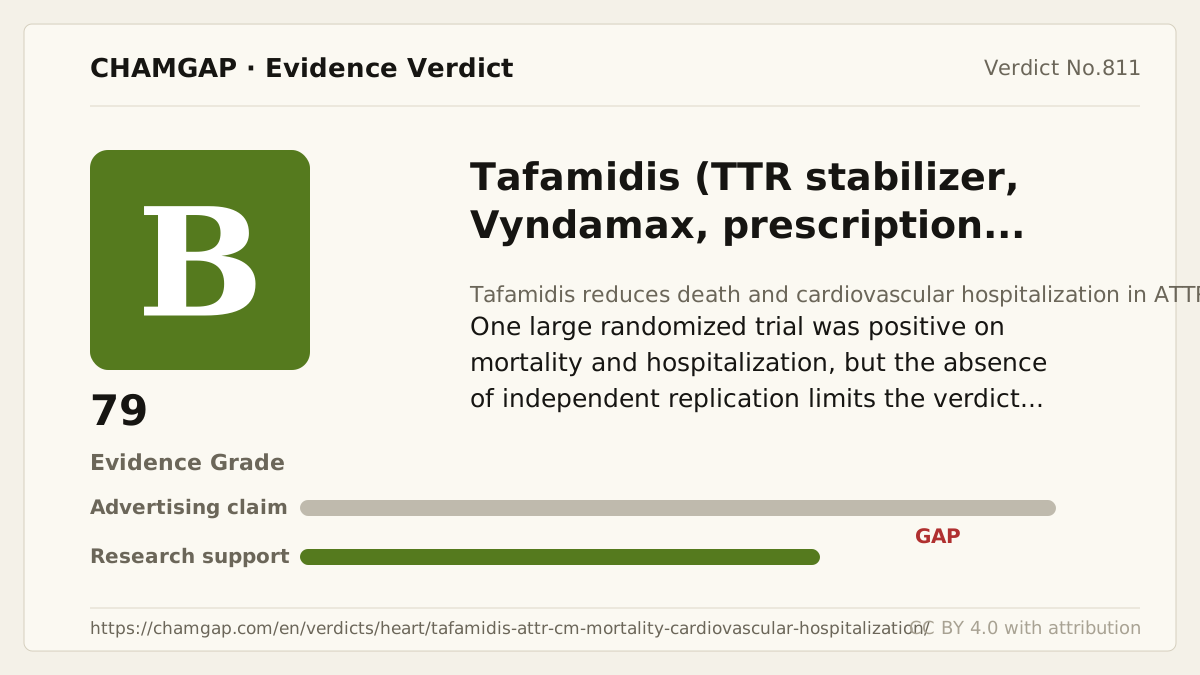
[Chamgap] Tafamidis x reduced mortality and cardiovascular hospitalization in ATTR-CM — Evidence Grade B·79. 2 cited sources checked. Source: https://chamgap.com/en/verdicts/heart/tafamidis-attr-cm-mortality-cardiovascular-hospitalization/ · CC BY 4.0CC BY 4.0 — free to use with attribution; do not distort grades, numbers, or verdict meaning.
What this document does and does not do
Chamgap is an information source. It reports what research has and has not confirmed; it does not tell readers what to take or buy. That decision belongs to readers and, when needed, medical or legal professionals. This verdict reflects literature available up to the search date and may change as new research appears. Nothing here is medical advice.