
Supervised walking exercise,
does it really help with Improved intermittent claudication and walking ability in peripheral artery disease?
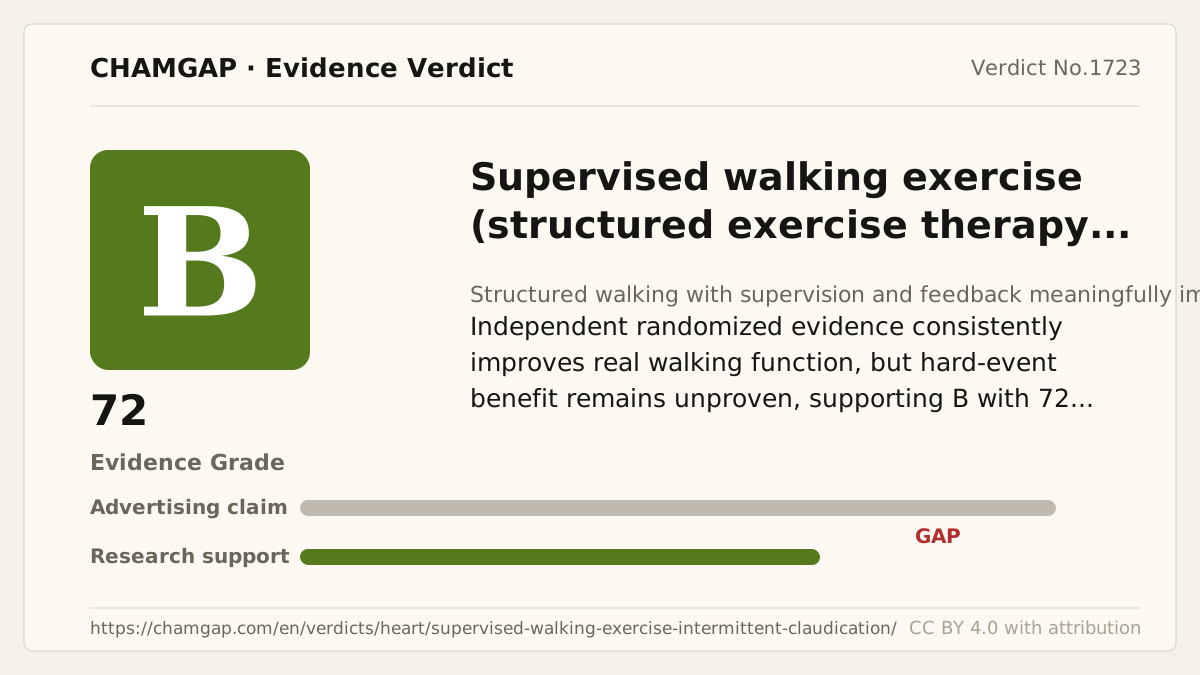
research showsSupervised walking exercise is rated B because it improves peak walking time in intermittent claudication due to peripheral artery disease. CLEVER randomized 111 participants, and the prespecified six-month peak-walking-time endpoint improved 4.6 minutes more than usual care (P<.001). In the Cochrane review of 21 trials and 1,400 participants, three-month maximal walking distance improved by SMD 0.37 (about 120 m) versus home exercise and SMD 0.80 (about 210 m) versus simple walking advice.
ads claimMarketing may turn the result into claims of opening arteries or extending life. Direct evidence establishes improvement in claudication and walking performance; amputation and mortality prevention require separate evidence.
Useful facts when choosing a product
- Programs commonly use repeated bouts of walking and rest about three times weekly, progressing intensity according to claudication.
- Exercise supplements rather than replaces antiplatelet therapy, lipid management, smoking cessation, and other standard care.
- Evidence is stronger for programs with clinical supervision and feedback than for simple walking advice.
- Chest pain, rest pain, wounds, or rapid deterioration warrant clinical assessment before exercise.
Chamgap Semantic Classification Code
Candidate index · review held
X.supervised-walking-exercise.behavioral.intermittent-claudication-and-walking-ability-in-peripheral-artery-disease.improve.usual-careBehaviors, exposures and policies > Supervised walking exercise > Behavioral delivery > intermittent claudication and walking ability in peripheral artery disease > Improvement claim > Usual care
An automated migration candidate, not an issued permanent code; exact claim scope remains under review. This machine-generated migration candidate helps retrieval but is not a permanent assignment. The original verdict ID and URL remain authoritative.
What the research actually shows
CLEVER randomized 111 participants among optimal medical care, supervised exercise, and stenting. Six-month data were available for 20, 38, and 41 participants respectively, totaling 99, and conclusions persisted in the multiple-imputation intention-to-treat analysis of 111. Changes in peak walking time were 1.2, 5.8, and 3.7 minutes, with supervised exercise versus medical care at P<.001. The 2018 Cochrane review included 21 trials and 1,400 participants; at three months maximal walking distance improved by SMD 0.37 (about 120 m) versus home exercise and SMD 0.80 (about 210 m) versus simple walking advice. CLEVER was publicly funded by NHLBI, with in-kind support from Boston Scientific, Cordis, eV3, Otsuka, and others.
Why this is classified as B (72)
Success of CLEVER's functional primary endpoint and replication across 21 trials support B with 72 points; unproven hard-event reduction prevents A.
Counterpoint. Structured home programs may be considered when access is limited, but they should not be equated with unstructured walking advice.
Rejudgment record. Cross-check applied — Success of the prespecified peak-walking-time primary endpoint with consistent functional improvement in an independent 21-trial Cochrane synthesis
Sub-claim grades by effect
This ingredient is marketed for several effects. A single overall grade blends strong and weak claims together, so each effect is graded separately here. The overall grade reflects the strongest disconfirming or core claim.
| Effect (sub-claim) | Grade | Basis |
|---|---|---|
| Improved peak walking time and distance | B | CLEVER's primary endpoint and the Cochrane synthesis are consistently positive. |
| Improved pain-free walking distance | B | Multiple supervised-exercise trials improved this direct functional outcome. |
| Improved peripheral-artery-disease-related quality of life | B | Disease-specific quality of life is generally positive, although generic quality-of-life results are less consistent. |
Cross-check — AI research and Codex final gate
Evidence Table
| Study | Design | Sample | Funding | Endpoint | Result | Weight |
|---|---|---|---|---|---|---|
| Murphy TP et al. 2012 (CLEVER) | Multicenter randomized controlled trial | 111 randomized and 111 in the multiple-imputation intention-to-treat analysis; 99 with available six-month data | Public NHLBI funding; stents from Boston Scientific, Cordis, and eV3, cilostazol from Otsuka, and equipment from SonoSite supplied in kind | Change in peak walking time at six months | Primary endpoint succeeded: 5.8 minutes with supervised exercise versus 1.2 with usual care, a 4.6-minute difference, P<.001. | Key direct functional evidence |
| Hageman D et al. 2018 Cochrane review | Systematic review of randomized trials | 21 trials and 1,400 participants | Public United Kingdom NIHR Cochrane Programme Grant funding | Maximal walking distance, pain-free walking distance, and quality of life | At three months, maximal walking distance improved by SMD 0.37 (about 120 m) versus home exercise and SMD 0.80 (about 210 m) versus simple walking advice. | Independent multi-trial replication |
Receipt — 2 References
All 2 cited sources were verified for existence at the original page (as of 2026-07-24).
Final verification and publication gate: Codex · Evidence date: 2026-07-24 · Corrections: none
Cite this verdict
[Chamgap] Supervised walking exercise x improved walking ability in peripheral artery disease — Evidence Grade B·72. 2 cited sources checked. Source: https://chamgap.com/en/verdicts/heart/supervised-walking-exercise-intermittent-claudication/ · CC BY 4.0CC BY 4.0 — free to use with attribution; do not distort grades, numbers, or verdict meaning.
What this document does and does not do
Chamgap is an information source. It reports what research has and has not confirmed; it does not tell readers what to take or buy. That decision belongs to readers and, when needed, medical or legal professionals. This verdict reflects literature available up to the search date and may change as new research appears. Nothing here is medical advice.