
Sublingual nitroglycerin,
does it really help with Rapid short-term relief within minutes of an acute angina attack caused by coronary artery disease?
research showsSublingual nitroglycerin is rated B because it relieves acute angina from coronary artery disease within minutes. Direct acute trials are small and old, but in a 13-person crossover study of exercise-induced angina, nitroglycerin completely relieved pain within ten minutes in 11 of 13 participants while placebo relieved none. In another small randomized trial, five of seven participants had complete relief at two minutes and all were almost pain-free at four minutes. Rapid vasodilation and long clinical use are consistent, but this is not modern large placebo-controlled evidence or proof that the drug improves death or myocardial-infarction prognosis, so the grade is B rather than A.
ads claimIt is wrong to infer that relief of pain means myocardial-infarction risk is resolved or that response to nitroglycerin alone confirms coronary disease. This is short-term symptom relief; persistent or worsening pain requires emergency assessment, and the drug does not replace antiplatelet, lipid-lowering, or reperfusion strategies that affect prognosis.
Useful facts when choosing a product
- At the onset of chest pain, a sublingual tablet is allowed to dissolve under the tongue while the patient is seated and may usually be repeated at five-minute intervals according to the prescription and product label. If pain does not improve after the first dose or worsens, emergency medical help should be requested without delay.
- Combining nitroglycerin with PDE5 inhibitors such as sildenafil, vardenafil, tadalafil, or avanafil, or with riociguat, can cause life-threatening hypotension and is absolutely contraindicated.
- Headache, flushing, dizziness, and orthostatic hypotension are common; it should not be taken while standing because of syncope risk, and hypotension or suspected right-ventricular infarction requires clinical judgment.
- Sublingual tablets are sensitive to light, heat, and moisture and should remain in their original tightly closed container with the expiration date and tablet condition checked; tolerance can develop with repeated or sustained exposure.
Chamgap Semantic Classification Code
Candidate index · review held
M.nitroglycerin.sublingual.rapid-short-term-relief-within-minutes-of-an-acute-angina-attack-caused-by-coronary-artery-disease.relieve.MULTIMedicinal interventions > Nitroglycerin > Sublingual > Rapid short-term relief within minutes of an acute angina attack caused by coronary artery disease > Symptom-relief claim > Multiple: primary unresolved
An automated migration candidate, not an issued permanent code; exact claim scope remains under review. This machine-generated migration candidate helps retrieval but is not a permanent assignment. The original verdict ID and URL remain authoritative.
What the research actually shows
Kattus 1979 induced mild angina with exercise in the same 13 participants and gave sublingual nitroglycerin, chewable isosorbide dinitrate, or placebo on separate days. Nitroglycerin and isosorbide dinitrate relieved pain in most participants within ten minutes, while placebo completely relieved none. Mooss 1989 randomized 13 people who developed chest pain during exercise testing to sublingual nitroglycerin or nifedipine; most nitroglycerin recipients had complete relief within two minutes. The Wei 2011 meta-analysis of 51 nitrate trials and 3,595 patients found better exercise time and fewer weekly attacks during longer-term prophylaxis, but no improvement in quality of life and frequent headache. These data support direct symptom relief and class consistency, not a prognostic benefit.
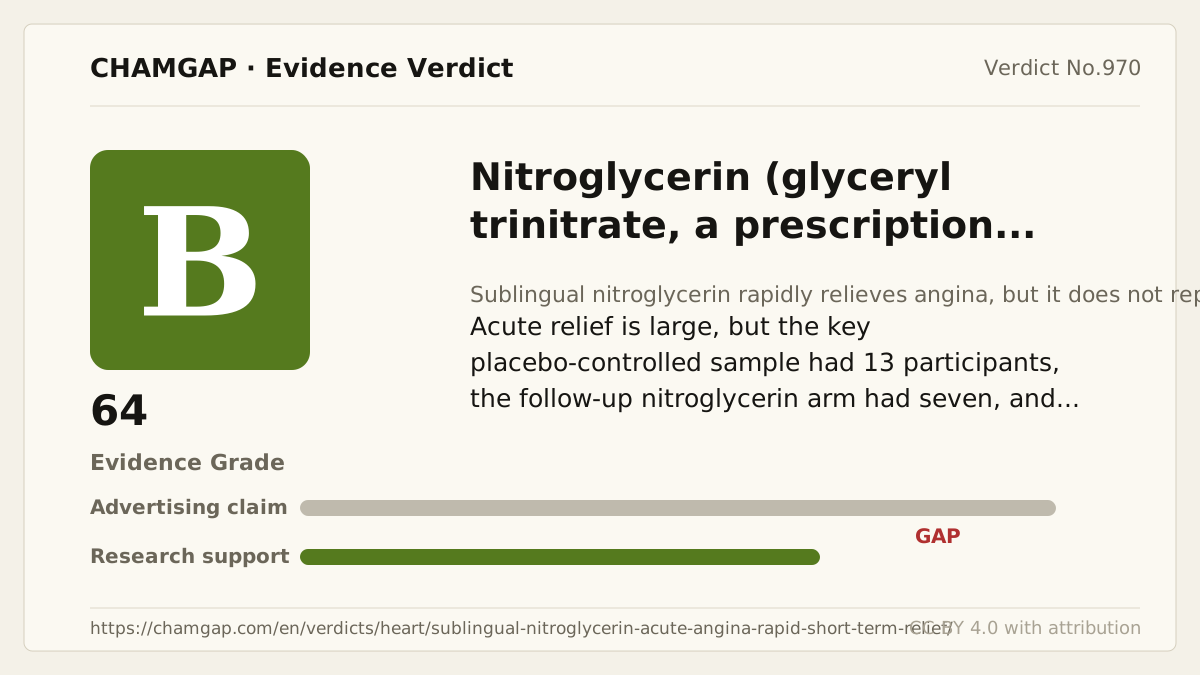
Why this is classified as B (64)
Acute trials showed a large direct patient-centered effect on angina pain within minutes, consistent with rapid sublingual pharmacology and long clinical experience. The key placebo-controlled sample had only 13 participants and the later direct nitroglycerin arm had seven, while the 51-trial synthesis mainly assessed long-term nitrate effects on exercise duration and attack frequency. The large acute effect remains credible, but the small direct evidence base and indirect larger synthesis yield B with 64 points. Hypotension, PDE5 interaction, and tolerance are separate safety issues.
Counterpoint. Patients with prescribed nitroglycerin should know their attack plan in advance. New pain, pain more severe than usual, pain at rest, or pain persisting after the first dose calls for emergency evaluation rather than waiting through repeated doses.
Rejudgment record. Cross-check revision — Adjusted to B with 64 points because the acute relief is large but the key placebo-controlled sample had 13 participants, the later nitroglycerin arm had seven, and the 51-trial meta-analysis mainly addressed long-term nitrate effects on exercise time and attack frequency
Sub-claim grades by effect
This ingredient is marketed for several effects. A single overall grade blends strong and weak claims together, so each effect is graded separately here. The overall grade reflects the strongest disconfirming or core claim.
| Effect (sub-claim) | Grade | Basis |
|---|---|---|
| Short-term pain relief during an acute angina attack | B | Small placebo-controlled and randomized trials showed large direct pain relief, but this is symptomatic benefit rather than improved prognosis or survival. |
| Onset within minutes after sublingual dosing | B | Trials observed relief within two to ten minutes and vasodilation begins in about one to three minutes, but the pivotal direct samples are very small. |
Cross-check — AI research and Codex final gate
Evidence Table
| Study | Design | Sample | Funding | Endpoint | Result | Weight |
|---|---|---|---|---|---|---|
| Kattus AA et al. 1979 | Randomized crossover placebo- and active-controlled trial | Thirteen participants with exercise-induced angina | Inadequately reported; older drug-evaluation study | Complete pain relief during continued exercise and duration of action | Sublingual nitroglycerin produced complete relief within ten minutes in 11 of 13 participants, versus none with placebo. | Direct acute symptomatic efficacy with a tiny sample |
| Mooss AN et al. 1989 | Randomized active-controlled trial in exercise-induced acute angina | Thirteen of 78 screened developed pain; seven initially received nitroglycerin | Inadequately reported | Chest-pain relief at two and four minutes | Five of seven nitroglycerin recipients had complete relief at two minutes, and the remaining two were almost pain-free at four minutes. | Direct confirmation of onset within minutes, limited by a tiny sample |
| Wei J et al. 2011 | Systematic review and meta-analysis of randomized nitrate trials | Fifty-one trials and 3,595 participants | Academic research from Chinese institutions | Exercise duration, angina attacks, nitroglycerin use, quality of life, and headache | Long-term nitrates improved exercise duration and attack frequency but not quality of life, and 51.6% reported headache. | Supports class symptom efficacy but is indirect for acute sublingual relief |
| Oliver JJ et al. 2009 | Two double-blind placebo-controlled randomized crossover interaction studies | Thirty-three healthy men and 20 men with stable angina | Academic clinical-pharmacology research | Blood-pressure interaction of sublingual GTN after sildenafil | In patients with angina, GTN after sildenafil caused greater blood-pressure reductions than GTN after placebo. | Key safety-interaction evidence |
Receipt — 5 References
All 5 cited sources were verified for existence at the original page (as of 2026-07-21).
Final verification and publication gate: Codex · Evidence date: 2026-07-21 · Corrections: none
Cite this verdict
[Chamgap] Sublingual nitroglycerin x rapid short-term relief of acute angina — Evidence Grade B·64. 5 cited sources checked. Source: https://chamgap.com/en/verdicts/heart/sublingual-nitroglycerin-acute-angina-rapid-short-term-relief/ · CC BY 4.0CC BY 4.0 — free to use with attribution; do not distort grades, numbers, or verdict meaning.
What this document does and does not do
Chamgap is an information source. It reports what research has and has not confirmed; it does not tell readers what to take or buy. That decision belongs to readers and, when needed, medical or legal professionals. This verdict reflects literature available up to the search date and may change as new research appears. Nothing here is medical advice.