
New statin initiation,
does it really help with Reduction in cardiovascular death, nonfatal myocardial infarction, or nonfatal stroke?
research showsThe grade is D. In 2,776 AURORA participants, the primary composite occurred 396 versus 408 times, HR 0.96 (95% CI 0.84 to 1.11), P=0.59. In 1,255 4D participants it occurred 226 versus 243 times, RR 0.92 (0.77 to 1.10), P=0.37. The pooled RR was 0.95 (0.88 to 1.03): repeated null results, but the benefit-side lower bound of 0.88 still allows about a 12% relative reduction. No validated threshold makes that irrelevant in dialysis, so benefit is not fully excluded and the grade is D with 34 points.
ads claimThis does not mean statins are ineffective generally. Verdict 1312 is A with 88 points for primary prevention in adults with hypercholesterolemia, and verdict 1671 is B with 72 points for major-event prevention in people with HIV receiving antiretroviral therapy. This verdict only says benefit was not established when newly starting a statin in maintenance hemodialysis.
Useful facts when choosing a product
- Rosuvastatin lowered LDL in AURORA without reducing the clinical composite.
- The pivotal trials used different statins and manufacturer programs.
- Fatal stroke increased with atorvastatin in 4D, RR 2.03 (95% CI 1.05 to 3.93).
Chamgap Semantic Classification Code
Candidate index · review held
P.new-initiation-of-statin-therapy-in-maintenance-hemodialysis.UNK.cardiovascular-death-nonfatal-myocardial-infarction-or-nonfatal-stroke.reduce.placeboProcedures, devices and tests > New initiation of statin therapy in maintenance hemodialysis > Unknown > cardiovascular death, nonfatal myocardial infarction, or nonfatal stroke > Reduction claim > Placebo
An automated migration candidate, not an issued permanent code; exact claim scope remains under review. This machine-generated migration candidate helps retrieval but is not a permanent assignment. The original verdict ID and URL remain authoritative.
What the research actually shows
4D randomized 1,255 hemodialysis patients with type 2 diabetes, 619 to atorvastatin and 636 to placebo. The primary composite occurred 226 versus 243 times, RR 0.92 (95% CI 0.77 to 1.10), P=0.37; the original report used RR, not HR. AURORA randomized 2,776 maintenance-hemodialysis patients, 1,391 to rosuvastatin and 1,385 to placebo; events were 396 versus 408, HR 0.96 (0.84 to 1.11), P=0.59. Cochrane reported RR 0.95 (0.88 to 1.03) across four trials and roughly seven thousand participants; its source text gives conflicting totals, so no exact total is asserted. Pfizer supported 4D and AstraZeneca funded AURORA, while independent Cochrane synthesis and SHARP mean the entire evidence base cannot be called manufacturer-only.
Why this is classified as D (34)
Multiple large maintenance-hemodialysis trials were repeatedly null, but the pooled lower bound of 0.88 retains about a 12% relative reduction without a validated threshold declaring it irrelevant, giving D with 34 points.
Counterpoint. D is not a class-wide verdict on statins; it applies narrowly to new initiation for event prevention in maintenance hemodialysis.
Rejudgment record. Cross-check applied — Repeated null maintenance-hemodialysis trials with pooled RR 0.95 and a lower bound of 0.88 retaining about a 12% relative reduction
| Endpoint | H | Hard endpoint - actual events such as death |
| Replication | RX | Repeatedly refuted in the same indication |
| Independence | I1 | Mixed funding sources |
| Effect size | E0 | Null |
| Precision | C0 | The confidence interval leaves room for benefit |
Stored derived and displayed grades match; this is not a current recalculation or validity check (D).
Sub-claim grades by effect
This ingredient is marketed for several effects. A single overall grade blends strong and weak claims together, so each effect is graded separately here. The overall grade reflects the strongest disconfirming or core claim.
| Effect (sub-claim) | Grade | Basis |
|---|---|---|
| Reduction in major cardiovascular events | D | Across four trials and roughly seven thousand participants, pooled RR was 0.95 (0.88 to 1.03), repeatedly null but retaining about a 12% possible reduction. |
| Reduction in cardiovascular death | D | Pooled RR was 0.94 (0.84 to 1.06), null while retaining meaningful benefit. |
| LDL lowering | C | The laboratory value decreased but does not substitute for the clinical-event claim. |
Cross-check — AI research and Codex final gate
Evidence Table
| Study | Design | Sample | Funding | Endpoint | Result | Weight |
|---|---|---|---|---|---|---|
| Fellström et al. 2009 AURORA | Multicenter double-blind randomized trial of rosuvastatin versus placebo | 2,776 randomized and analyzed by intention to treat, 1,391/1,385 | AstraZeneca | Primary composite of cardiovascular death, nonfatal myocardial infarction, or nonfatal stroke | 396 versus 408 events, HR 0.96 (95% CI 0.84 to 1.11), P=0.59. | Large repeatedly null trial |
| Wanner et al. 2005 4D | Multicenter double-blind randomized trial of atorvastatin versus placebo | 1,255 randomized and analyzed by intention to treat, 619/636 | Supported by Pfizer | Primary composite of cardiac death, nonfatal myocardial infarction, or stroke | 226 versus 243 events, RR 0.92 (95% CI 0.77 to 1.10), P=0.37; fatal stroke RR 2.03 (1.05 to 3.93). | Repeated null result with another statin and a harm signal |
| Palmer et al. 2013 Cochrane review | Systematic review and meta-analysis of randomized statin trials in dialysis | Four trials and roughly seven thousand participants; source totals conflict | Independent Cochrane synthesis; pivotal large trials were manufacturer funded | Major cardiovascular events | RR 0.95 (95% CI 0.88 to 1.03). | Pooled repeated-null evidence retaining about a 12% possible relative reduction |
| Baigent et al. 2011 SHARP | Randomized trial of simvastatin plus ezetimibe versus placebo in chronic kidney disease | 9,270 overall; 3,023 on dialysis at baseline | Commercial and noncommercial support including Merck and Schering-Plough | Major atherosclerotic events | Overall 526 (11.3%) versus 619 (13.4%), RR 0.83 (95% CI 0.74 to 0.94); dialysis subgroup alone was not significant, with no evidence of interaction by dialysis status | Contextual combination-therapy subgroup evidence distinct from statin monotherapy |
Receipt — 4 References
All 4 cited sources were verified for existence at the original page (as of 2026-08-01).
Final verification and publication gate: Codex · Evidence date: 2026-08-01 · Corrections: none
Cite this verdict
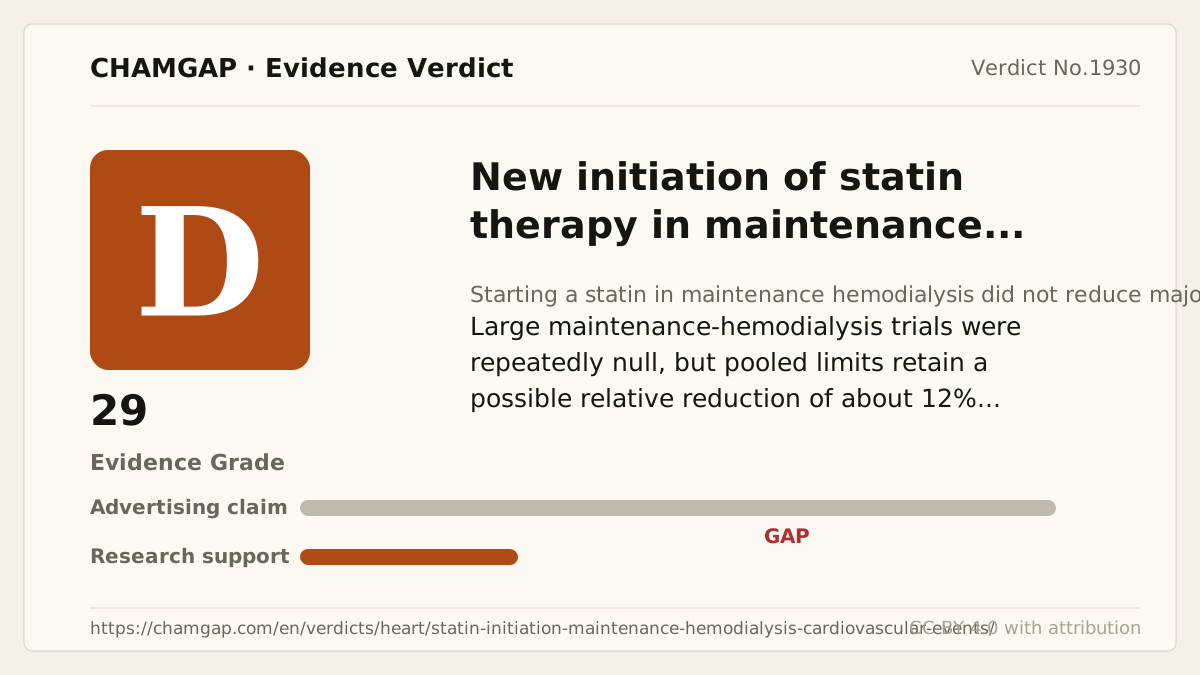
[Chamgap] New statin initiation x cardiovascular-event prevention in maintenance hemodialysis — Evidence Grade D·34. 4 cited sources checked. Source: https://chamgap.com/en/verdicts/heart/statin-initiation-maintenance-hemodialysis-cardiovascular-events/ · CC BY 4.0CC BY 4.0 — free to use with attribution; do not distort grades, numbers, or verdict meaning.
What this document does and does not do
Chamgap is an information source. It reports what research has and has not confirmed; it does not tell readers what to take or buy. That decision belongs to readers and, when needed, medical or legal professionals. This verdict reflects literature available up to the search date and may change as new research appears. Nothing here is medical advice.