
Sotatercept,
does it really help with Reduced composite risk of death, lung transplantation, or hospitalization for worsening disease in high-risk pulmonary arterial hypertension despite maximally tolerated background therapy?
research showsSotatercept is rated B because it markedly reduced the composite of death, lung transplantation, or hospitalization for worsening disease in adults with pulmonary arterial hypertension at high risk of death despite maximally tolerated background therapy. The phase 3 ZENITH trial randomized 172 patients and recorded a primary event in 17.4% with sotatercept versus 54.7% with placebo, hazard ratio 0.24 (95% CI 0.13 to 0.43), prompting early stopping for efficacy at the interim analysis. Death occurred in 8.1% versus 15.1%, lung transplantation in 1.2% versus 7.0%, and worsening hospitalization in 9.3% versus 50.0%, but the individual components were not powered for separate confirmation. The earlier 323-patient STELLAR trial also found a 40.8-m between-group improvement in 6-minute walk distance at 24 weeks, although this is an intermediate exercise-capacity endpoint. This is the strongest result within grade B, but the evidence comes from a single 172-patient, sponsor-funded, early-stopped trial and the effect was driven mainly by worsening hospitalization, supporting B with 79 points.
ads claimPromotion can turn a 76% relative reduction in a composite into a 76% reduction in death alone. ZENITH established a reduction in the first event of death, lung transplantation, or worsening hospitalization; the death component alone, 7 versus 13 events, was favorable but not confirmatory. The scope is also World Health Organization group 1 pulmonary arterial hypertension treated with add-on prescription biologic therapy, not all pulmonary hypertension.
Useful facts when choosing a product
- Winrevair is a prescription subcutaneous treatment for adults with World Health Organization group 1 pulmonary arterial hypertension. Labeling starts at 0.3 mg/kg and, after acceptable hemoglobin and platelet results, targets 0.7 mg/kg every three weeks.
- The drug was studied as an addition to maximally tolerated or stable pulmonary arterial hypertension background therapy, not as a replacement monotherapy.
- Hemoglobin elevation and platelet reduction require testing before the first five doses, for longer while values are unstable, and periodically thereafter.
- Epistaxis, telangiectasia, and gingival bleeding can occur, and serious bleeding has been reported. Low platelets and concomitant prostacyclin infusion or antithrombotic therapy warrant particular attention.
Chamgap Semantic Classification Code
Candidate index · review held
M.sotatercept-csrk.subcutaneous.composite-risk-of-death-lung-transplantation-or-hospitalization-for-worsening-disease-in-high-risk-pulmonary-arterial-hypertension-despite-maximally-tolerated-background-therapy.reduce.placeboMedicinal interventions > Sotatercept-csrk > Subcutaneous > composite risk of death, lung transplantation, or hospitalization for worsening disease in high-risk pulmonary arterial hypertension despite maximally tolerated background therapy > Reduction claim > Placebo
An automated migration candidate, not an issued permanent code; exact claim scope remains under review. This machine-generated migration candidate helps retrieval but is not a permanent assignment. The original verdict ID and URL remain authoritative.
What the research actually shows
The ZENITH trial by Humbert and colleagues randomized 172 adults with World Health Organization functional class III or IV pulmonary arterial hypertension and generally a REVEAL Lite 2 score of at least 9 to sotatercept or placebo. The starting dose was 0.3 mg/kg and the target dose was 0.7 mg/kg subcutaneously every three weeks, with maximally tolerated background therapy continued. At the prespecified interim analysis, composite events occurred in 15 of 86 versus 47 of 86 patients, hazard ratio 0.24, and the trial stopped for favorable efficacy. Components were 7 versus 13 deaths, 1 versus 6 lung transplants, and 8 versus 43 worsening hospitalizations. The earlier STELLAR trial by Hoeper and colleagues enrolled 323 patients with functional class II or III disease and found a 40.8-m between-group difference in 6-minute walk distance at week 24, with improvement across several hierarchical secondary endpoints. Both trials were funded by companies in the drug's development lineage, so independent replication of the hard outcome is not yet available.
Why this is classified as B (79)
ZENITH showed a very large, patient-important reduction in death, lung transplantation, or worsening hospitalization, 17.4% versus 54.7% with a hazard ratio of 0.24, while STELLAR provided directionally consistent exercise and clinical-worsening evidence. The hard-composite evidence nevertheless comes from one 172-patient, sponsor-funded trial stopped at interim analysis, the largest component difference was in worsening hospitalization, and death alone had only 7 versus 13 events. Balancing the exceptional magnitude against limited replication and precision gives the top of grade B, B with 79 points.
Counterpoint. For an eligible high-risk patient, sotatercept is an important addition that may substantially reduce residual risk despite multidrug therapy. Specialist monitoring of blood counts and bleeding is required, and the composite result should not be described as a confirmed mortality effect by itself.
Rejudgment record. Cross-check applied — Rule ⑤ requires a hard-endpoint benefit to be specific to the ingredient or procedure for grade A or B. ZENITH directly demonstrated a sotatercept-specific composite benefit in death, lung transplantation, and worsening hospitalization, allowing B. A is not justified because this was a single 172-patient, sponsor-funded trial stopped at interim analysis. STELLAR's 6-minute walk distance was interpreted as supportive under the intent of rule ①-ⓐ: when only a surrogate that substitutes for clinical benefit, such as a biomarker or intermediate measure, improves, the maximum is C; the overall verdict instead rests on ZENITH's hard endpoint.
Sub-claim grades by effect
This ingredient is marketed for several effects. A single overall grade blends strong and weak claims together, so each effect is graded separately here. The overall grade reflects the strongest disconfirming or core claim.
| Effect (sub-claim) | Grade | Basis |
|---|---|---|
| Reduction in the composite of death, lung transplantation, or worsening hospitalization in high-risk pulmonary arterial hypertension | B | ZENITH found 17.4% versus 54.7%, hazard ratio 0.24, but it was one 172-patient early-stopped trial. |
| Improvement in 6-minute walk distance in pulmonary arterial hypertension | B | STELLAR found a 40.8-m between-group difference in 323 participants, but this is an exercise-capacity intermediate endpoint rather than a hard clinical outcome. |
| Reduction in death alone in high-risk pulmonary arterial hypertension | C | The direction favored sotatercept at 7 versus 13 deaths, but event counts and independent replication are insufficient to confirm mortality alone. |
Cross-check — AI research and Codex final gate
Evidence Table
| Study | Design | Sample | Funding | Endpoint | Result | Weight |
|---|---|---|---|---|---|---|
| Humbert M et al.; ZENITH Trial Investigators. 2025 | Phase 3 multicenter randomized double-blind placebo-controlled trial stopped at a prespecified interim analysis | 172 adults with high-risk pulmonary arterial hypertension, 86 per group | Funded by Merck Sharp and Dohme | First event of death, lung transplantation, or hospitalization for at least 24 hours for worsening pulmonary arterial hypertension | Events occurred in 17.4% versus 54.7%, HR 0.24 (95% CI 0.13 to 0.43); components were 7 versus 13 deaths, 1 versus 6 lung transplants, and 8 versus 43 worsening hospitalizations. | Key hard-composite evidence from one early-stopped confirmatory trial |
| Hoeper MM et al.; STELLAR Trial Investigators. 2023 | Phase 3 multicenter randomized double-blind placebo-controlled trial | 323 adults with World Health Organization functional class II or III pulmonary arterial hypertension | Funded by Acceleron Pharma, a subsidiary of MSD | Six-minute walk distance at 24 weeks and hierarchical clinical secondary endpoints | The between-group difference in 6-minute walk distance was 40.8 m (95% CI 27.5 to 54.1), P<0.001, and the first eight hierarchical secondary endpoints improved. | Supportive consistency for exercise capacity and clinical worsening |
| United States Food and Drug Administration WINREVAIR label. 2025 | Prescribing information and integrated clinical safety review | Includes 323 STELLAR and 172 ZENITH participants | United States FDA regulatory document | Dosing, hemoglobin, platelets, and serious bleeding | Specifies a target dose of 0.7 mg/kg every three weeks with hemoglobin and platelet monitoring and warns about erythrocytosis, severe thrombocytopenia, and serious bleeding. | Dosing and safety evidence |
Receipt — 3 References
All 3 cited sources were verified for existence at the original page (as of 2026-07-24).
Final verification and publication gate: Codex · Evidence date: 2026-07-24 · Corrections: none
Cite this verdict
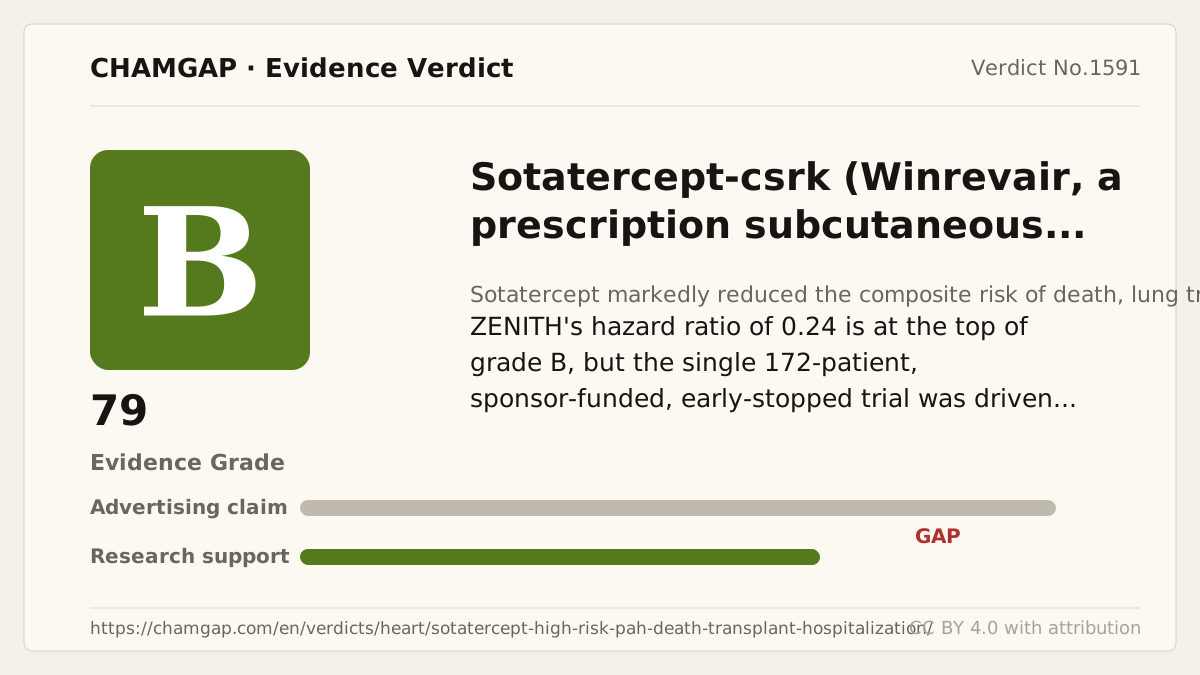
[Chamgap] Sotatercept x reduced composite risk of death, lung transplantation, or hospitalization in high-risk pulmonary arterial hypertension — Evidence Grade B·79. 3 cited sources checked. Source: https://chamgap.com/en/verdicts/heart/sotatercept-high-risk-pah-death-transplant-hospitalization/ · CC BY 4.0CC BY 4.0 — free to use with attribution; do not distort grades, numbers, or verdict meaning.
What this document does and does not do
Chamgap is an information source. It reports what research has and has not confirmed; it does not tell readers what to take or buy. That decision belongs to readers and, when needed, medical or legal professionals. This verdict reflects literature available up to the search date and may change as new research appears. Nothing here is medical advice.