
Smoking cessation,
does it really help with Reduction in all-cause mortality versus continued smoking?
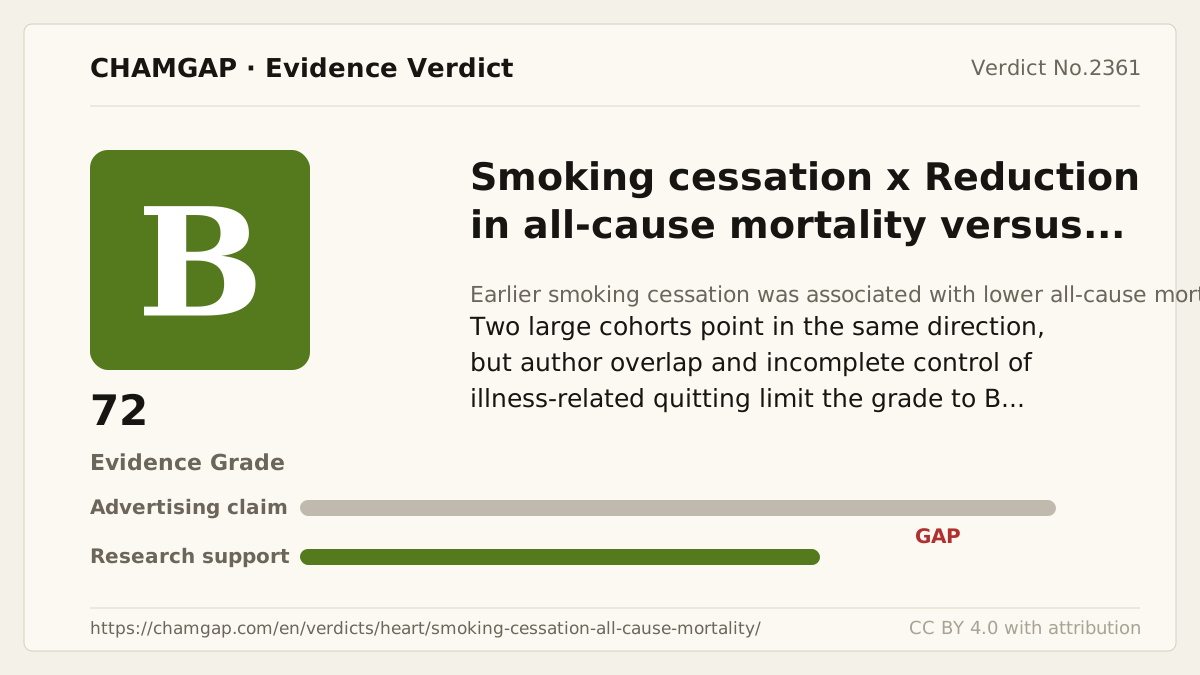
research showsThe grade is B. Large prospective cohorts in Japan and the United States linked quitting with lower mortality than continued smoking, with larger gains after earlier cessation. Richard Peto appears on both author lists, so this is not replication by wholly separate teams, and reverse causation from illness-related quitting was not fully eliminated.
ads claimThis is not the same claim as whether a cessation aid helps people quit. Verdict 1243 is B with 74 points, verdict 1670 is D with 28 points, and verdict 1712 is B with 72 points; those address cessation success.
Useful facts when choosing a product
- Mean follow-up was 22.9 years in Japan and 11 years in the United States.
- In the Japanese study, the combined birth cohorts gave a rate ratio of 1.02 (95% CI 0.91-1.13) versus never smokers for cessation before age 35. Among those born in 1920-1945, the ratios were 1.22 for cessation at 35-44 and 1.84 for continued smoking.
- In the US cohort, quitting 5-14 years earlier avoided about half, and quitting at least 15 years earlier about 90%, of excess mortality from continued smoking.
Chamgap Semantic Classification Code
Candidate index · review held
UNK.smoking-cessation.UNK.all-cause-mortality.reduce.reference-exposureUnknown > Smoking cessation > Unknown > all-cause mortality > Reduction claim > Reference exposure
An automated migration candidate, not an issued permanent code; exact claim scope remains under review. This machine-generated migration candidate helps retrieval but is not a permanent assignment. The original verdict ID and URL remain authoritative.
What the research actually shows
Sakata et al followed 67,973 Japanese participants for a mean 22.9 years and began counting deaths one year after smoking ascertainment, but did not reclassify recent quitters before death, restrict the analysis to participants without baseline disease, or analyze mortality by time since cessation. Thomson et al followed 551,388 US adults for a mean 11 years and observed 74,870 deaths; they reclassified people who had quit within five years before death as current smokers, restricted analyses to participants without major chronic disease at recruitment, and analyzed 5-14, 15-24, 25-34, and at least 35 years since cessation. Richard Peto is the sole shared author, so the two cohorts were not counted as wholly independent replication.
Why this is classified as B (72)
Hard mortality outcomes and large positive associations support the claim, but shared authorship and incomplete control of illness-related quitting in the Japanese cohort limit it to B with 72 points.
Counterpoint. The observational limitations do not justify delaying cessation; the individual gain varies with age at quitting and cumulative exposure.
Rejudgment record. Cross-check applied — Large positive prospective-cohort mortality results, tempered by overlapping authorship and incomplete handling of illness-related quitting
| Endpoint | H | Hard endpoint - actual events such as death |
| Replication | R1 | Single confirmatory trial |
| Independence | I2 | Decisive evidence is publicly or non-profit funded |
| Effect size | E+ | Meets the clinically important threshold |
Stored derived and displayed grades match; this is not a current recalculation or validity check (B).
Sub-claim grades by effect
This ingredient is marketed for several effects. A single overall grade blends strong and weak claims together, so each effect is graded separately here. The overall grade reflects the strongest disconfirming or core claim.
| Effect (sub-claim) | Grade | Basis |
|---|---|---|
| Lower all-cause mortality versus continued smoking | B | Both cohorts point in the same direction, but the teams are not wholly independent. |
| Larger benefit from earlier cessation | B | Quitting before roughly age 35-45 avoided most excess mortality. |
Cross-check — AI research and Codex final gate
Evidence Table
| Study | Design | Sample | Funding | Endpoint | Result | Weight |
|---|---|---|---|---|---|---|
| Sakata et al. 2012 Japanese Life Span Study | Population-based prospective cohort | 67,973 participants; mean follow-up 22.9 years | RERF Research Protocol RP 3-08 and MHLW International Exchange Program Fund; RERF funded by Japanese MHLW and US DOE; Oxford core support from Cancer Research UK, British Heart Foundation and Medical Research Council | All-cause mortality by age at cessation versus never and continuing smokers | Combined birth cohorts gave RR 1.02 (0.91-1.13) versus never smokers for quitting before 35; among those born in 1920-1945, RRs were 1.22 at 35-44 and 1.84 for continuing smokers | Long Japanese cohort with author overlap and reverse-causation limitations |
| Thomson et al. 2022 US NHIS | Nationally representative prospective cohort | 551,388 participants, 6.0 million person-years, 74,870 deaths, mean 11 years | Intramural Research Department of the American Cancer Society | All-cause and cause-specific mortality | Current versus never smoking RR 2.80 (2.73-2.88); quitting before 45 avoided about 90% of excess mortality from continued smoking | Large US cohort with a supportive baseline-disease-restricted sensitivity analysis |
Receipt — 2 References
All 2 cited sources were verified for existence at the original page (as of 2026-08-07).
Final verification and publication gate: Codex · Evidence date: 2026-08-07 · Corrections: none
Cite this verdict
[Chamgap] Smoking cessation x lower all-cause mortality — Evidence Grade B·72. 2 cited sources checked. Source: https://chamgap.com/en/verdicts/heart/smoking-cessation-all-cause-mortality/ · CC BY 4.0CC BY 4.0 — free to use with attribution; do not distort grades, numbers, or verdict meaning.
What this document does and does not do
Chamgap is an information source. It reports what research has and has not confirmed; it does not tell readers what to take or buy. That decision belongs to readers and, when needed, medical or legal professionals. This verdict reflects literature available up to the search date and may change as new research appears. Nothing here is medical advice.