
Brisk walking,
does it really help with Lower cardiovascular and all-cause mortality than self-rated slow walking?
research showsThe grade is C. After excluding events in the first two years, 49,731 participants from 11 British cohorts who rated their pace brisk or fast had 24% lower all-cause mortality hazard (95% CI 13% to 33%) and 21% lower cardiovascular mortality hazard (1% to 38%) than self-rated slow walkers. Pace was not measured in km/h or steps per minute. Healthier and fitter people may simply be more likely to call themselves brisk walkers.
ads claimBrisk cannot be converted into a universal numerical prescription from this study. It measured how participants described their usual pace, not whether assigning a specific speed lowers mortality.
Useful facts when choosing a product
- Exposure was self-rated slow, average, or brisk-fast rather than measured km/h or cadence.
- After excluding the first two years, groups contained 4,101 slow, 25,857 average, and 19,773 brisk-fast walkers.
- Verdict 1436 is C with 54 points and concerns post-meal walking and glucose, while this verdict concerns habitual self-rated pace and death.
Chamgap Semantic Classification Code
Candidate index · review held
X.self-rated-brisk-or-fast-walking.behavioral.cardiovascular-and-all-cause-mortality-than-self-rated-slow-walking.reduce.UNKBehaviors, exposures and policies > Self-rated brisk or fast walking > Behavioral delivery > cardiovascular and all-cause mortality than self-rated slow walking > Reduction claim > Unknown
An automated migration candidate, not an issued permanent code; exact claim scope remains under review. This machine-generated migration candidate helps retrieval but is not a permanent assignment. The original verdict ID and URL remain authoritative.
What the research actually shows
Eleven Health Survey for England and Scottish Health Survey samples were linked to mortality records. Core analysis began with 50,225 walkers and retained 49,731 after excluding events in the first two years. Exposure categories were slow, average, and brisk or fast, with no km/h or cadence prescription. Models adjusted walking volume, highest other activity intensity, smoking, BMI, and illness, but exposure and much health information remained questionnaire based. The analysis had no direct project funding; harmonization used UK NIHR support and investigators held Australian NHMRC fellowships. No competing interests were declared.
Why this is classified as C (56)
A large publicly supported event cohort with a lag analysis is offset by self-rated exposure, reverse causation, and residual confounding, giving C with 56 points.
Counterpoint. C does not advise against brisk walking; it prevents converting a self-rated association into a proven mortality prescription.
Rejudgment record. Cross-check applied — A large lagged event cohort found an association, but pace was self-rated and health-related reverse causation and residual confounding remained
| Endpoint | H | Hard endpoint - actual events such as death |
| Replication | R1 | Single confirmatory trial |
| Independence | I2 | Decisive evidence is publicly or non-profit funded |
| Effect size | E+ | Meets the clinically important threshold |
Stored derived and displayed grades match; this is not a current recalculation or validity check (C).
Sub-claim grades by effect
This ingredient is marketed for several effects. A single overall grade blends strong and weak claims together, so each effect is graded separately here. The overall grade reflects the strongest disconfirming or core claim.
| Effect (sub-claim) | Grade | Basis |
|---|---|---|
| Association of self-rated brisk walking with lower all-cause mortality | C | HR was 0.76 (0.67 to 0.87), but the evidence is observational. |
| Causally lowering cardiovascular mortality by increasing pace | C | Neither measured speed nor a randomized pace prescription established causality. |
Cross-check — AI research and Codex final gate
Evidence Table
| Study | Design | Sample | Funding | Endpoint | Result | Weight |
|---|---|---|---|---|---|---|
| Stamatakis E et al. 2018 pooled British cohorts | Pooled individual-participant prospective cohort analysis | 50,225 in core analysis; 49,731 after excluding first two years | No direct analysis funding; NIHR data harmonization and NHMRC fellowships | All-cause, cardiovascular, and cancer mortality | Versus slow pace, brisk-fast pace HR was 0.76 (0.67 to 0.87) for all-cause and 0.79 (0.62 to 0.99) for cardiovascular mortality; cancer mortality was null. | Principal hard-outcome cohort with self-rated exposure |
Receipt — 1 References
All 1 cited sources were verified for existence at the original page (as of 2026-08-04).
Final verification and publication gate: Codex · Evidence date: 2026-08-04 · Corrections: none
Cite this verdict
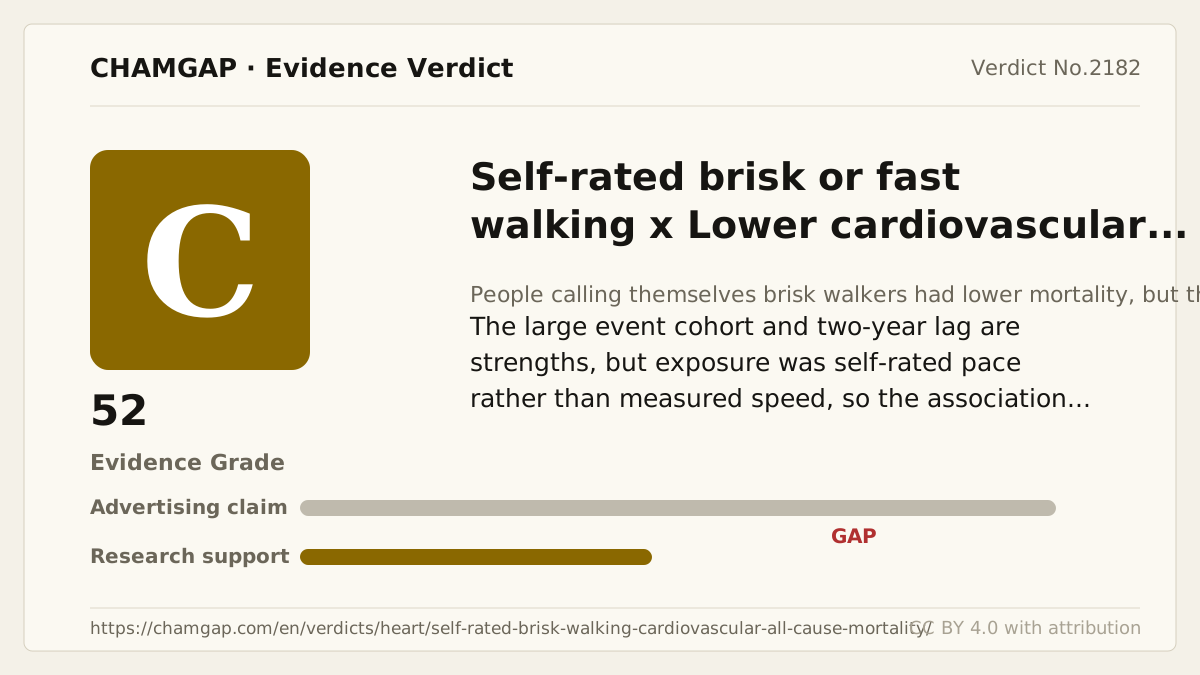
[Chamgap] Brisk walking x lower cardiovascular and all-cause mortality — Evidence Grade C·56. 1 cited sources checked. Source: https://chamgap.com/en/verdicts/heart/self-rated-brisk-walking-cardiovascular-all-cause-mortality/ · CC BY 4.0CC BY 4.0 — free to use with attribution; do not distort grades, numbers, or verdict meaning.
What this document does and does not do
Chamgap is an information source. It reports what research has and has not confirmed; it does not tell readers what to take or buy. That decision belongs to readers and, when needed, medical or legal professionals. This verdict reflects literature available up to the search date and may change as new research appears. Nothing here is medical advice.