
Sacubitril/valsartan,
does it really help with Reduction in cardiovascular death, heart-failure hospitalization, or outpatient heart failure after acute myocardial infarction?
research showsThe grade is D. PARADISE-MI randomized and analyzed by intention to treat 5,661 high-risk patients after acute myocardial infarction. The primary composite of cardiovascular death, first heart-failure hospitalization, or outpatient heart failure failed: 11.9% versus 13.2%, HR 0.90 (95% CI 0.78 to 1.04), P=0.17. The lower bound still allows a 22% relative reduction, so the result is D with 34 points rather than F.
ads claimResults differ in chronic heart failure with reduced ejection fraction. Verdict 732 is B with 77 points in that population, whereas this verdict addresses event prevention immediately after acute myocardial infarction. Success in one population cannot be transferred to another.
Useful facts when choosing a product
- PARADISE-MI used standard ACE-inhibitor ramipril rather than placebo as comparator.
- All 5,661 randomized participants entered the primary intention-to-treat analysis.
- Supportive recurrent-event analyses do not reverse the failed first-event primary endpoint.
Chamgap Semantic Classification Code
Candidate index · review held
M.sacubitril-valsartan.UNK.cardiovascular-death-heart-failure-hospitalization-or-outpatient-heart-failure-after-acute-myocardial-infarction.reduce.activeMedicinal interventions > Sacubitril/valsartan > Unknown > cardiovascular death, heart-failure hospitalization, or outpatient heart failure after acute myocardial infarction > Reduction claim > Active comparator
An automated migration candidate, not an issued permanent code; exact claim scope remains under review. This machine-generated migration candidate helps retrieval but is not a permanent assignment. The original verdict ID and URL remain authoritative.
What the research actually shows
PARADISE-MI assigned 5,661 participants to sacubitril/valsartan, 2,830, or ramipril, 2,831, in a multicenter double-blind active-comparator superiority trial. The primary intention-to-treat analysis included all randomized participants. The composite occurred in 338 (11.9%) versus 373 (13.2%), HR 0.90 (95% CI 0.78 to 1.04), P=0.17. Novartis sponsored the trial, and the executive committee worked with the sponsor on design, conduct, and analysis.
Why this is classified as D (34)
A large hard-outcome trial exists, but its primary endpoint was null and the interval retained meaningful benefit, giving D with 34 points.
Counterpoint. D does not deny efficacy in chronic HFrEF; it applies only to superiority over ramipril after acute myocardial infarction.
Rejudgment record. Cross-check applied — Failed first-event primary endpoint in 5,661 intention-to-treat participants with a confidence interval allowing up to 22% relative reduction
| Endpoint | H | Hard endpoint - actual events such as death |
| Replication | R1 | Single confirmatory trial |
| Independence | I0 | Evidence comes only from manufacturer studies |
| Effect size | E0 | Null |
| Precision | C0 | The confidence interval leaves room for benefit |
Stored derived and displayed grades match; this is not a current recalculation or validity check (D).
Sub-claim grades by effect
This ingredient is marketed for several effects. A single overall grade blends strong and weak claims together, so each effect is graded separately here. The overall grade reflects the strongest disconfirming or core claim.
| Effect (sub-claim) | Grade | Basis |
|---|---|---|
| Reduction in cardiovascular death | D | The failed primary composite does not support superiority based on an individual component. |
| Reduction in first heart-failure hospitalization | D | The primary composite had HR 0.90 and P=0.17, without established superiority. |
| Reduction in outpatient heart-failure events | D | As a component of the failed primary composite, it cannot independently establish success. |
Cross-check — AI research and Codex final gate
Evidence Table
| Study | Design | Sample | Funding | Endpoint | Result | Weight |
|---|---|---|---|---|---|---|
| Pfeffer et al. 2021 PARADISE-MI | Multicenter double-blind ramipril-controlled superiority randomized trial | 5,661 randomized and analyzed by intention to treat, 2,830/2,831 | Novartis | Primary composite of cardiovascular death, first heart-failure hospitalization, or outpatient heart failure | 338 (11.9%) versus 373 (13.2%), HR 0.90 (95% CI 0.78 to 1.04), P=0.17. | Only large confirmatory trial; failed primary endpoint |
Receipt — 1 References
All 1 cited sources were verified for existence at the original page (as of 2026-08-01).
Final verification and publication gate: Codex · Evidence date: 2026-08-01 · Corrections: none
Cite this verdict
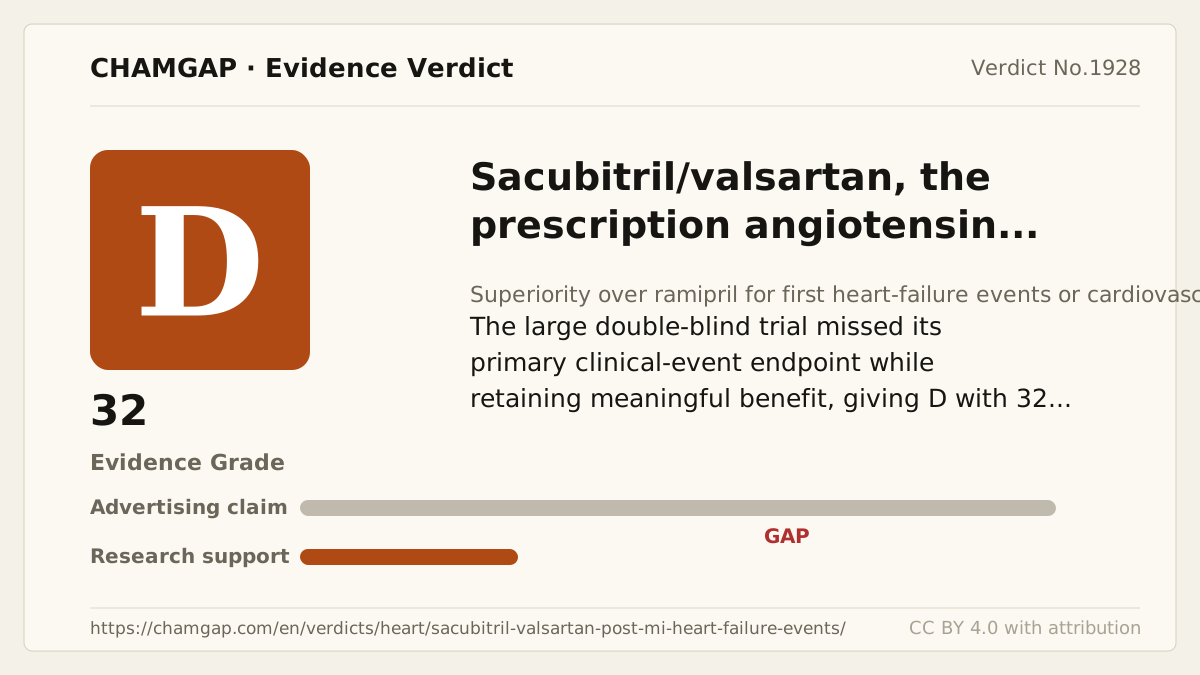
[Chamgap] Sacubitril/valsartan x prevention of heart-failure events after myocardial infarction — Evidence Grade D·34. 1 cited sources checked. Source: https://chamgap.com/en/verdicts/heart/sacubitril-valsartan-post-mi-heart-failure-events/ · CC BY 4.0CC BY 4.0 — free to use with attribution; do not distort grades, numbers, or verdict meaning.
What this document does and does not do
Chamgap is an information source. It reports what research has and has not confirmed; it does not tell readers what to take or buy. That decision belongs to readers and, when needed, medical or legal professionals. This verdict reflects literature available up to the search date and may change as new research appears. Nothing here is medical advice.