
Sacubitril/valsartan,
does it really help with Reduced cardiovascular death and heart-failure hospitalization in heart failure with reduced ejection fraction?
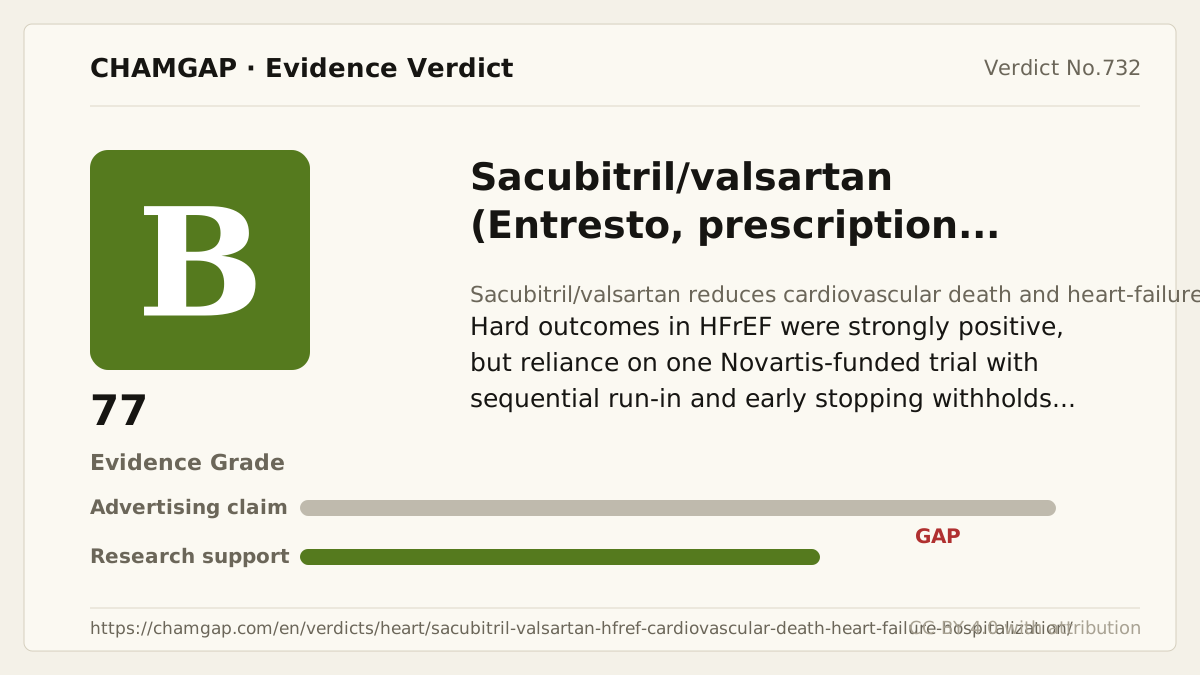
research showsSacubitril/valsartan is rated B because PARADIGM-HF reduced cardiovascular death or heart-failure hospitalization versus enalapril in 8,442 patients: 21.8% versus 26.5%, HR 0.80. The pivotal evidence is concentrated in one Novartis-funded trial that randomized only patients tolerating sequential ARNI and enalapril run-in and stopped early. These limitations yield B with 77 points, one point below dapagliflozin at B with 77 points. Null primary outcomes in PARAGON-HF and PARADISE-MI concern different indications, HFpEF and post-infarction treatment, and therefore do not refute the HFrEF result.
ads claimIt is exaggerated to extend the direct HFrEF benefit to every heart-failure phenotype or routine post-infarction prevention, or to portray ARNI as replacing all other therapy. It is used with other foundational treatments and adjusted with blood pressure, potassium, and kidney monitoring.
Useful facts when choosing a product
- Sacubitril/valsartan combines neprilysin inhibition with angiotensin-receptor blockade and is a prescription ARNI used alongside other foundational HFrEF therapies.
- Concurrent ACE-inhibitor use increases angioedema risk, so a washout interval is required when switching and the prescriber's exact directions should be followed.
- Blood pressure, serum potassium, and kidney function require monitoring before and after initiation, and the drug must not be used during pregnancy because of fetal toxicity.
Chamgap Semantic Classification Code
Candidate index · review held
M.sacubitril-valsartan.UNK.cardiovascular-death-and-heart-failure-hospitalization-in-heart-failure-with-reduced-ejection-fraction.reduce.activeMedicinal interventions > Sacubitril/valsartan > Unknown > cardiovascular death and heart-failure hospitalization in heart failure with reduced ejection fraction > Reduction claim > Active comparator
An automated migration candidate, not an issued permanent code; exact claim scope remains under review. This machine-generated migration candidate helps retrieval but is not a permanent assignment. The original verdict ID and URL remain authoritative.
What the research actually shows
McMurray 2014 PARADIGM-HF double-blind randomized 8,442 patients with NYHA class II to IV heart failure and ejection fraction of 40% or less to sacubitril/valsartan or enalapril. The primary outcome occurred in 21.8% versus 26.5% (HR 0.80), and cardiovascular death in 13.3% versus 16.5% (HR 0.80); the trial stopped early under prespecified rules. PARAGON-HF in 4,822 patients did not significantly reduce total heart-failure hospitalizations and cardiovascular death in HFpEF. PARADISE-MI in 5,661 patients also missed its post-infarction primary outcome, with HR 0.90 and P=0.17.
Why this is classified as B (77)
The 21.8% versus 26.5%, HR 0.80 mortality and hospitalization result in an 8,442-patient active-controlled trial is strong, but one Novartis-funded pivotal trial, sequential ARNI and enalapril run-in, early stopping, and no independent large replication yield B with 77 points, one point below dapagliflozin at B with 77 points. Null HFpEF and post-infarction results concern other indications and do not refute HFrEF efficacy.
Counterpoint. For an appropriate patient with HFrEF, this therapy affects survival and hospitalization rather than symptoms alone, but hypotension and kidney or potassium problems require individualized titration and monitoring.
Rejudgment record. New verdict — Accepted the 21.8% versus 26.5%, HR 0.80 hard-outcome result in 8,442 PARADIGM-HF participants while accounting for a single Novartis-funded pivotal trial, sequential ARNI and enalapril run-in selection, early stopping, and no independent large replication; null trials in other indications were not treated as refutation of HFrEF efficacy
Sub-claim grades by effect
This ingredient is marketed for several effects. A single overall grade blends strong and weak claims together, so each effect is graded separately here. The overall grade reflects the strongest disconfirming or core claim.
| Effect (sub-claim) | Grade | Basis |
|---|---|---|
| Reduced cardiovascular death and heart-failure hospitalization in HFrEF | B | A large hard-outcome trial was positive, but evidence is concentrated in one industry-funded trial stopped early. |
| Reduced cardiovascular death and heart-failure hospitalization across HFpEF | D | The primary composite outcome was not significant in the large PARAGON-HF trial. |
| Reduced cardiovascular death and incident heart failure after acute myocardial infarction | D | The primary outcome was not significant in the large PARADISE-MI trial. |
Cross-check — AI research and Codex final gate
Evidence Table
| Study | Design | Sample | Funding | Endpoint | Result | Weight |
|---|---|---|---|---|---|---|
| McMurray JJV et al. 2014 PARADIGM-HF | Randomized double-blind active-controlled event-driven trial | 8,442 patients with HFrEF | Novartis | Cardiovascular death or heart-failure hospitalization | Rates were 21.8% versus 26.5%, HR 0.80; cardiovascular-death HR was 0.80 and heart-failure hospitalization fell 21%. | Pivotal HFrEF hard-outcome evidence |
| Solomon SD et al. 2019 PARAGON-HF | Randomized double-blind active-controlled trial | 4,822 patients with HFpEF | Novartis | Total heart-failure hospitalizations and cardiovascular death | The between-group difference in the primary composite was not significant. | Limits extension to HFpEF |
| Pfeffer MA et al. 2021 PARADISE-MI | Randomized double-blind active-controlled trial | 5,661 patients after high-risk acute myocardial infarction | Novartis | Cardiovascular death or incident heart failure | HR was 0.90 (95% CI 0.78 to 1.04), P=0.17, and not significant. | Limits post-infarction extension |
Receipt — 3 References
All 3 cited sources were verified for existence at the original page (as of 2026-07-20).
Final verification and publication gate: Codex · Evidence date: 2026-07-20 · Corrections: none
Cite this verdict
[Chamgap] Sacubitril/valsartan x lower cardiovascular death and heart-failure hospitalization in HFrEF — Evidence Grade B·77. 3 cited sources checked. Source: https://chamgap.com/en/verdicts/heart/sacubitril-valsartan-hfref-cardiovascular-death-heart-failure-hospitalization/ · CC BY 4.0CC BY 4.0 — free to use with attribution; do not distort grades, numbers, or verdict meaning.
What this document does and does not do
Chamgap is an information source. It reports what research has and has not confirmed; it does not tell readers what to take or buy. That decision belongs to readers and, when needed, medical or legal professionals. This verdict reflects literature available up to the search date and may change as new research appears. Nothing here is medical advice.