
Sacha inchi oil,
does it really help with Cardiovascular disease prevention through improved LDL cholesterol and triglycerides?
research showsSacha inchi oil receives C with 45 points based only on a limited LDL surrogate signal. In a 30-person four-month trial, both sacha inchi and sunflower oil lowered total and LDL cholesterol, while a 54-person 12-week trial reported a 0.3 mmol/L LDL reduction versus corn oil. A 47-person functional-yogurt trial found no overall between-group lipid difference, and triglyceride findings are inconsistent. With no trial of myocardial infarction, stroke, or cardiovascular death prevention, the evidence remains at the lower end of C.
ads claimMarketing links plant omega-3 content and small LDL changes to cleaned arteries and prevention of heart attacks. ALA content and blood-lipid changes do not establish a cardiovascular-event benefit for the product.
Useful facts when choosing a product
- Sacha inchi oil is an edible oil rich in alpha-linolenic and linoleic acids; its fatty-acid profile differs from EPA- and DHA-rich fish oil.
- Trial doses ranged from a 1-g daily capsule to 10 or 15 mL of liquid oil, so the amount on a product label must be compared directly with the tested regimen.
- Quality can vary with heating, storage, and oxidation, so the oil should be protected from light and heat and used according to shelf-life instructions.
- Nausea and gastrointestinal discomfort occurred early in some studies, and the oil should not replace lipid-lowering or cardiovascular therapy.
Chamgap Semantic Classification Code
Candidate index · review held
UNK.sacha-inchi-oil.UNK.cardiovascular-disease-prevention-through-improved-ldl-cholesterol-and-triglycerides.prevent.activeUnknown > Sacha inchi oil > Unknown > Cardiovascular disease prevention through improved LDL cholesterol and triglycerides > Occurrence-prevention claim > Active comparator
An automated migration candidate, not an issued permanent code; exact claim scope remains under review. This machine-generated migration candidate helps retrieval but is not a permanent assignment. The original verdict ID and URL remain authoritative.
What the research actually shows
Gonzales 2014 assigned 30 healthy adults to 10 or 15 mL of sacha inchi or sunflower oil for four months; both oils lowered LDL and total cholesterol, while HDL was higher with sacha inchi at month four. A 2025 trial in 54 patients with hyperglycemia, hypertension, and hyperlipidemia compared 1 g of sacha inchi oil with corn oil and reported a 0.3 mmol/L LDL reduction, but participants continued prescribed medication and multiple surrogates were tested. A 2024 trial of 47 adults found no overall lipid or ApoB/ApoA1 difference among sacha-inchi yogurt, palm-oil yogurt, and plain yogurt.
Why this is classified as C (45)
A 30-person trial found lower LDL and total cholesterol with both sacha inchi and sunflower oil, so only a limited LDL surrogate signal is accepted. Another trial found no between-group difference, triglycerides are inconsistent, and cardiovascular-event prevention has never been tested, yielding lower-C with 45 points.
Counterpoint. It may be a reasonable edible-oil replacement for saturated fat, but adding a capsule and replacing dietary fat are not equivalent interventions.
Rejudgment record. New verdict — Accepted LDL and total-cholesterol signals from small randomized trials, but applied the rule ① surrogate ceiling of C because triglyceride results are inconsistent, another controlled trial found no between-group lipid difference, and no cardiovascular-event trial exists
Sub-claim grades by effect
This ingredient is marketed for several effects. A single overall grade blends strong and weak claims together, so each effect is graded separately here. The overall grade reflects the strongest disconfirming or core claim.
| Effect (sub-claim) | Grade | Basis |
|---|---|---|
| Improvement in LDL cholesterol | C | Small trials show a positive signal, but control-oil effects and a conflicting trial remain. |
| Improvement in triglycerides | C | Results are inconsistent, and the recent 54-person trial found no improvement. |
| Prevention of cardiovascular events | ? | No human sacha inchi oil trial has assessed myocardial infarction, stroke, or cardiovascular death. |
| A sacha-inchi-specific effect beyond general dietary unsaturated fat | ? | Control oils also improved outcomes, preventing isolation of a product-specific effect. |
Cross-check — AI research and Codex final gate
Evidence Table
| Study | Design | Sample | Funding | Endpoint | Result | Weight |
|---|---|---|---|---|---|---|
| Gonzales GF and Gonzales C. 2014 | Randomized double-blind sunflower-oil active-controlled trial | 30 healthy adults | Perubiodiverso project supported by Swiss SECO and German GIZ | Four-month lipids, blood pressure, hepatic and renal markers, and tolerability | Both oils lowered total and LDL cholesterol; HDL was higher with sacha inchi at month four, and early nausea occurred. | Direct small surrogate-outcome evidence |
| Mhd Rodzi NAR et al. 2025 | Randomized double-blind corn-oil-controlled trial | 54 patients with hyperglycemia, hypertension, and hyperlipidemia | Malaysian academic and public support; details reported in the paper | Twelve-week glycemic, blood-pressure, and lipid outcomes | LDL fell by 0.3 mmol/L versus control, but triglycerides and glycemic measures did not improve. | Recent small surrogate signal |
| Villamil RA et al. 2024 | Pilot randomized double-blind parallel controlled trial | 47 healthy adults | Internal support from Pontificia Universidad Javeriana | Three-month lipids and ApoB/ApoA1 | There was no significant overall between-group lipid difference among sacha-inchi and control yogurts. | Conflicting small controlled evidence |
Receipt — 3 References
All 3 cited sources were verified for existence at the original page (as of 2026-07-20).
Final verification and publication gate: Codex · Evidence date: 2026-07-20 · Corrections: none
Cite this verdict
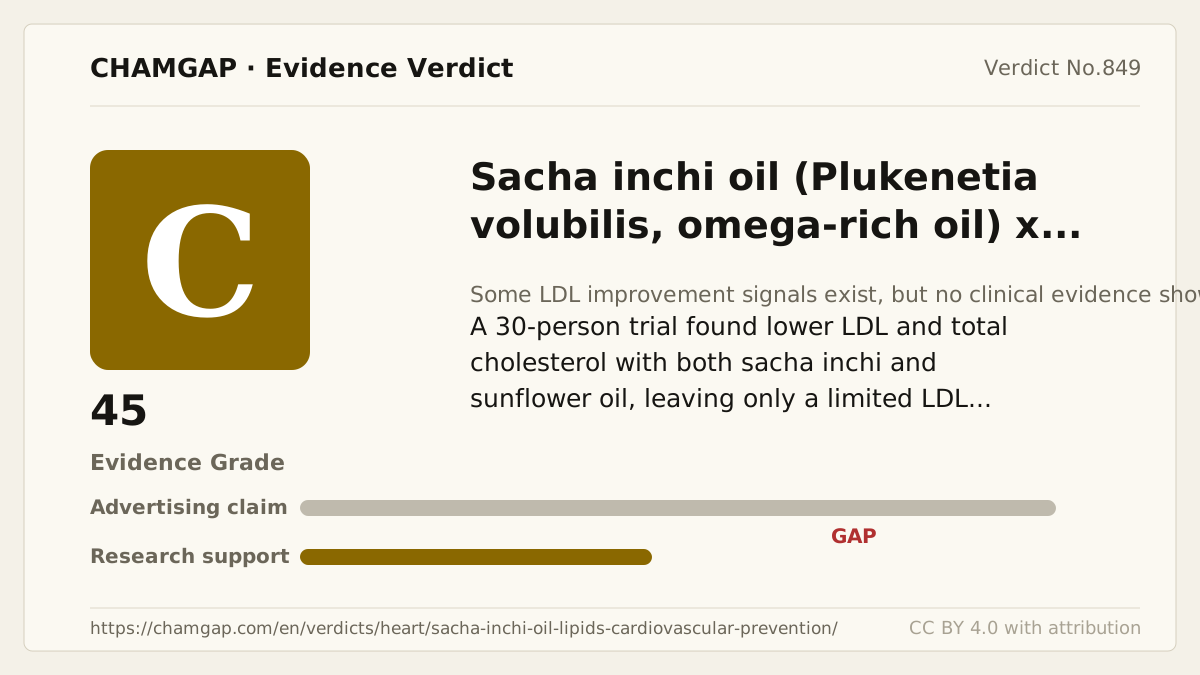
[Chamgap] Sacha inchi oil x lipid improvement and cardiovascular prevention — Evidence Grade C·45. 3 cited sources checked. Source: https://chamgap.com/en/verdicts/heart/sacha-inchi-oil-lipids-cardiovascular-prevention/ · CC BY 4.0CC BY 4.0 — free to use with attribution; do not distort grades, numbers, or verdict meaning.
What this document does and does not do
Chamgap is an information source. It reports what research has and has not confirmed; it does not tell readers what to take or buy. That decision belongs to readers and, when needed, medical or legal professionals. This verdict reflects literature available up to the search date and may change as new research appears. Nothing here is medical advice.