
Routine early PCI,
does it really help with Prevention of death and myocardial infarction in stable coronary artery disease?
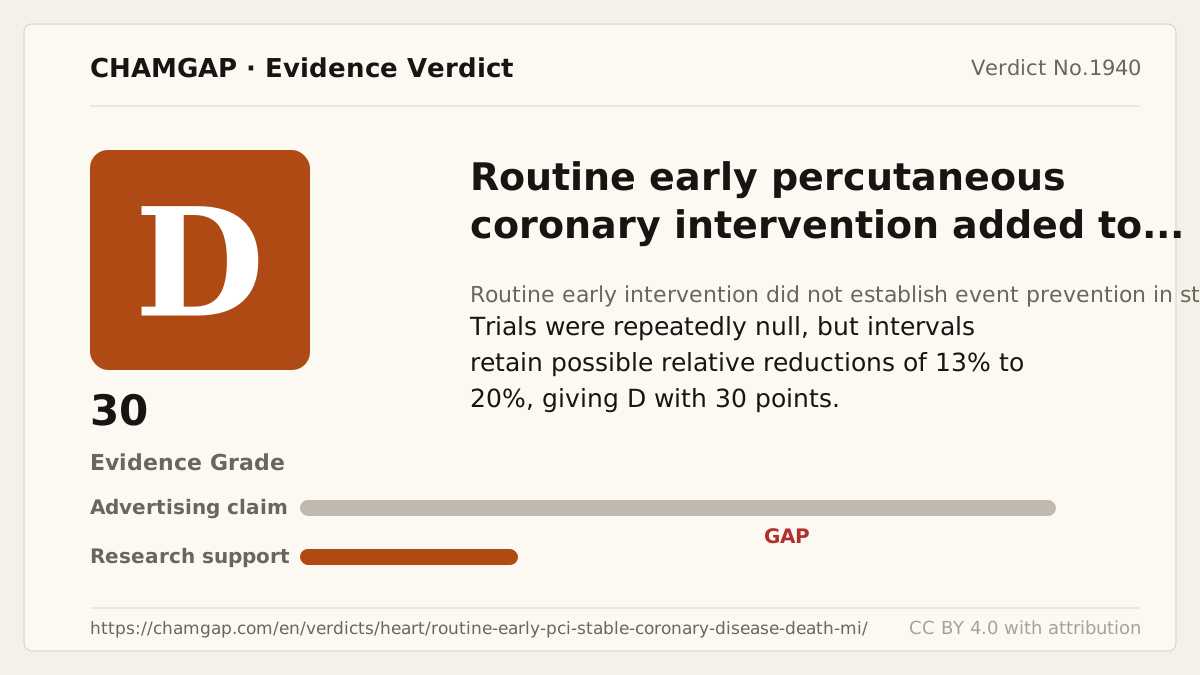
research showsThe grade is D. COURAGE randomized 2,287 and found death or nonfatal MI HR 1.05 (95% CI 0.87 to 1.27), P=0.62. ISCHEMIA randomized 5,179 and found primary-outcome HR 0.93 (0.80 to 1.08), P=0.34. Yet their benefit-side lower bounds retain possible relative reductions of 13% and 20%, which would be meaningful in stable coronary disease. Benefit is not fully excluded, giving D with 34 points.
ads claimThis verdict addresses only whether routine early intervention added to optimal medical therapy reduces death or myocardial infarction in stable patients. It does not mean stents are generally useless. Verdict 1791 is A with 86 points for primary PCI in STEMI: the same procedure has the highest grade in acute MI and a low grade for routine stable-disease prevention.
Useful facts when choosing a product
- COURAGE found earlier reduction in angina prevalence with PCI but no reduction in the primary death-or-MI outcome.
- Pooled evidence found fewer nonprocedural infarctions but more procedural infarctions, with no difference in total MI.
- Verdict 1791 is A with 86 points for primary PCI in emergency STEMI, while verdict 1321 is B with 76 points for prasugrel in PCI-scheduled acute coronary syndrome; both differ from this stable preventive strategy.
Chamgap Semantic Classification Code
Candidate index · review held
P.routine-early-percutaneous-coronary-intervention-added-to-optimal-medical-therapy.transdermal.death-and-myocardial-infarction-in-stable-coronary-artery-disease.prevent.addonProcedures, devices and tests > Routine early percutaneous coronary intervention added to optimal medical therapy > Transdermal > death and myocardial infarction in stable coronary artery disease > Occurrence-prevention claim > Added intervention on common background care
An automated migration candidate, not an issued permanent code; exact claim scope remains under review. This machine-generated migration candidate helps retrieval but is not a permanent assignment. The original verdict ID and URL remain authoritative.
What the research actually shows
COURAGE's 2,287-person primary death-or-nonfatal-MI outcome was HR 1.05 (0.87 to 1.27), P=0.62, funded by US VA, Canadian Institutes of Health Research, and unrestricted pharmaceutical and device-company grants. BARI 2D randomized 2,368 people with diabetes: five-year survival was 88.3% versus 87.8%, P=0.97, and freedom from major cardiovascular events 77.2% versus 75.9%, P=0.70; the original paper gave no randomized-strategy HR and CI. NHLBI, NIDDK, industry support, and donated drugs funded it. ISCHEMIA randomized 5,179; primary-outcome HR was 0.93 (0.80 to 1.08), P=0.34, and death HR 1.05 (0.83 to 1.32). Event rates were initially higher with the invasive strategy at six months, 5.3% versus 3.4%, but 16.4% versus 18.2% at five years. The invasive strategy included PCI or CABG and was primarily NHLBI funded.
Why this is classified as D (34)
Large trials were repeatedly null, but COURAGE and ISCHEMIA intervals retain possible relative reductions of 13% to 20%, so meaningful benefit is not excluded and the grade is D with 34 points.
Counterpoint. Angina relief and emergency PCI for acute disease are separate benefits.
Rejudgment record. Cross-check applied — Repeated null results with COURAGE lower bound 0.87 and ISCHEMIA lower bound 0.80 retaining clinically meaningful 13% to 20% relative-reduction possibilities
| Endpoint | H | Hard endpoint - actual events such as death |
| Replication | RX | Repeatedly refuted in the same indication |
| Independence | I2 | Decisive evidence is publicly or non-profit funded |
| Effect size | E0 | Null |
| Precision | C0 | The confidence interval leaves room for benefit |
Stored derived and displayed grades match; this is not a current recalculation or validity check (D).
Sub-claim grades by effect
This ingredient is marketed for several effects. A single overall grade blends strong and weak claims together, so each effect is graded separately here. The overall grade reflects the strongest disconfirming or core claim.
| Effect (sub-claim) | Grade | Basis |
|---|---|---|
| Prevention of death | D | Results were repeatedly null, but pivotal composite-event intervals retained a meaningful-benefit possibility. |
| Prevention of total myocardial infarction | D | Repeated trials found no reduction, but ISCHEMIA's primary-outcome lower bound of 0.80 retained meaningful benefit. |
| Angina symptom relief | B | Earlier symptom relief is possible but is separate from preventing death or MI. |
Cross-check — AI research and Codex final gate
Evidence Table
| Study | Design | Sample | Funding | Endpoint | Result | Weight |
|---|---|---|---|---|---|---|
| Boden et al. 2007 COURAGE | Multicenter randomized open-label intention-to-treat trial | 2,287 randomized and analyzed by intention to treat, 1,149 PCI and 1,138 medical therapy | US Veterans Affairs and Canadian Institutes of Health Research, with unrestricted corporate support | Primary death or nonfatal myocardial infarction | 211 events (19.0%) versus 202 (18.5%), HR 1.05 (0.87 to 1.27), P=0.62 | Pivotal large null trial |
| Bangalore et al. 2020 routine-revascularization meta-analysis | Systematic review and meta-analysis of randomized trials | 14 randomized trials and 14,877 participants | Academic synthesis; mixed funding across included trials | Death and total myocardial infarction | Death RR 0.99 (0.90 to 1.09); total MI RR 0.93 (0.83 to 1.03); futility crossed for at least 10% mortality reduction | Supporting pooled evidence of repeated null effects |
Receipt — 5 References
All 5 cited sources were verified for existence at the original page (as of 2026-08-01).
Final verification and publication gate: Codex · Evidence date: 2026-08-01 · Corrections: none
Cite this verdict
[Chamgap] Routine early PCI x prevention of death and myocardial infarction in stable coronary disease — Evidence Grade D·34. 5 cited sources checked. Source: https://chamgap.com/en/verdicts/heart/routine-early-pci-stable-coronary-disease-death-mi/ · CC BY 4.0CC BY 4.0 — free to use with attribution; do not distort grades, numbers, or verdict meaning.
What this document does and does not do
Chamgap is an information source. It reports what research has and has not confirmed; it does not tell readers what to take or buy. That decision belongs to readers and, when needed, medical or legal professionals. This verdict reflects literature available up to the search date and may change as new research appears. Nothing here is medical advice.