
Road-traffic noise exposure,
does it really help with Increased ischemic heart disease and stroke?
research showsThe grade is C. In a 2025 review using a linear range of roughly 40-80 dB Lden, pooled relative risks per 10 dB were 1.017 for ischemic heart disease, 1.029 for myocardial infarction, and 1.025 for stroke. The ischemic-heart-disease interval included the null, and the main pooled estimates preferentially used models without air-pollution adjustment, limiting attribution to noise itself.
ads claimThis verdict concerns chronic road-traffic noise and cardiovascular events. White-noise machines, earplugs, and particulate-air-pollution verdicts ask different questions.
Useful facts when choosing a product
- Lden combines day, evening, and night sound levels with extra evening and night penalties.
- The main linear range was about 40-80 dB Lden and effects were reported per 10 dB.
- Main pooled estimates preferentially used models without air-pollution adjustment.
- Traffic noise and road air pollution share a source and are difficult to separate statistically.
Chamgap Semantic Classification Code
Candidate index · review held
UNK.residential-road-traffic-noise.UNK.ischemic-heart-disease-and-stroke.increase.baselineUnknown > Residential road-traffic noise > Unknown > ischemic heart disease and stroke > Increase claim > Within-group baseline comparison
An automated migration candidate, not an issued permanent code; exact claim scope remains under review. This machine-generated migration candidate helps retrieval but is not a permanent assignment. The original verdict ID and URL remain authoritative.
What the research actually shows
Pershagen and colleagues reviewed 20 publications covering 28 populations and more than 8.4 million people in 2025. They included longitudinal cohorts and case-control studies with modeled or measured residential road noise and excluded subjective noise ratings. Thirteen studies had high exposure-assessment risk, seven high confounding risk, and five high selection risk; only five were low risk in all four domains. Air-pollution data were available in about half, and main pooled estimates preferentially used models without air-pollution adjustment. NO2 adjustment showed no consistent direction, while PM2.5 adjustment tended to lower estimates, especially for ischemic heart disease; exact paired pooled values for the same study set could not be verified. Neither a separate review funding statement nor a comparison of funding across all component studies could be verified.
Why this is classified as C (54)
Millions of participants, many events, and three estimates in the same direction are strengths. The ischemic-heart-disease interval included one, while limited air-pollution adjustment, exposure-model error, and residual confounding give C with 54 points.
Counterpoint. C does not erase the myocardial-infarction and stroke signals. It means the combined claim and noise-specific causal effect remain uncertain.
Rejudgment record. Cross-check applied — Separated 2025 pooled Lden event estimates from before-and-after air-pollution estimates in an individual Danish study
| Endpoint | H | Hard endpoint - actual events such as death |
| Replication | R1 | Single confirmatory trial |
| Independence | I1 | Mixed funding sources |
| Effect size | E+ | Meets the clinically important threshold |
Stored derived and displayed grades match; this is not a current recalculation or validity check (C).
Sub-claim grades by effect
This ingredient is marketed for several effects. A single overall grade blends strong and weak claims together, so each effect is graded separately here. The overall grade reflects the strongest disconfirming or core claim.
| Effect (sub-claim) | Grade | Basis |
|---|---|---|
| Increased ischemic heart disease incidence | D | RR 1.017, 95% CI 0.990-1.044, included the null. |
| Increased myocardial-infarction incidence | C | RR was 1.029, 95% CI 1.011-1.048. |
| Increased stroke incidence | C | RR was 1.025, 95% CI 1.009-1.041. |
Cross-check — AI research and Codex final gate
Evidence Table
| Study | Design | Sample | Funding | Endpoint | Result | Weight |
|---|---|---|---|---|---|---|
| Pershagen et al. 2025 systematic review | Systematic review and random-effects meta-analysis of longitudinal observational studies | 20 publications, 28 populations, more than 8.4 million people | A separate funding statement could not be verified in the accessible article text | Ischemic heart disease, myocardial infarction, and stroke per 10 dB Lden | RR 1.017, 0.990-1.044; 1.029, 1.011-1.048; and 1.025, 1.009-1.041 | Largest current synthesis, but main models were not air-pollution adjusted |
| Sorensen et al. Danish myocardial-infarction cohort | Prospective cohort | 57,053 participants | Danish public research support | Incident myocardial infarction per 10 dB Lden | IRR 1.10, 1.03-1.19, before NOx adjustment and 1.12, 1.02-1.22, after adjustment | Within-study comparison before and after air-pollution adjustment |
Receipt — 2 References
All 2 cited sources were verified for existence at the original page (as of 2026-08-05).
Final verification and publication gate: Codex · Evidence date: 2026-08-05 · Corrections: none
Cite this verdict
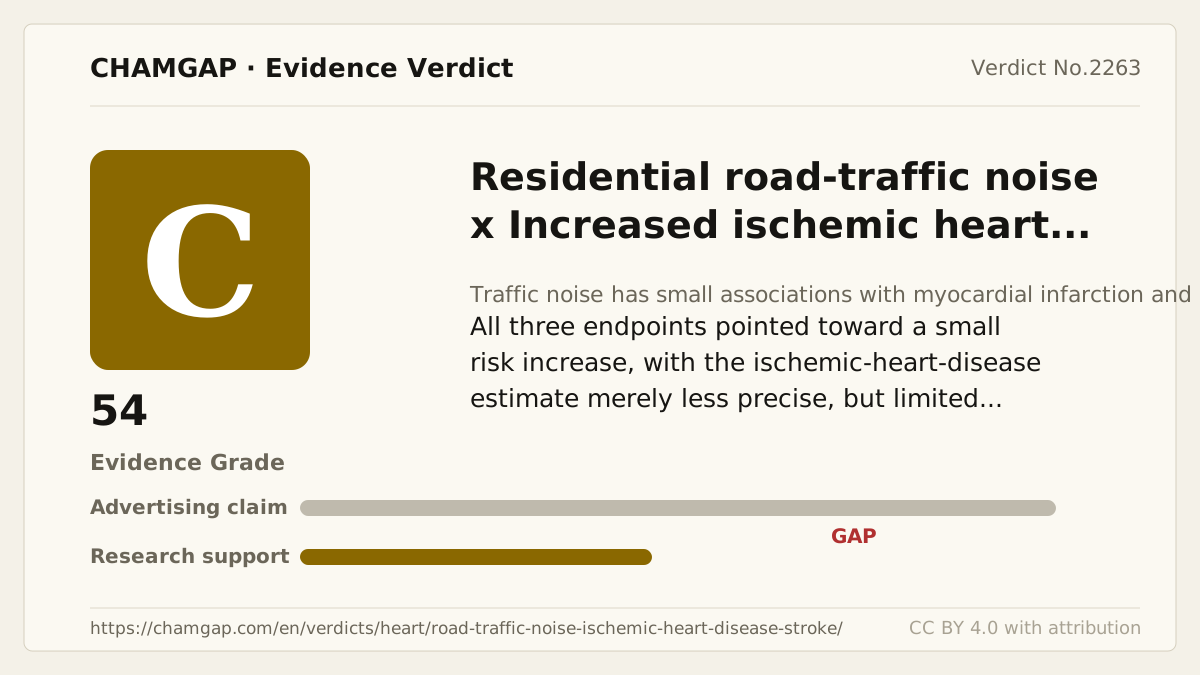
[Chamgap] Road-traffic noise exposure x ischemic heart disease and stroke — Evidence Grade C·54. 2 cited sources checked. Source: https://chamgap.com/en/verdicts/heart/road-traffic-noise-ischemic-heart-disease-stroke/ · CC BY 4.0CC BY 4.0 — free to use with attribution; do not distort grades, numbers, or verdict meaning.
What this document does and does not do
Chamgap is an information source. It reports what research has and has not confirmed; it does not tell readers what to take or buy. That decision belongs to readers and, when needed, medical or legal professionals. This verdict reflects literature available up to the search date and may change as new research appears. Nothing here is medical advice.