
Replacing red meat with plant protein,
does it really help with Reduced coronary heart disease incidence?
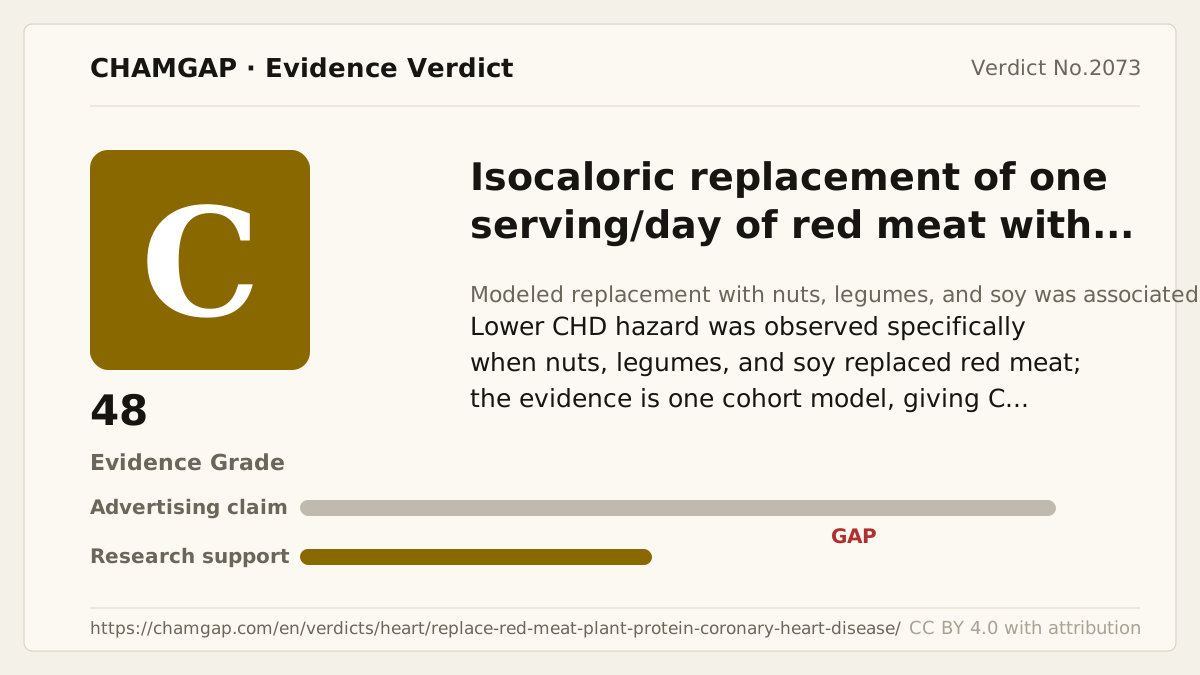
research showsThe grade is C. In an isocaloric model of 43,272 HPFS men and 4,456 CHD events, replacing one serving/day of red meat with nuts, legumes, and soy gave HR 0.86 (95% CI 0.80 to 0.93), while replacement with whole grains gave HR 0.62 (0.53 to 0.73). This was a model rather than an actual food-swap intervention in one male health-professional cohort, giving C with 56 points.
ads claimThe estimate is not for merely removing red meat. It belongs to an isocaloric model in which nuts, legumes, and soy take its place; the replacement is part of the claim.
Useful facts when choosing a product
- Saturated fat in red meat varies by cut, trimming, and cooking loss; this cohort model did not directly assay saturated fat in consumed products.
- FFQ-versus-diet-record correlations were 0.59 for unprocessed red meat, 0.52 for processed meat, 0.46 for legumes, and 0.45 for nuts.
- Cooking temperature and doneness were not separated in the substitution analysis.
- Verdict 2035 is D with 28 points for replacing red meat with mushrooms and long-term weight; this verdict concerns nuts, legumes, soy, and CHD events.
Chamgap Semantic Classification Code
Candidate index · review held
F.isocaloric-replacement-of-one-serving-day-of-red-meat-with-one-serving-day-of-nuts.food.coronary-heart-disease-incidence.reduce.UNKFoods and beverages > Isocaloric replacement of one serving/day of red meat with one serving/day of nuts > Food consumption > coronary heart disease incidence > Reduction claim > Unknown
An automated migration candidate, not an issued permanent code; exact claim scope remains under review. This machine-generated migration candidate helps retrieval but is not a permanent assignment. The original verdict ID and URL remain authoritative.
What the research actually shows
From 1986 to 2016, 4,456 of 43,272 men, about 10.3%, developed CHD and 1,860 events were fatal. This overall proportion is not an absolute difference between substitution groups. Models adjusted extensively for diet, smoking, alcohol, BMI, activity, medicines, and occupation, but higher-meat consumers still differed in smoking, alcohol, activity, and diet quality. NIH funded the research.
Why this is classified as C (56)
An explicit replacement and 4,456 hard events are strengths, but a single occupational cohort, low replacement-food validity, residual confounding, and multiple models give C with 56 points.
Counterpoint. The model supports a hypothesis that nuts, legumes, and soy may be preferable to red meat, but it did not randomize an actual food exchange.
Rejudgment record. Cross-check applied — Hard-outcome hazard ratios for explicit replacement foods, balanced against exposure error and residual confounding in one occupational cohort
| Endpoint | H | Hard endpoint - actual events such as death |
| Replication | R1 | Single confirmatory trial |
| Independence | I2 | Decisive evidence is publicly or non-profit funded |
| Effect size | E+ | Meets the clinically important threshold |
Stored derived and displayed grades match; this is not a current recalculation or validity check (C).
Sub-claim grades by effect
This ingredient is marketed for several effects. A single overall grade blends strong and weak claims together, so each effect is graded separately here. The overall grade reflects the strongest disconfirming or core claim.
| Effect (sub-claim) | Grade | Basis |
|---|---|---|
| Replacing red meat with nuts, legumes, and soy reduces coronary heart disease | C | The substitution-model HR was 0.86 (0.80 to 0.93), but the food exchange was not randomized. |
| Replacing red meat with whole grains reduces coronary heart disease | C | The substitution-model HR was 0.62 (0.53 to 0.73), but the food exchange was not randomized. |
Cross-check — AI research and Codex final gate
Evidence Table
| Study | Design | Sample | Funding | Endpoint | Result | Weight |
|---|---|---|---|---|---|---|
| Al-Shaar L et al. 2020 HPFS | Prospective cohort Cox isocaloric statistical substitution analysis with repeated dietary assessment | 43,272 men, 1,023,872 person-years, 4,456 CHD events | US National Institutes of Health | Nonfatal myocardial infarction or fatal coronary heart disease | HR 0.86 (95% CI 0.80 to 0.93) for nuts, legumes, and soy replacement and 0.62 (0.53 to 0.73) for whole-grain replacement | Pivotal hard-outcome substitution evidence |
Receipt — 2 References
All 2 cited sources were verified for existence at the original page (as of 2026-08-03).
Final verification and publication gate: Codex · Evidence date: 2026-08-03 · Corrections: none
Cite this verdict
[Chamgap] Replacing red meat with plant protein x reduced coronary heart disease incidence — Evidence Grade C·56. 2 cited sources checked. Source: https://chamgap.com/en/verdicts/heart/replace-red-meat-plant-protein-coronary-heart-disease/ · CC BY 4.0CC BY 4.0 — free to use with attribution; do not distort grades, numbers, or verdict meaning.
What this document does and does not do
Chamgap is an information source. It reports what research has and has not confirmed; it does not tell readers what to take or buy. That decision belongs to readers and, when needed, medical or legal professionals. This verdict reflects literature available up to the search date and may change as new research appears. Nothing here is medical advice.