
Registered dog ownership,
does it really help with Lower cardiovascular and all-cause mortality?
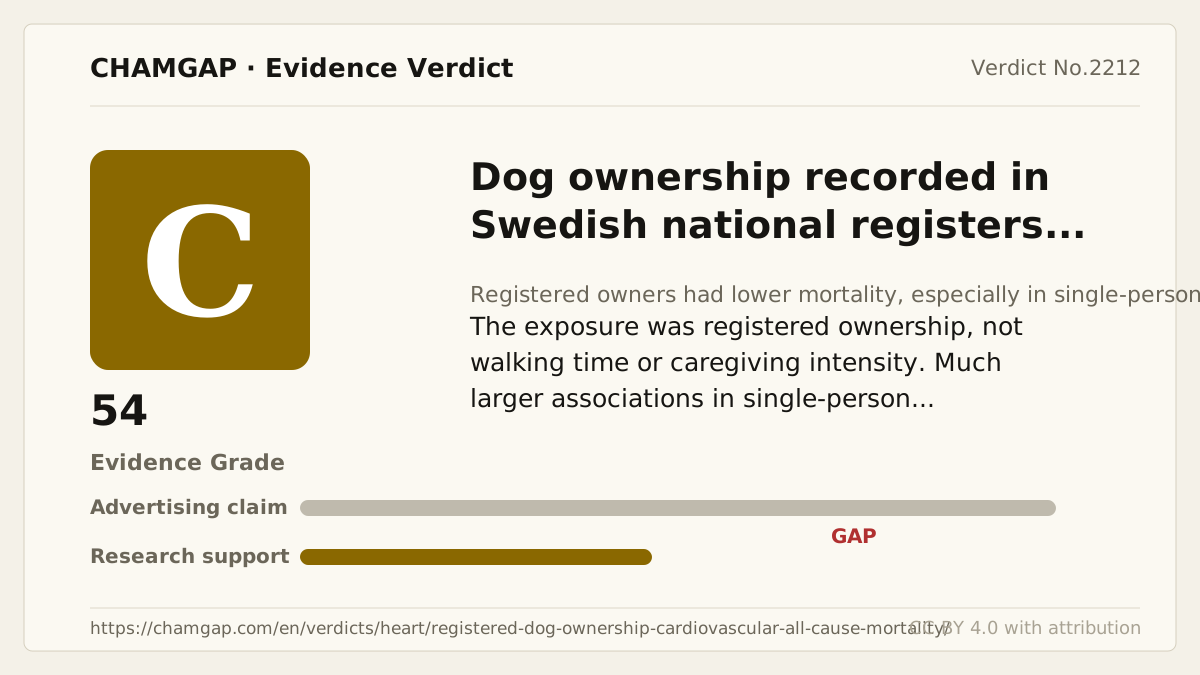
research showsThe grade is C with 54 points. Among 3,432,153 adults aged 40-80 without baseline cardiovascular disease, registered owners had HR 0.77 (95% CI 0.73-0.80) for cardiovascular mortality and 0.80 (0.79-0.82) for all-cause mortality in the full cohort. Estimates were larger in single-person households, 0.64 (0.59-0.70) and 0.67 (0.65-0.69), than in multi-person households, 0.85 (0.81-0.90) and 0.89 (0.87-0.91). This household-dependent size raises concern about selection and confounding.
ads claimAn observational link between registration and mortality cannot be converted into proof that dogs extend life or that dog walking protects the heart. Walking time was not the principal exposure.
Useful facts when choosing a product
- Ownership meant registration of the person or spouse in one of two national dog registers; walking time was not the primary exposure.
- Full-cohort HRs were 0.77 for cardiovascular mortality and 0.80 for all-cause mortality, with larger estimates of 0.64 and 0.67 in single-person households.
- The 34,202-person twin data were null for all-cause mortality, HR 0.87 (0.71-1.07).
Chamgap Semantic Classification Code
Candidate index · review held
UNK.dog-ownership-recorded-in-swedish-national-registers.UNK.cardiovascular-and-all-cause-mortality.reduce.MULTIUnknown > Dog ownership recorded in Swedish national registers > Unknown > cardiovascular and all-cause mortality > Reduction claim > Multiple: primary unresolved
An automated migration candidate, not an issued permanent code; exact claim scope remains under review. This machine-generated migration candidate helps retrieval but is not a permanent assignment. The original verdict ID and URL remain authoritative.
What the research actually shows
The Swedish study followed adults aged 40-80 without baseline cardiovascular disease for up to 12 years. Exposure was a period when the person or spouse was registered as an owner with the Board of Agriculture or Kennel Club. A 2012 survey estimated 83% (95% CI 78%-87%) of dogs were in at least one register. There were 448,298 owners and 2,983,855 nonowners. The comparator was observational nonownership, not no treatment, a waitlist, or an active control. Baseline cardiovascular disease was excluded, but an early-event exclusion analysis was not identified in the article. Support came from FORMAS, the Agria and SKK Research Foundation, and the Goran Gustafsson Foundation.
Why this is classified as C (54)
A very large register cohort found objective mortality associations, but healthy-owner selection, household-dependent estimates, and a null twin analysis prevent causal inference, giving C with 54 points.
Counterpoint. Dogs may increase activity and social contact, but those pathways were not randomized in this study.
Rejudgment record. Cross-check applied — Credited objective nationwide mortality associations while accounting for household-dependent effect sizes, a null twin analysis, healthy-owner selection, and nonrandomized exposure
| Endpoint | H | Hard endpoint - actual events such as death |
| Replication | R1 | Single confirmatory trial |
| Independence | I1 | Mixed funding sources |
| Effect size | E+ | Meets the clinically important threshold |
Stored derived and displayed grades match; this is not a current recalculation or validity check (C).
Sub-claim grades by effect
This ingredient is marketed for several effects. A single overall grade blends strong and weak claims together, so each effect is graded separately here. The overall grade reflects the strongest disconfirming or core claim.
| Effect (sub-claim) | Grade | Basis |
|---|---|---|
| Association of registered dog ownership with lower all-cause mortality | C | The full-cohort HR was 0.80, but exposure was nonrandomized. |
| Dog ownership causally extends life | D | Register cohorts cannot establish causality, and the twin analysis was null. |
Cross-check — AI research and Codex final gate
Evidence Table
| Study | Design | Sample | Funding | Endpoint | Result | Weight |
|---|---|---|---|---|---|---|
| Mubanga et al. Swedish nationwide and twin cohorts 2017 | Register-based prospective cohort with a twin sensitivity cohort | 3,432,153 nationwide, including 448,298 owners, plus 34,202 twins | FORMAS, Agria and SKK Research Foundation, and Goran Gustafsson Foundation | Cardiovascular and all-cause mortality over up to 12 years | Full cohort HRs 0.77 and 0.80; single-person households 0.64 and 0.67; twin all-cause mortality HR 0.87 (0.71-1.07). | Pivotal large observational evidence |
Receipt — 1 References
All 1 cited sources were verified for existence at the original page (as of 2026-08-04).
Final verification and publication gate: Codex · Evidence date: 2026-08-04 · Corrections: none
Cite this verdict
[Chamgap] Registered dog ownership x lower cardiovascular and all-cause mortality — Evidence Grade C·54. 1 cited sources checked. Source: https://chamgap.com/en/verdicts/heart/registered-dog-ownership-cardiovascular-all-cause-mortality/ · CC BY 4.0CC BY 4.0 — free to use with attribution; do not distort grades, numbers, or verdict meaning.
What this document does and does not do
Chamgap is an information source. It reports what research has and has not confirmed; it does not tell readers what to take or buy. That decision belongs to readers and, when needed, medical or legal professionals. This verdict reflects literature available up to the search date and may change as new research appears. Nothing here is medical advice.