
Red and white meat,
does it really help with LDL and apoB versus nonmeat protein, and red-versus-white meat differences?
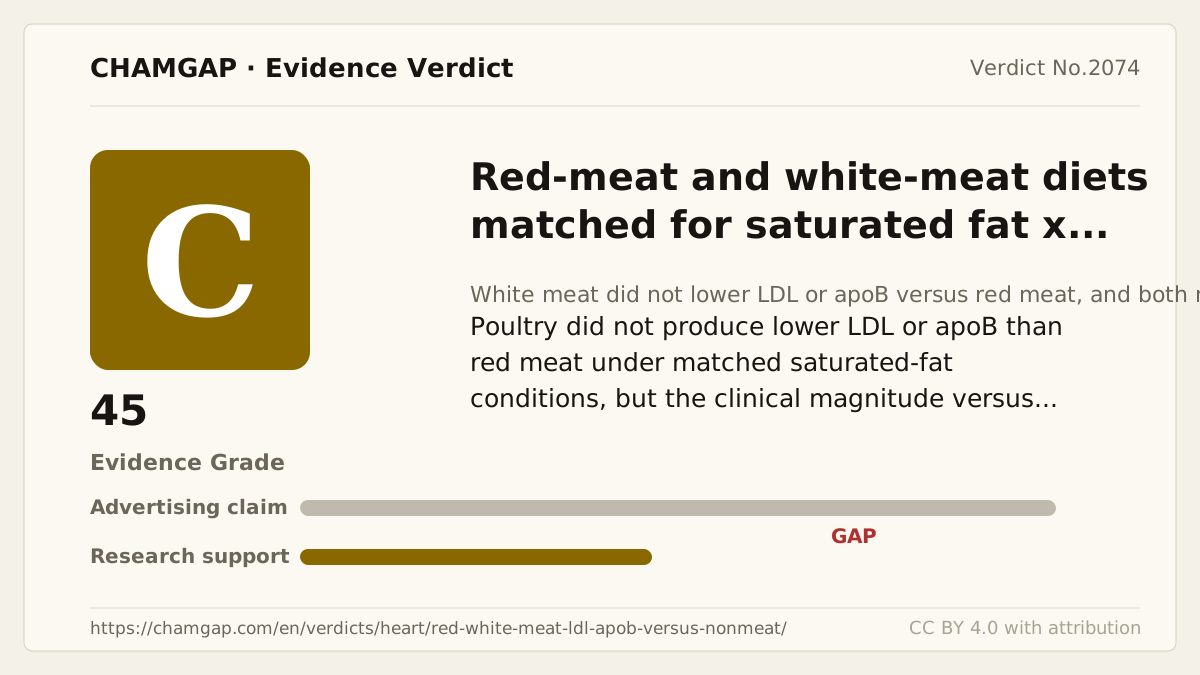
research showsThe grade is C. Among 113 completers in the APPROACH crossover feeding trial, both red and white meat produced higher LDL and apoB than nonmeat protein, while red and white meat did not differ. The official analysis was period-adjusted crossover ANOVA, but adjusted pairwise estimates, standard errors, and confidence intervals were unavailable in the material checked, so effect size could not be reconstructed. Surrogate outcomes, four-week periods, and completer analysis give C with 50 points.
ads claimThe claim that white meat is safer for cholesterol than red meat was not supported under these conditions. This four-week surrogate trial also cannot be converted into a direct myocardial-infarction or mortality comparison.
Useful facts when choosing a product
- Low-SFA diets provided about 7% of energy and high-SFA diets 13 to 14%; only about 2 to 3% came from meat, with most of the contrast created by full-fat dairy and butter.
- Test protein supplied about 12% of energy: red meat was 11% beef plus 1% pork, white meat 8% chicken plus 4% turkey, and nonmeat protein came from legumes, nuts, grains, and soy.
- Menu composition was assayed, but a common grams-per-day dose and results by cooking method or doneness were not reported.
- Verdict 2053 is D with 28 points for whole eggs and LDL or HDL effects; this verdict compares SFA-matched red, white, and nonmeat protein diets.
Chamgap Semantic Classification Code
Candidate index · review held
D.red-meat-and-white-meat-diets-matched.dietary.ldl-and-apob.compare.UNKDietary patterns and eating practices > Red-meat and white-meat diets matched > Dietary regimen > LDL and apoB > Comparative claim > Unknown
An automated migration candidate, not an issued permanent code; exact claim scope remains under review. This machine-generated migration candidate helps retrieval but is not a permanent assignment. The original verdict ID and URL remain authoritative.
What the research actually shows
Participants were assigned in parallel to a high- or low-SFA arm, then within each arm consumed red-meat, white-meat, and nonmeat diets for four weeks each in randomized order in a three-period crossover. Saturated fat was matched between red and white meat within each parallel arm. The publication analyzed 113 completers. Funding was NHLBI R01HL106003 and NCATS UL1TR000004; two authors disclosed Dairy Management support unrelated to this study.
Why this is classified as C (50)
Only surrogates were measured in a small four-week completer analysis, and the adjusted pairwise effect magnitude could not be reconstructed, giving C with 50 points.
Counterpoint. No red-versus-white difference does not mean either meat diet equaled the nonmeat diet; both were higher for LDL and apoB.
Rejudgment record. Cross-check applied — The significant period-adjusted protein-source effect was retained, while missing adjusted pairwise magnitudes and the surrogate, short completer design were accounted for
| Endpoint | S | Surrogate marker - laboratory or imaging measures |
| Replication | R1 | Single confirmatory trial |
| Independence | I2 | Decisive evidence is publicly or non-profit funded |
| Effect size | EX | The clinical size of the effect could not be judged |
Stored derived and displayed grades match; this is not a current recalculation or validity check (C).
Sub-claim grades by effect
This ingredient is marketed for several effects. A single overall grade blends strong and weak claims together, so each effect is graded separately here. The overall grade reflects the strongest disconfirming or core claim.
| Effect (sub-claim) | Grade | Basis |
|---|---|---|
| Red and white meat produce higher LDL and apoB than nonmeat protein | C | The direction was significant, but the adjusted pairwise magnitude could not be reconstructed. |
| White meat produces lower LDL and apoB than red meat | D | The trial found no significant difference between red and white meat. |
Cross-check — AI research and Codex final gate
Evidence Table
| Study | Design | Sample | Funding | Endpoint | Result | Weight |
|---|---|---|---|---|---|---|
| Bergeron N et al. 2019 APPROACH | Parallel high- or low-SFA assignment followed by a randomized three-period crossover within each arm | 113 completers of all three diets, 62 high-SFA and 51 low-SFA | NHLBI R01HL106003 and NCATS UL1TR000004 | LDL, apoB, small-plus-medium LDL particles, and total-to-HDL ratio | Red and white meat were SFA-matched, higher than nonmeat for LDL and apoB, and did not differ; table plus-minus values are SDs | Pivotal direct feeding evidence |
Receipt — 2 References
All 2 cited sources were verified for existence at the original page (as of 2026-08-03).
Final verification and publication gate: Codex · Evidence date: 2026-08-03 · Corrections: none
Cite this verdict
[Chamgap] Red and white meat x LDL and apoB — Evidence Grade C·50. 2 cited sources checked. Source: https://chamgap.com/en/verdicts/heart/red-white-meat-ldl-apob-versus-nonmeat/ · CC BY 4.0CC BY 4.0 — free to use with attribution; do not distort grades, numbers, or verdict meaning.
What this document does and does not do
Chamgap is an information source. It reports what research has and has not confirmed; it does not tell readers what to take or buy. That decision belongs to readers and, when needed, medical or legal professionals. This verdict reflects literature available up to the search date and may change as new research appears. Nothing here is medical advice.