
Public-access AED,
does it really help with Increased survival to hospital discharge after out-of-hospital cardiac arrest?
research showsPublic-access AEDs are graded B because a community-randomized trial showed increased survival to hospital discharge where trained volunteers were deployed. The PAD trial randomized 993 North American community units with more than 19,000 volunteers; 30 of 128 arrests in the CPR-plus-AED arm survived to discharge versus 15 of 107 in the CPR-only arm (RR 2.0, 95% CI 1.07 to 3.77; P=.03). The absolute number of survivors was small and this remains one pivotal trial. In contrast, the 7,001-patient HAT trial found no survival benefit from home AED placement, so the public-setting evidence is not extended to the home.
ads claimPromotion can imply that device presence alone substantially improves every cardiac-arrest outcome. The direct evidence concerns a public-access program in which training, emergency activation, CPR, planned location, and maintenance operated together.
Useful facts when choosing a product
- An AED automatically analyzes cardiac rhythm and is designed to advise or deliver a shock only when a shockable rhythm is detected.
- The PAD intervention included volunteer training in arrest recognition, emergency activation, CPR, and AED use rather than device placement alone.
- AEDs advise shocks for pulseless ventricular tachycardia or ventricular fibrillation, but not for asystole or pulseless electrical activity.
- Inappropriate shocks are uncommon, while pad placement, avoiding contact during analysis, and minimizing interruption of chest compressions are parts of the emergency response system.
Chamgap Semantic Classification Code
Candidate index · review held
P.public-access-automated-external-defibrillator.device.survival-to-hospital-discharge-after-out-of-hospital-cardiac-arrest.increase.UNKProcedures, devices and tests > Public-access automated external defibrillator > Device delivered > survival to hospital discharge after out-of-hospital cardiac arrest > Increase claim > Unknown
An automated migration candidate, not an issued permanent code; exact claim scope remains under review. This machine-generated migration candidate helps retrieval but is not a permanent assignment. The original verdict ID and URL remain authoritative.
What the research actually shows
The Public Access Defibrillation Trial Investigators randomized 993 community units in 24 North American regions to CPR training or CPR plus AED training. More than 19,000 volunteers participated. Survival to discharge after definite arrest was 30 of 128 with CPR plus AED versus 15 of 107 with CPR alone, RR 2.0 (95% CI 1.07 to 3.77; P=.03); only two survivors were in residential complexes. Bardy and colleagues randomized 7,001 survivors of anterior-wall myocardial infarction without an implantable-defibrillator indication to a home AED response or emergency-system activation and CPR. Over a median 37.3 months, all-cause deaths were 222 versus 228, HR 0.97 (95% CI 0.81 to 1.17; P=.77).
Why this is classified as B (74)
PAD showed randomized hard-endpoint benefit with 30 of 128 versus 15 of 107 survivors to discharge, RR 2.0 (95% CI 1.07 to 3.77; P=.03). Small event counts, reliance on one pivotal public-system trial, and the null HAT home-placement result impose the single-trial and restricted-setting ceiling, giving B with 74 points.
Counterpoint. Evidence for neurologically favorable survival is less complete than discharge survival, and absent witnesses or delayed device access can weaken effectiveness in residences.
Rejudgment record. New verdict — Accepted the randomized PAD hard endpoint of survival to discharge in public settings while applying the single-trial and restricted-setting ceiling because event counts were small, the intervention was a trained facility system, and home placement was null in HAT
Sub-claim grades by effect
This ingredient is marketed for several effects. A single overall grade blends strong and weak claims together, so each effect is graded separately here. The overall grade reflects the strongest disconfirming or core claim.
| Effect (sub-claim) | Grade | Basis |
|---|---|---|
| Increased survival to discharge after out-of-hospital cardiac arrest in public settings | B | PAD found 30/128 versus 15/107 survivors, RR 2.0, but it is one pivotal community trial. |
| Increased neurologically favorable survival | C | Direct randomized reporting and event counts are more limited than for survival to discharge. |
| Increased overall survival from home AED placement | D | HAT showed no benefit, with all-cause mortality HR 0.97 (95% CI 0.81 to 1.17; P=.77). |
Cross-check — AI research and Codex final gate
Evidence Table
| Study | Design | Sample | Funding | Endpoint | Result | Weight |
|---|---|---|---|---|---|---|
| Hallstrom AP et al.; Public Access Defibrillation Trial Investigators. 2004 PAD | Prospective community-unit randomized trial | 993 community units and more than 19,000 volunteers; 235 definite arrests | NHLBI and American Heart Association; donated equipment from AED manufacturers | Survival to hospital discharge | CPR plus AED 30/128 versus CPR alone 15/107; RR 2.0 (95% CI 1.07 to 3.77; P=.03). | Pivotal direct randomized hard-endpoint evidence |
| Bardy GH et al.; HAT Investigators. 2008 | Multicenter randomized home-AED controlled trial | 7,001 survivors of anterior-wall myocardial infarction | United States NHLBI | All-cause mortality | 222 versus 228 deaths; HR 0.97 (95% CI 0.81 to 1.17; P=.77). | Evidence limiting generalization across settings |
Receipt — 2 References
All 2 cited sources were verified for existence at the original page (as of 2026-07-23).
Final verification and publication gate: Codex · Evidence date: 2026-07-23 · Corrections: none
Cite this verdict
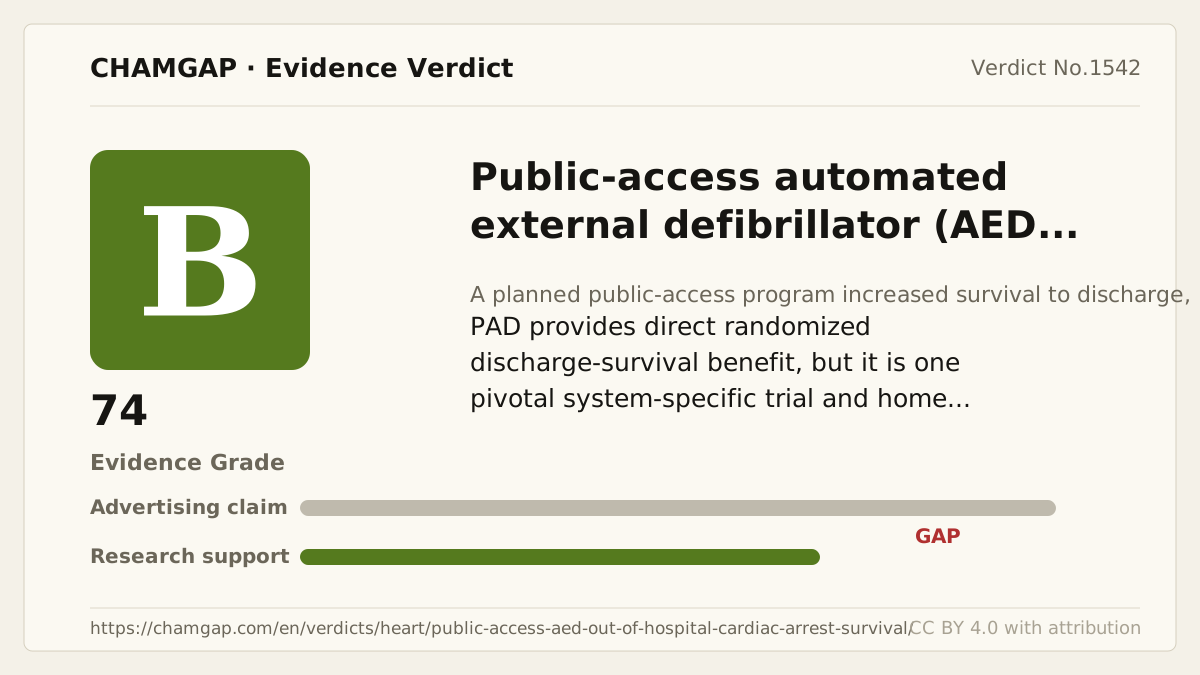
[Chamgap] Public-access AED x increased survival to hospital discharge after out-of-hospital cardiac arrest — Evidence Grade B·74. 2 cited sources checked. Source: https://chamgap.com/en/verdicts/heart/public-access-aed-out-of-hospital-cardiac-arrest-survival/ · CC BY 4.0CC BY 4.0 — free to use with attribution; do not distort grades, numbers, or verdict meaning.
What this document does and does not do
Chamgap is an information source. It reports what research has and has not confirmed; it does not tell readers what to take or buy. That decision belongs to readers and, when needed, medical or legal professionals. This verdict reflects literature available up to the search date and may change as new research appears. Nothing here is medical advice.