
Propranolol,
does it really help with Reduction in long-term all-cause mortality?
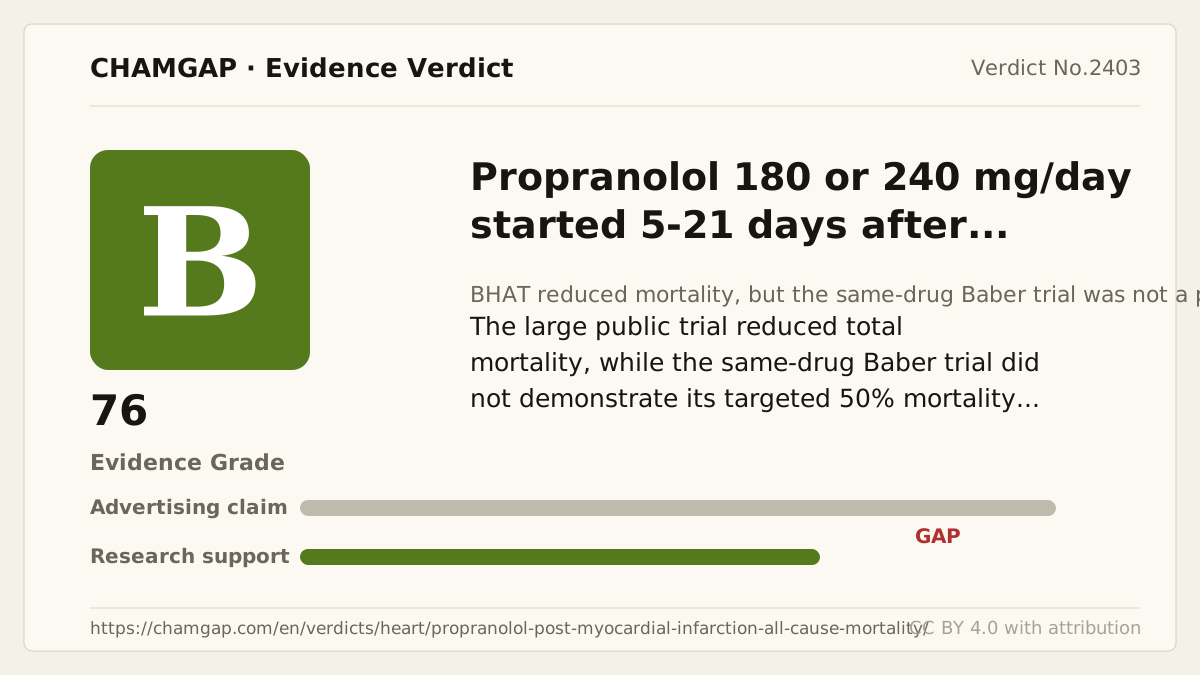
research showsThe grade is B. In the 3,837-participant NHLBI BHAT, mortality was 7.2% with propranolol versus 9.8% with placebo. The Norwegian trial used timolol, a different drug, and the Baber propranolol trial was not a positive replication.
ads claimDo not treat other beta blockers as replication of propranolol itself.
Useful facts when choosing a product
- The first-author field was the Beta-Blocker Heart Attack Trial Research Group.
- BHAT was NHLBI-sponsored.
- Baber funding, absolute death counts, and absolute harm counts could not be verified.
Chamgap Semantic Classification Code
Candidate index · review held
UNK.propranolol-180-or-started-after-myocardial-infarction.UNK.long-term-all-cause-mortality.reduce.placeboUnknown > Propranolol 180 or started after myocardial infarction > Unknown > long-term all-cause mortality > Reduction claim > Placebo
An automated migration candidate, not an issued permanent code; exact claim scope remains under review. This machine-generated migration candidate helps retrieval but is not a permanent assignment. The original verdict ID and URL remain authoritative.
What the research actually shows
BHAT randomized 3,837 patients at 31 US centers and began treatment 5-21 days after infarction. The original report gave mortality rates of 7.2% versus 9.8%; approximately 138/1,916 versus 188/1,921 are calculated values, not source-reported absolute counts. The one avoidable defect was termination nine months early. The Norwegian trial used timolol 10 mg twice daily, a different drug, and was not propranolol replication. Baber randomized 720 patients to propranolol or placebo but did not show its targeted 50% mortality reduction. Baber funding, absolute death counts, and absolute harm counts could not be verified and were not estimated.
Why this is classified as B (76)
A decisive public hard-outcome trial with early termination and no positive same-drug replication gives B with 76 points.
Counterpoint. Incremental benefit on modern therapy is a separate question.
Rejudgment record. Cross-check applied — Large public mortality trial, null Baber replication, different-drug Norwegian trial, and early termination
| Endpoint | H | Hard endpoint - actual events such as death |
| Replication | R1 | Single confirmatory trial |
| Independence | I2 | Decisive evidence is publicly or non-profit funded |
| Effect size | E+ | Meets the clinically important threshold |
Stored derived and displayed grades match; this is not a current recalculation or validity check (B).
Sub-claim grades by effect
This ingredient is marketed for several effects. A single overall grade blends strong and weak claims together, so each effect is graded separately here. The overall grade reflects the strongest disconfirming or core claim.
| Effect (sub-claim) | Grade | Basis |
|---|---|---|
| Reduced post-MI all-cause mortality | B | BHAT found 7.2% versus 9.8%. |
Cross-check — AI research and Codex final gate
Evidence Table
| Study | Design | Sample | Funding | Endpoint | Result | Weight |
|---|---|---|---|---|---|---|
| Beta-Blocker Heart Attack Trial Research Group. 1982 BHAT | Multicenter double-blind placebo-controlled randomized trial | 3,837; 1,916 versus 1,921 | National Heart, Lung, and Blood Institute-sponsored | Primary total mortality | 7.2% versus 9.8%, 26% reduction; mean follow-up about 25 months | Decisive publicly funded hard-outcome evidence |
Receipt — 3 References
All 3 cited sources were verified for existence at the original page (as of 2026-08-07).
Final verification and publication gate: Codex · Evidence date: 2026-08-07 · Corrections: none
Cite this verdict
[Chamgap] Propranolol x reduced all-cause mortality after myocardial infarction — Evidence Grade B·76. 3 cited sources checked. Source: https://chamgap.com/en/verdicts/heart/propranolol-post-myocardial-infarction-all-cause-mortality/ · CC BY 4.0CC BY 4.0 — free to use with attribution; do not distort grades, numbers, or verdict meaning.
What this document does and does not do
Chamgap is an information source. It reports what research has and has not confirmed; it does not tell readers what to take or buy. That decision belongs to readers and, when needed, medical or legal professionals. This verdict reflects literature available up to the search date and may change as new research appears. Nothing here is medical advice.