
Prehospital tourniquet,
does it really help with Reduced in-hospital mortality after civilian peripheral vascular trauma?
research showsThe grade is C with 54 points. In a retrospective civilian cohort of 1,026 patients at eleven Texas level-I trauma centers, mortality was 7/181 (3.9%) with a tourniquet and 44/845 (5.2%) without one, a nonsignificant crude difference. Multivariable analysis associated tourniquet use with survival, adjusted OR 5.86 (95% CI 1.41-24.47). There was no randomization or propensity-score matching, and confounding by indication and exclusion of prehospital deaths remain.
ads claimBattlefield experience and guideline recommendations are not grading evidence. This grade rests on civilian human mortality data and does not endorse routine use outside life-threatening extremity hemorrhage.
Useful facts when choosing a product
- The data came from eleven US civilian trauma centers, not a military registry.
- The study used multivariable regression, not propensity scores.
- Delayed amputation and transfusion were separate outcomes from mortality.
Chamgap Semantic Classification Code
Candidate index · review held
UNK.prehospital-extremity-tourniquet-use.UNK.in-hospital-mortality-after-civilian-peripheral-vascular-trauma.reduce.UNKUnknown > Prehospital extremity tourniquet use > Unknown > in-hospital mortality after civilian peripheral vascular trauma > Reduction claim > Unknown
An automated migration candidate, not an issued permanent code; exact claim scope remains under review. This machine-generated migration candidate helps retrieval but is not a permanent assignment. The original verdict ID and URL remain authoritative.
What the research actually shows
Teixeira et al. reviewed 1,026 civilian peripheral vascular injuries admitted to eleven urban Texas level-I trauma centers from 2011 through 2016: 181 received prehospital tourniquets and 845 did not. They used logistic regression, not propensity scoring or matching. Delayed amputation was 1.1% in each group, adjusted OR 1.82 (0.36-9.99). Mean 24-hour red-cell transfusion was 5.0 versus 3.9 units and was not significant; plasma was 2.8 versus 1.8 units. Product-manufacturer funding could not be established from the publicly accessible reporting.
Why this is classified as C (54)
A favorable adjusted mortality association is offset by multiple major observational limitations, giving C with 54 points.
Counterpoint. A 2026 propensity-matched urban penetrating-trauma analysis was null, but its population and injury scope differ and were not treated as direct replication or refutation.
Rejudgment record. Cross-check applied — Cross-checked civilian setting, denominators, absolute mortality, adjustment method, absence of propensity analysis, and separate amputation and transfusion outcomes
| Endpoint | H | Hard endpoint - actual events such as death |
| Replication | R1 | Single confirmatory trial |
| Independence | I1 | Mixed funding sources |
| Effect size | E+ | Meets the clinically important threshold |
Stored derived and displayed grades match; this is not a current recalculation or validity check (C).
Sub-claim grades by effect
This ingredient is marketed for several effects. A single overall grade blends strong and weak claims together, so each effect is graded separately here. The overall grade reflects the strongest disconfirming or core claim.
| Effect (sub-claim) | Grade | Basis |
|---|---|---|
| Reduced mortality after civilian peripheral vascular injury | C | Adjusted survival was favorable, but observational bias is substantial. |
| Reduced delayed amputation | D | Rates were identical at 1.1% versus 1.1%. |
Cross-check — AI research and Codex final gate
Evidence Table
| Study | Design | Sample | Funding | Endpoint | Result | Weight |
|---|---|---|---|---|---|---|
| Teixeira et al. 2018 | Eleven-center civilian retrospective cohort | 1,026 patients; 181 with and 845 without a tourniquet | Manufacturer funding could not be established | In-hospital mortality; delayed amputation as secondary outcome | Mortality 7/181 (3.9%) versus 44/845 (5.2%); adjusted survival OR 5.86 (1.41-24.47); delayed amputation 1.1% versus 1.1% | Direct hard-outcome evidence with residual confounding by indication |
Receipt — 2 References
All 2 cited sources were verified for existence at the original page (as of 2026-08-05).
Final verification and publication gate: Codex · Evidence date: 2026-08-05 · Corrections: none
Cite this verdict
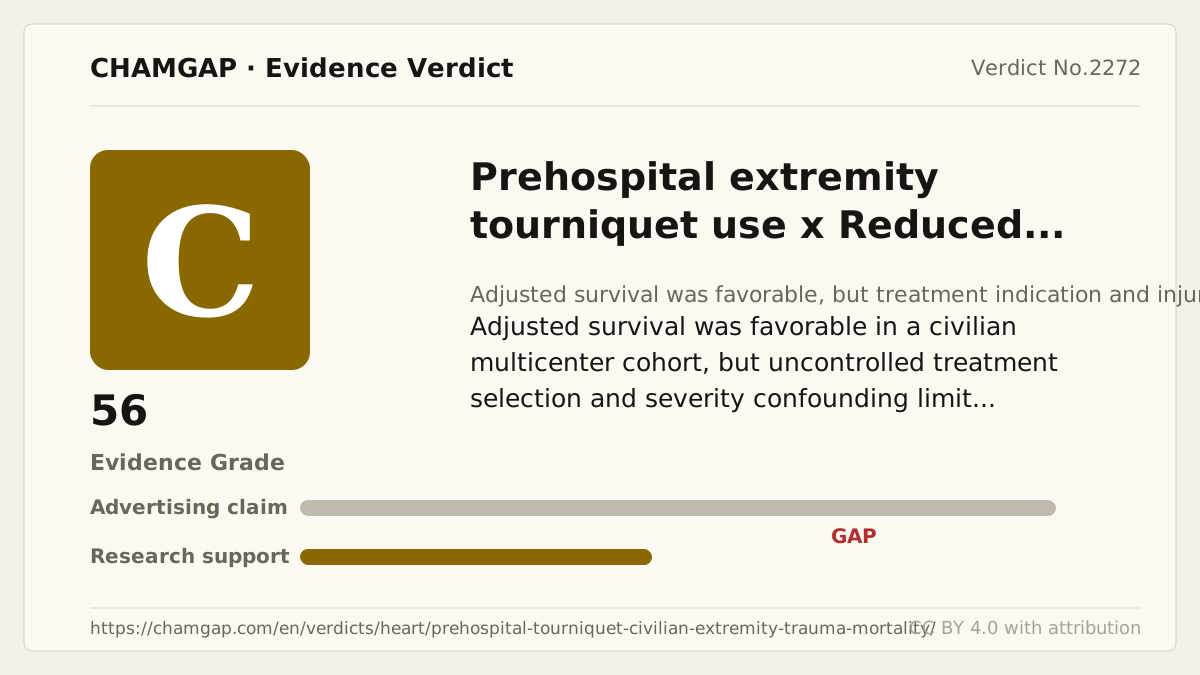
[Chamgap] Prehospital tourniquet x mortality after extremity trauma — Evidence Grade C·54. 2 cited sources checked. Source: https://chamgap.com/en/verdicts/heart/prehospital-tourniquet-civilian-extremity-trauma-mortality/ · CC BY 4.0CC BY 4.0 — free to use with attribution; do not distort grades, numbers, or verdict meaning.
What this document does and does not do
Chamgap is an information source. It reports what research has and has not confirmed; it does not tell readers what to take or buy. That decision belongs to readers and, when needed, medical or legal professionals. This verdict reflects literature available up to the search date and may change as new research appears. Nothing here is medical advice.