
Pravastatin,
does it really help with Primary prevention of coronary heart disease death and nonfatal myocardial infarction in adults with hypercholesterolemia and no prior myocardial infarction?
research showsPravastatin is rated A because a large ingredient-specific trial prevented coronary heart disease death or nonfatal myocardial infarction in hypercholesterolemic men without prior myocardial infarction. WOSCOPS followed 6,595 participants for a mean 4.9 years and reduced this hard composite endpoint from 7.9% to 5.5%, a 31% relative reduction. All-cause mortality moved 22% lower but was of borderline statistical significance, while the secondary-prevention LIPID trial replicated cardiovascular benefit in a different population. LDL reduction itself is a surrogate; the clinical-event reduction supports A.
ads claimPromotion may imply that lowering LDL produces the same absolute reduction in myocardial infarction for everyone. Absolute benefit varies with baseline cardiovascular risk, and this verdict most directly fits a primary-prevention population resembling the hypercholesterolemic WOSCOPS participants.
Useful facts when choosing a product
- Pravastatin is an oral prescription statin that can be taken without regard to food. Dose and goals are determined by age, comorbidity, and total cardiovascular risk rather than LDL concentration alone.
- Unexplained muscle pain, weakness, or dark urine warrants medical assessment. Severe muscle injury is rare, but risk can increase with interacting medicines and impaired kidney function.
- Liver-enzyme elevations and a small increase in glucose or diabetes risk are recognized safety issues. Pravastatin is generally stopped during pregnancy, with individualized risk and alternatives discussed with the prescriber.
Chamgap Semantic Classification Code
Candidate index · review held
M.pravastatin.UNK.primary-prevention-of-coronary-heart-disease-death-and-nonfatal-myocardial-infarction-with-hypercholesterolemia-and-no-prior-myocardial-infarction.prevent.MULTIMedicinal interventions > Pravastatin > Unknown > Primary prevention of coronary heart disease death and nonfatal myocardial infarction with hypercholesterolemia and no prior myocardial infarction > Occurrence-prevention claim > Multiple: primary unresolved
An automated migration candidate, not an issued permanent code; exact claim scope remains under review. This machine-generated migration candidate helps retrieval but is not a permanent assignment. The original verdict ID and URL remain authoritative.
What the research actually shows
Shepherd and colleagues for the WOSCOPS Study Group assigned 6,595 hypercholesterolemic men aged 45 to 64 years without prior myocardial infarction to pravastatin 40 mg or placebo. During a mean 4.9 years, definite coronary death or nonfatal myocardial infarction occurred 248 times with placebo and 174 times with pravastatin, a 31% relative reduction and an absolute incidence decline from about 7.9% to 5.5%. All-cause mortality was 22% lower, but its confidence interval included no reduction and P equaled 0.051. The separate 9,014-participant LIPID trial reduced coronary and all-cause death in secondary-prevention patients with prior myocardial infarction or unstable angina, replicating ingredient activity in another high-risk setting; WOSCOPS remains the direct evidence for this primary-prevention verdict. Unlike the existing simvastatin verdict 681 in high-risk patients, this entry specifically concerns pravastatin and primary prevention without prior myocardial infarction.
Why this is classified as A (88)
The 6,595-participant double-blind placebo-controlled WOSCOPS trial directly reduced coronary death or nonfatal myocardial infarction from 7.9% to 5.5% in hypercholesterolemic men without prior myocardial infarction. This large ingredient-specific randomized hard-endpoint benefit supports A with 88 points. Borderline all-cause mortality and the surrogate nature of LDL reduction temper the score.
Counterpoint. Whether and how intensively to use pravastatin depends on individual absolute cardiovascular risk, preferences, comparative statin intensity, interactions, and tolerability rather than a trial average alone.
Rejudgment record. Cross-check applied — Applied A because the 6,595-participant ingredient-specific double-blind placebo-controlled WOSCOPS trial directly reduced the hard endpoint of coronary death or nonfatal myocardial infarction from 7.9% to 5.5% in hypercholesterolemic men without prior myocardial infarction
Sub-claim grades by effect
This ingredient is marketed for several effects. A single overall grade blends strong and weak claims together, so each effect is graded separately here. The overall grade reflects the strongest disconfirming or core claim.
| Effect (sub-claim) | Grade | Basis |
|---|---|---|
| Prevention of coronary death or nonfatal myocardial infarction in hypercholesterolemic adults without prior myocardial infarction | A | WOSCOPS reduced the hard composite endpoint from approximately 7.9% to 5.5%. |
| Reduced all-cause mortality in primary prevention | B | WOSCOPS showed a 22% reduction in direction, but statistical significance was borderline at P=0.051. |
| Reduced coronary and all-cause mortality after prior myocardial infarction or unstable angina | A | Directly demonstrated in the secondary-prevention LIPID population, which is a separate indication from the current primary-prevention claim. |
Cross-check — AI research and Codex final gate
Evidence Table
| Study | Design | Sample | Funding | Endpoint | Result | Weight |
|---|---|---|---|---|---|---|
| Shepherd J et al., WOSCOPS Study Group. 1995 | Multicenter randomized double-blind placebo-controlled primary-prevention trial | 6,595 hypercholesterolemic men without a history of myocardial infarction | Supported by Bristol-Myers Squibb | Definite coronary heart disease death or nonfatal myocardial infarction | At a mean 4.9 years there were 248 versus 174 events, approximately 7.9% versus 5.5%, for a 31% relative reduction. | Pivotal ingredient-specific primary-prevention hard-endpoint randomized trial |
| LIPID Study Group. 1998 | Multicenter randomized double-blind placebo-controlled secondary-prevention trial | 9,014 patients with prior myocardial infarction or unstable angina | Supported by Bristol-Myers Squibb and Australian public research funding | Coronary heart disease death; all-cause mortality; cardiovascular events | Coronary death fell from 8.3% to 6.4% and all-cause mortality from 14.1% to 11.0%. | Ingredient-effect replication in another indication; indirect to the current primary-prevention verdict |
| Nakamura H et al., MEGA Study Group. 2006 | Prospective randomized open-label blinded-endpoint primary-prevention trial | 7,832 Japanese patients with hypercholesterolemia and no history of coronary heart disease or stroke | Sponsored by the Mitsukoshi Health and Welfare Foundation with the Japanese Ministry of Health, Labour and Welfare and Daiichi Sankyo as collaborators per the ClinicalTrials.gov registration; the funding statement in the article itself was not verified | First occurrence of coronary heart disease (primary endpoint) | At a mean 5.3 years there were 101 events with diet alone versus 66 with diet plus pravastatin; HR 0.67, 95% CI 0.49-0.91, P=0.01. | Independent primary-prevention replication by different investigators with different funding in another population; open-label low-dose (10-20 mg) design |
| ALLHAT Officers and Coordinators for the ALLHAT Collaborative Research Group. 2002 | Multicenter randomized nonblinded pragmatic trial versus usual care | 10,355 hypertensive patients aged 55 years or older with moderate hypercholesterolemia, including 14% with a history of coronary heart disease | Supported by the US NHLBI (N01-HC-35130) | Primary all-cause mortality; secondary nonfatal myocardial infarction or fatal coronary heart disease events | At a mean 4.8 years all-cause mortality showed RR 0.99 (95% CI 0.89-1.11, P=0.88) and coronary heart disease events RR 0.91 (95% CI 0.79-1.04, P=0.16), neither significant; lipid-lowering drug use in up to 32% of the usual-care group narrowed the between-group cholesterol difference. | Null result from a large publicly funded trial; interpretation is limited by usual-care crossover and the nonblinded design, and the population only partly overlaps the current primary-prevention verdict |
Receipt — 4 References
All 4 cited sources were verified for existence at the original page (as of 2026-08-11).
Final verification and publication gate: Codex · Evidence date: 2026-08-11 · Corrections: none
Cite this verdict
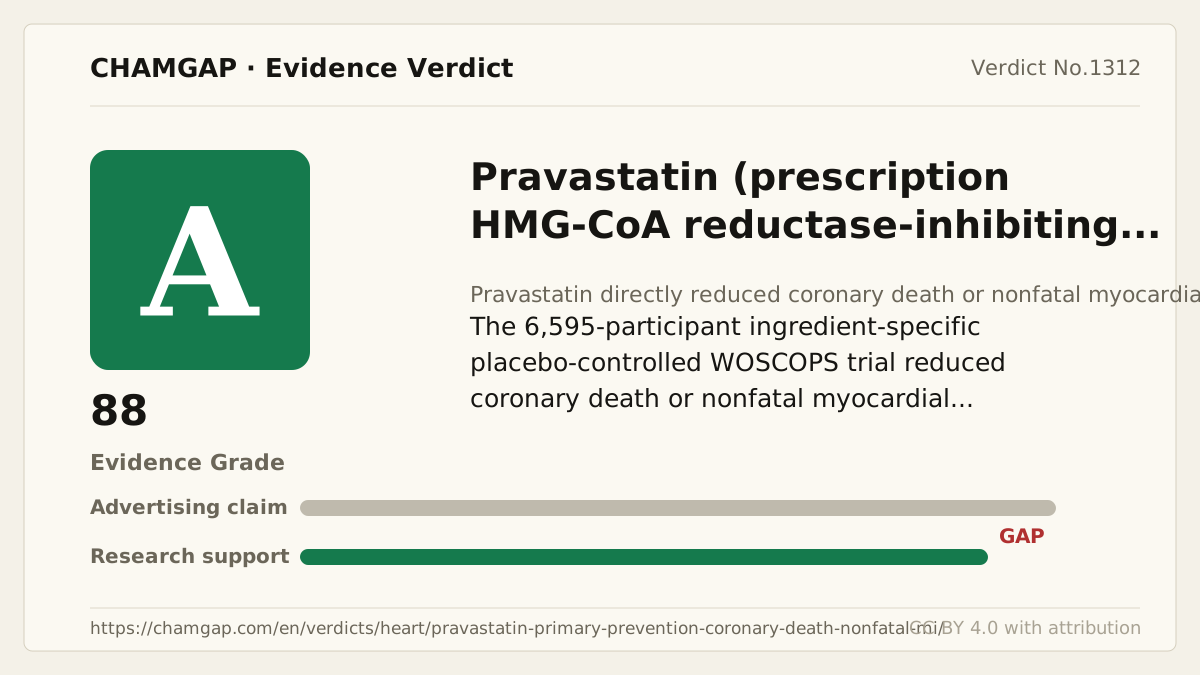
[Chamgap] Pravastatin x primary prevention of coronary death and nonfatal myocardial infarction — Evidence Grade A·88. 4 cited sources checked. Source: https://chamgap.com/en/verdicts/heart/pravastatin-primary-prevention-coronary-death-nonfatal-mi/ · CC BY 4.0CC BY 4.0 — free to use with attribution; do not distort grades, numbers, or verdict meaning.
What this document does and does not do
Chamgap is an information source. It reports what research has and has not confirmed; it does not tell readers what to take or buy. That decision belongs to readers and, when needed, medical or legal professionals. This verdict reflects literature available up to the search date and may change as new research appears. Nothing here is medical advice.