
New perioperative metoprolol initiation,
does it really help with Safe prevention of cardiovascular events?
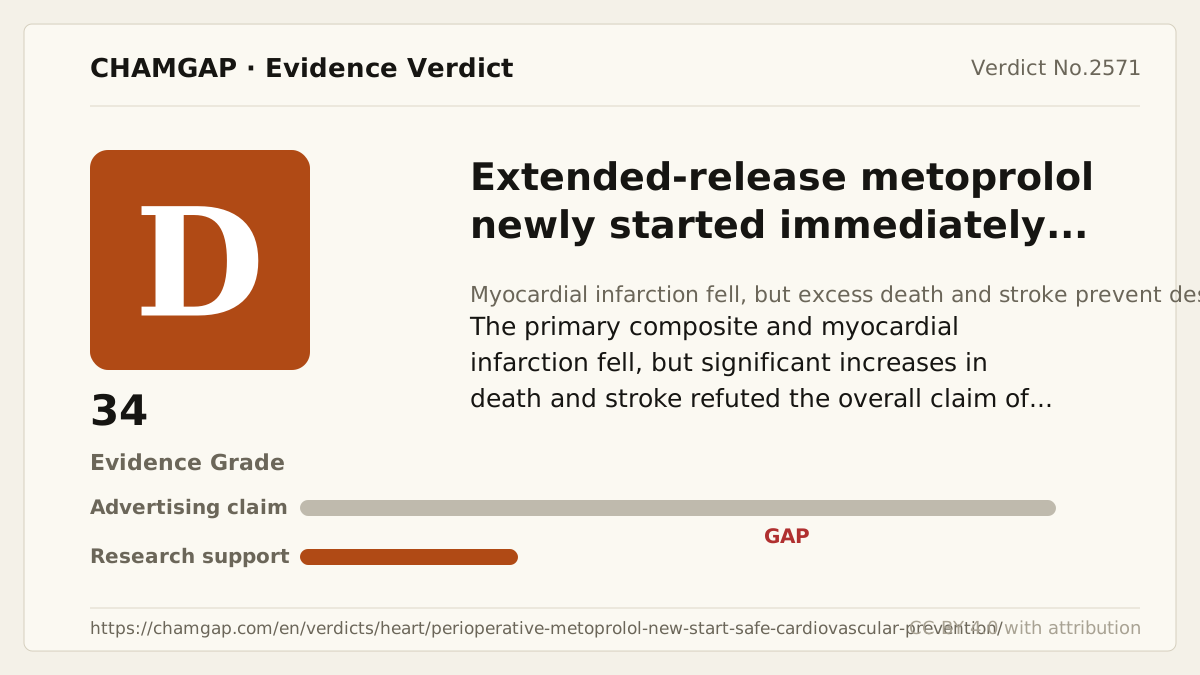
research showsThe grade is D. In 8,351 POISE participants, the 30-day primary composite fell from 6.9% to 5.8%, but all-cause death rose from 2.3% to 3.1% and stroke from 0.5% to 1.0%. Myocardial-infarction benefit and fatal or disabling harm occurred together, so the claim of safe prevention fails. Only POISE established the harm, so this is D with 34 points rather than F.
ads claimContinuing a stable chronic beta-blocker and newly starting high-dose metoprolol on surgery day are different questions. Advertising the myocardial-infarction reduction as safe protection omits the mortality and stroke excesses.
Useful facts when choosing a product
- POISE began extended-release metoprolol two to four hours before surgery and continued it for 30 days against matching placebo.
- Verdict 1598 is F with 10 points after myocardial infarction with ejection fraction at least 50%, while verdict 969 is A with 92 points in stable symptomatic HFrEF; both are different indications.
- Propranolol verdict 1862 is C with 54 points and verdict 797 is C with 42 points; their drugs, indications, and endpoints differ.
Chamgap Semantic Classification Code
Candidate index · review held
P.extended-release-metoprolol-newly-started-immediately-before-non-cardiac-surgery.procedural.safe-prevention-of-cardiovascular-events.prevent.placeboProcedures, devices and tests > Extended-release metoprolol newly started immediately before non-cardiac surgery > Procedural > Safe prevention of cardiovascular events > Occurrence-prevention claim > Placebo
An automated migration candidate, not an issued permanent code; exact claim scope remains under review. This machine-generated migration candidate helps retrieval but is not a permanent assignment. The original verdict ID and URL remain authoritative.
What the research actually shows
The POISE Study Group started extended-release metoprolol two to four hours before surgery in patients not already taking a beta-blocker and continued it for 30 days. All 8,351 analyzed participants were included in the reported intention-to-treat analyses, 8,331 (99.8%) completed 30-day follow-up, and blinded adjudicators assessed events. Data from 947 randomized participants at sites with verified fraud were removed before outcome unblinding, so the report did not analyze every randomized record. DIPOM enrolled 921 and found a primary-composite HR of 1.06 (0.80-1.41), mortality RR of 1.32 (0.69-2.56), and long-term mortality HR of 1.03 (0.74-1.42). In 496 MaVS participants, death was 0/246 versus 4/250 and stroke 5/246 versus 4/250, so POISE's 30-day death and stroke harms were not significantly replicated. MaVS did find more intraoperative bradycardia requiring treatment, 53/246 versus 19/250 (P=.00001), and hypotension requiring treatment, 114/246 versus 84/250 (P=.0045). Those intraoperative physiologic harms were not counted as replication of POISE because the endpoints differed from 30-day death and stroke. AstraZeneca supplied POISE study drug; DIPOM combined foundation, hospital, and AstraZeneca support; MaVS was funded by the Heart and Stroke Foundation of Canada.
Why this is classified as D (34)
A large hard-outcome trial reduced myocardial infarction but significantly increased death and stroke, refuting safe prevention. Because harm was confirmed by only one trial, the result is D; the hard endpoint and large trial give 34 points.
Counterpoint. This verdict does not assess continuation of chronic beta-blocker therapy or treatment of another cardiac indication.
Rejudgment record. Cross-check applied — We cross-checked timing, analyzed counts, prespecified primary outcome, mortality, stroke, funding, and independent replication in the POISE, DIPOM, and MaVS reports and registration.
| Endpoint | H | Hard endpoint - actual events such as death |
| Replication | R1 | Single confirmatory trial |
| Independence | I1 | Mixed funding sources |
| Effect size | E- | Harm increased in the trials |
| Precision | C0 | The confidence interval leaves room for benefit |
Stored derived and displayed grades match; this is not a current recalculation or validity check (D).
Sub-claim grades by effect
This ingredient is marketed for several effects. A single overall grade blends strong and weak claims together, so each effect is graded separately here. The overall grade reflects the strongest disconfirming or core claim.
| Effect (sub-claim) | Grade | Basis |
|---|---|---|
| Reduced 30-day cardiovascular composite | B | POISE found 5.8% versus 6.9%, HR 0.84 (0.70-0.99). |
| Safe prevention without increased death or stroke | D | All-cause death and stroke each increased significantly. |
Cross-check — AI research and Codex final gate
Evidence Table
| Study | Design | Sample | Funding | Endpoint | Result | Weight |
|---|---|---|---|---|---|---|
| POISE Study Group, 2008 POISE | Multinational double-blind randomized placebo-controlled trial | 8,351 analyzed, 4,174 metoprolol and 4,177 placebo; 8,331 completed 30-day follow-up | Canadian public and nonprofit multicenter support, with study drug supplied by AstraZeneca | 30-day composite of cardiovascular death, nonfatal myocardial infarction, or nonfatal cardiac arrest; all-cause death and stroke | Composite 244/4,174 (5.8%) vs 290/4,177 (6.9%), HR 0.84 (0.70-0.99); death HR 1.33 (1.03-1.74), stroke HR 2.17 (1.26-3.74) | Pivotal large hard-outcome evidence |
| Juul AB, Wetterslev J, Gluud C et al., 2006 DIPOM | Multicenter double-blind randomized placebo-controlled trial | 921 randomized, 462 versus 459 | Mixed support including Danish foundations, Copenhagen Hospital Corporation, and AstraZeneca | Median 18-month composite of death, myocardial infarction, unstable angina, or heart failure | Composite 99/462 (21%) vs 93/459 (20%), HR 1.06 (0.80-1.41); death HR 1.03 (0.74-1.42) | Supporting evidence confirming neither benefit nor harm |
| Yang H, Raymer K, Butler R, Parlow J et al., 2006 MaVS | Double-blind randomized placebo-controlled trial | 496 randomized, 246 versus 250 | Heart and Stroke Foundation of Canada | 30-day composite of cardiac death, myocardial infarction, unstable angina, heart failure, or ventricular tachycardia; death and stroke; intraoperative bradycardia and hypotension requiring treatment | Composite 25/246 (10.2%) vs 30/250 (12.0%), relative risk reduction 15.3% (95% CI -38.3% to 48.2%); death 0/246 vs 4/250 and stroke 5/246 vs 4/250; intraoperative bradycardia 53/246 vs 19/250 (P=.00001) and hypotension 114/246 vs 84/250 (P=.0045) | Smaller evidence showing intraoperative bradycardia and hypotension but not replicating POISE death and stroke because the endpoints differed |
Receipt — 3 References
All 3 cited sources were verified for existence at the original page (as of 2026-08-14).
Final verification and publication gate: Codex · Evidence date: 2026-08-14 · Corrections: none
Cite this verdict
[Chamgap] New perioperative metoprolol initiation x safe cardiovascular-event prevention — Evidence Grade D·34. 3 cited sources checked. Source: https://chamgap.com/en/verdicts/heart/perioperative-metoprolol-new-start-safe-cardiovascular-prevention/ · CC BY 4.0CC BY 4.0 — free to use with attribution; do not distort grades, numbers, or verdict meaning.
What this document does and does not do
Chamgap is an information source. It reports what research has and has not confirmed; it does not tell readers what to take or buy. That decision belongs to readers and, when needed, medical or legal professionals. This verdict reflects literature available up to the search date and may change as new research appears. Nothing here is medical advice.