
Perioperative aspirin,
does it really help with Prevention of 30-day death or nonfatal myocardial infarction?
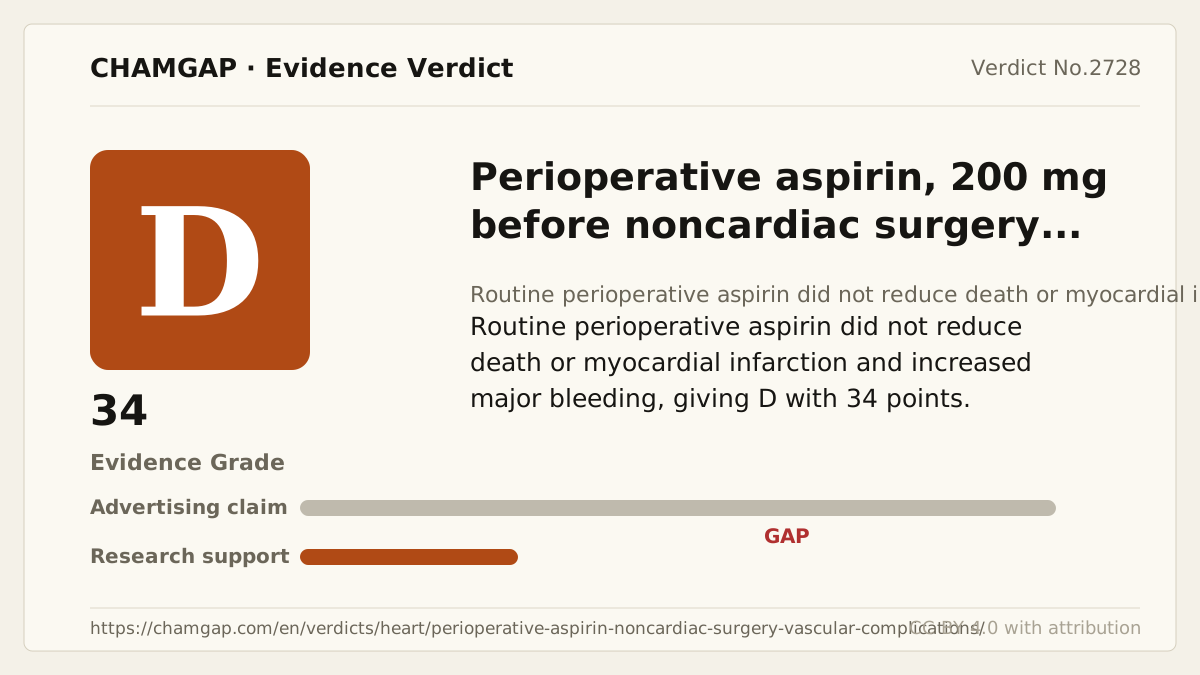
research showsThe grade is D with 34 points. POISE-2 assigned 10,010 patients to aspirin, 4,998, or placebo, 5,012. Death or nonfatal myocardial infarction occurred in 7.0% versus 7.1%, hazard ratio 0.99 (95% CI 0.86 to 1.15; P=.92), while major bleeding increased to 4.6% versus 3.8%, hazard ratio 1.23 (1.01 to 1.49; P=.04).
ads claimThis does not mean aspirin should be stopped for a recent coronary stent or another separate high-risk indication. The verdict is limited to routine perioperative prevention around noncardiac surgery.
Useful facts when choosing a product
- POISE-2 evaluated aspirin and clonidine separately in a 2-by-2 factorial design.
- The aspirin comparison is registered as NCT01082874.
- Aspirin began at 200 mg two to four hours before surgery, followed by 100 mg daily.
Chamgap Semantic Classification Code
Candidate index · review held
P.perioperative-aspirin.procedural.death-or-nonfatal-myocardial-infarction.prevent.MULTIProcedures, devices and tests > Perioperative aspirin > Procedural > death or nonfatal myocardial infarction > Occurrence-prevention claim > Multiple: primary unresolved
An automated migration candidate, not an issued permanent code; exact claim scope remains under review. This machine-generated migration candidate helps retrieval but is not a permanent assignment. The original verdict ID and URL remain authoritative.
What the research actually shows
POISE-2 was an international placebo-controlled 2-by-2 factorial trial; this verdict isolates 4,998 aspirin versus 5,012 placebo patients and does not mix clonidine outcomes. Canadian, Australian, and Spanish public grants were combined with aspirin supplied by Bayer and clonidine plus some funding from Boehringer Ingelheim. Industry support affected funding independence only. Axis 6 B0 evidence ① Allocation concealment: "Randomization was performed in fixed blocks with the use of a computerized interactive Web-based randomization system, with stratification according to center and status with respect to long-term aspirin therapy." ② Masking: "Patients, health care providers, data collectors, and outcome adjudicators were unaware of the study-group assignments." ③ Analysis population and missing data: "We will analyze patients in the treatment group to which they are allocated, according to the intention-to-treat principle."; "The 30-day follow-up was complete for 99.9% of the participants." ④ Prespecified primary outcome: "The primary outcome was a composite of death or nonfatal myocardial infarction at 30 days." — matches registration NCT01082874
Why this is classified as D (34)
A well-conducted 10,010-patient hard-outcome trial found no benefit and increased major bleeding, but repeated independent refutation is absent, giving D with 34 points.
Counterpoint. Stent timing, coronary risk, surgical bleeding risk, and the existing indication require individualized specialist decisions.
Rejudgment record. Cross-check applied — Cross-checked the NEJM report, protocol, and NCT01082874 for factorial design, central web randomization, intention-to-treat analysis, 99.9% follow-up, prespecified outcome, mixed funding, and bleeding
| Endpoint | H | Hard endpoint - actual events such as death |
| Replication | R1 | Single confirmatory trial |
| Independence | I1 | Mixed funding sources |
| Effect size | E- | Harm increased in the trials |
| Precision | C0 | The confidence interval leaves room for benefit |
Stored derived and displayed grades match; this is not a current recalculation or validity check (D).
Sub-claim grades by effect
This ingredient is marketed for several effects. A single overall grade blends strong and weak claims together, so each effect is graded separately here. The overall grade reflects the strongest disconfirming or core claim.
| Effect (sub-claim) | Grade | Basis |
|---|---|---|
| Prevention of 30-day death or nonfatal myocardial infarction | D | Rates were 7.0% versus 7.1%, with no benefit. |
| Aspirin for a recent stent or another separate indication | ? | This is outside the graded question. |
Cross-check — AI research and Codex final gate
Evidence Table
| Study | Design | Sample | Funding | Endpoint | Result | Weight |
|---|---|---|---|---|---|---|
| Devereaux PJ et al. 2014 POISE-2 aspirin comparison | International double-blind placebo-controlled 2-by-2 factorial randomized trial | 10,010 randomized, 4,998 aspirin and 5,012 placebo; 99.9% 30-day follow-up | Canadian, Australian, and Spanish public grants plus Bayer study drug and some Boehringer Ingelheim funding | Death or nonfatal myocardial infarction at 30 days | 7.0% versus 7.1%, HR 0.99 (95% CI 0.86 to 1.15); major bleeding 4.6% versus 3.8%, HR 1.23 (1.01 to 1.49) | Large hard-outcome null trial with harm |
Receipt — 1 References
All 1 cited sources were verified for existence at the original page (as of 2026-08-18).
Final verification and publication gate: Codex · Evidence date: 2026-08-18 · Corrections: none
Cite this verdict
[Chamgap] Perioperative aspirin x vascular complications after noncardiac surgery — Evidence Grade D·34. 1 cited sources checked. Source: https://chamgap.com/en/verdicts/heart/perioperative-aspirin-noncardiac-surgery-vascular-complications/ · CC BY 4.0CC BY 4.0 — free to use with attribution; do not distort grades, numbers, or verdict meaning.
What this document does and does not do
Chamgap is an information source. It reports what research has and has not confirmed; it does not tell readers what to take or buy. That decision belongs to readers and, when needed, medical or legal professionals. This verdict reflects literature available up to the search date and may change as new research appears. Nothing here is medical advice.