
Initial outpatient treatment,
does it really help with Noninferior 90-day recurrence in low-risk acute pulmonary embolism?
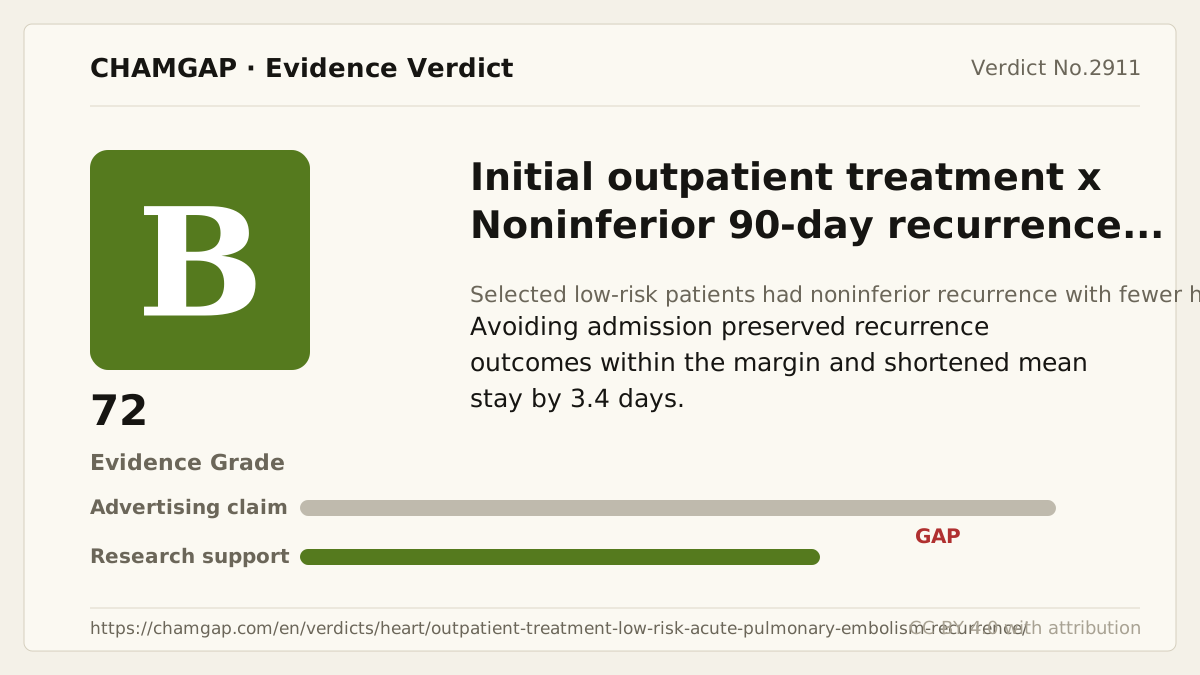
research showsGrade B, 72 points. Symptomatic recurrent VTE occurred in 1/171 outpatients (0.6%) versus 0/168 inpatients; the one-sided 95% upper limit of 2.7 points remained below the prespecified 4-point noninferiority margin. Mean stay was 0.5 versus 3.9 days.
ads claimThis less-is-more strategy omits admission after diagnosis, not diagnostic testing. Verdict 2841 is B with 72 points (/verdicts/heart/perc-rule-very-low-risk-pe-missed-vte/) and asks whether testing can be omitted in very-low-risk suspected PE; this verdict asks whether admission can be omitted after confirmed low-risk PE. The trial did not directly report cost. Satisfaction was 92% versus 95%.
Useful facts when choosing a product
- Outpatients were discharged within 24 hours of randomization.
- Mean stay was 0.5 versus 3.9 days.
- The trial did not directly report cost.
Chamgap Semantic Classification Code
Candidate index · review held
UNK.initial-outpatient-treatment.UNK.recurrence-in-low-risk-acute-pulmonary-embolism.noninferior.MULTIUnknown > Initial outpatient treatment > Unknown > recurrence in low-risk acute pulmonary embolism > Noninferiority claim > Multiple: primary unresolved
An automated migration candidate, not an issued permanent code; exact claim scope remains under review. This machine-generated migration candidate helps retrieval but is not a permanent assignment. The original verdict ID and URL remain authoritative.
What the research actually shows
Four-gate review: ① Noninferiority design ② listed item ③ the paper states, "We used a non-inferiority margin of 4%"; the recurrence upper limit was 2.7 points ④ avoidable with a superiority design, so counted. ① Active control only ② listed item ③ both groups received the same anticoagulation and differed in setting ④ untreated placebo care was not feasible, so not counted. ① Unmasked subjective endpoint ② listed item ③ open label, but imaging-confirmed recurrence and death were objective ④ criterion not met.
Why this is classified as B (72)
A 344-person hard-outcome RCT crossed the 4-point noninferiority margin. Mixed public support and Sanofi-Aventis study-drug supply, plus a single noninferiority trial, give B, 72.
Counterpoint. The 90-day major-bleeding upper limit exceeded the safety margin by 0.5 points.
Rejudgment record. Source checked — The 90-day recurrence upper confidence limit stayed within the prespecified 4-point margin
| Endpoint | H | Hard endpoint - actual events such as death |
| Replication | R1 | Single confirmatory trial |
| Independence | I1 | Mixed funding sources |
| Effect size | E+ | Meets the clinically important threshold |
Stored derived and displayed grades match; this is not a current recalculation or validity check (B).
Sub-claim grades by effect
This ingredient is marketed for several effects. A single overall grade blends strong and weak claims together, so each effect is graded separately here. The overall grade reflects the strongest disconfirming or core claim.
| Effect (sub-claim) | Grade | Basis |
|---|---|---|
| Noninferior 90-day recurrence | B | The upper limit of 2.7 points was within the 4-point margin. |
| Shorter hospitalization | B | Mean stay was 0.5 versus 3.9 days. |
Cross-check — AI research and Codex final gate
Evidence Table
| Study | Design | Sample | Funding | Endpoint | Result | Weight |
|---|---|---|---|---|---|---|
| Aujesky et al. OTPE | International multicenter open-label randomized noninferiority trial | 344 enrolled, 339 in primary analysis (171/168) | Swiss National Science Foundation, French Programme Hospitalier de Recherche Clinique, and US NHLBI; Sanofi-Aventis supplied study drug at European centers | Symptomatic recurrent venous thromboembolism within 90 days | 1/171 (0.6%) vs 0/168; one-sided 95% upper limit 2.7 points; margin 4 points | Hard recurrent-event noninferiority evidence |
Receipt — 1 References
All 1 cited sources were verified for existence at the original page (as of 2026-08-26).
Final verification and publication gate: Codex · Evidence date: 2026-08-26 · Corrections: none
Cite this verdict
[Chamgap] Benefit of Outpatient Treatment for Noninferior 90-Day Recurrence in Low-Risk Acute Pulmonary Embolism — Evidence Grade B·72. 1 cited sources checked. Source: https://chamgap.com/en/verdicts/heart/outpatient-treatment-low-risk-acute-pulmonary-embolism-recurrence/ · CC BY 4.0CC BY 4.0 — free to use with attribution; do not distort grades, numbers, or verdict meaning.
What this document does and does not do
Chamgap is an information source. It reports what research has and has not confirmed; it does not tell readers what to take or buy. That decision belongs to readers and, when needed, medical or legal professionals. This verdict reflects literature available up to the search date and may change as new research appears. Nothing here is medical advice.