
Single-ingredient oral vitamin C,
does it really help with Blood-pressure reduction in hypertension or prehypertension?
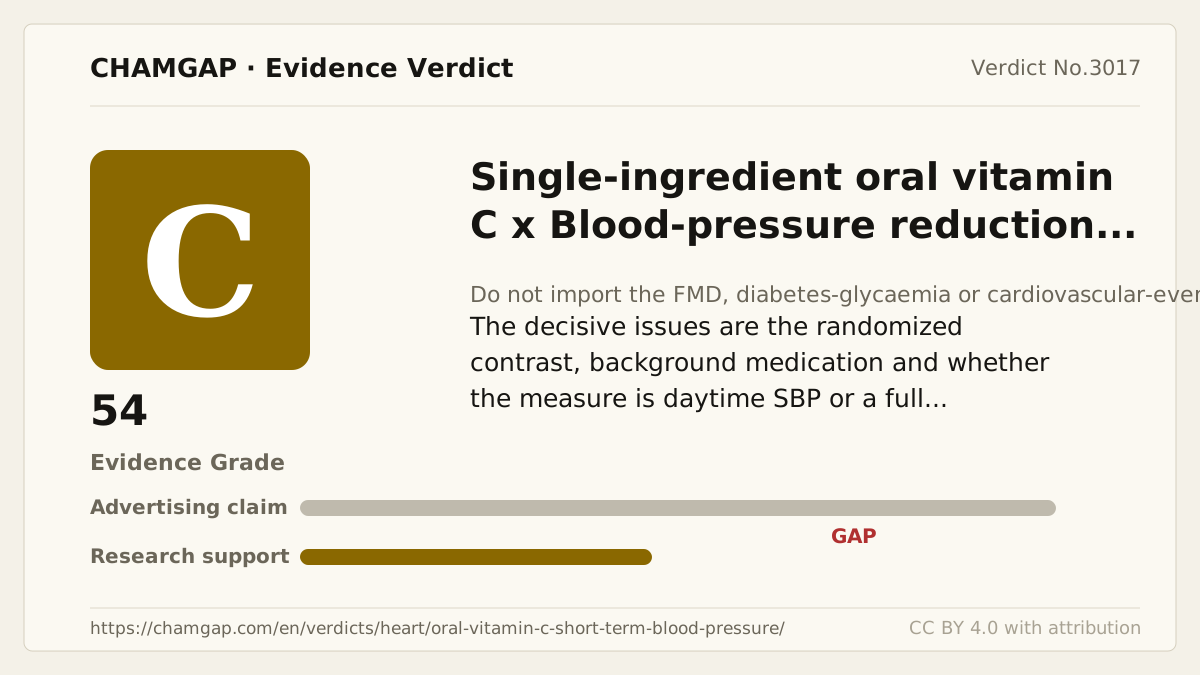
research showsGrade C with 54 points. Meta-analyses of randomized trials show an approximately 3-mmHg systolic signal, but mostly short heterogeneous studies do not establish 24-hour, nocturnal, or cardiovascular-event benefit.
ads claimClaims of replacing antihypertensive treatment or preventing cardiovascular events go beyond the evidence examined.
Useful facts when choosing a product
- This verdict concerns single-ingredient oral vitamin C and does not automatically include foods, combinations, or intravenous infusion.
- Trials with different doses, durations, and populations were not treated as interchangeable.
- High oral doses can cause gastrointestinal effects; caution is warranted with stone risk, kidney disease, or iron overload.
Chamgap Semantic Classification Code
Permanent code issued
S.vitamin-c.oral.blood-pressure.reduce.placeboSupplements and nutraceuticals > Vitamin C > Oral > Blood pressure > Reduction claim > Placebo
Permanent semantic code issued. Dose, duration, population, and endpoint boundaries remain in the exact facets and duplicate key. The code identifies the intervention and claim; it never contains the evidence grade, score, or safety result.
Exact Claim Classification
These independent facets prevent evidence from different forms, routes, populations, effects, and comparators from being mixed.
| Intervention class | S · Supplement or nutraceutical |
|---|---|
| Canonical ingredient or intervention | Vitamin C |
| Source or part used | Purified nutrient. Feedstock, manufacturing process and country are unverified; plant part is not applicable. |
| Formulation or processing | Single-ingredient ascorbic acid supplement; unverified tablet/capsule, salt and excipient details are flagged by study. |
| Route | Oral |
| Dose | Direct trial: 500 mg/day; other regimens 500–2000 mg/day; acute 2 g is separate |
| Duration | Six-week direct trial; one month, three-month crossover periods and longer studies kept separate |
| Population | Treated hypertensive adults directly; older general-population and diabetic cohorts are separate |
| Effect or condition | Blood-pressure reduction in hypertension or prehypertension |
| Primary endpoint | Office and ambulatory SBP/DBP treated separately |
| Comparator | Matched placebo; grape-seed combination and low-dose active comparators separated |
| Duplicate-detection key | vitamin-c|oral|hypertension-prehypertension-adults|blood-pressure-reduction|office-ambulatory |
What the research actually shows
Trials added a supplement to existing care or compared it with placebo; they did not test a fruit-and-vegetable dietary pattern.
Why this is classified as C (54)
A pooled short-term surrogate signal and independence are strengths; conflicting trials, nonclinical endpoints, and short duration cap the grade at C with 54 points.
Counterpoint. Uncertainty is not proof of no effect. Conversely, secondary BP findings in a different disease do not supply confirmation.
Rejudgment record. Independent Codex cross-check — One page, one route, one population, one claim, one principal comparator
| Endpoint | S | Surrogate marker - laboratory or imaging measures |
| Replication | R0 | Trials conflict in direction |
| Independence | I2 | Decisive evidence is publicly or non-profit funded |
| Effect size | E+ | Meets the clinically important threshold |
| Precision | C0 | The confidence interval leaves room for benefit |
Stored derived and displayed grades match; this is not a current recalculation or validity check (C).
Cross-check — AI research and Codex final gate
Evidence Table
| Study | Design | Sample | Funding | Endpoint | Result | Weight |
|---|---|---|---|---|---|---|
| The combination of vitamin C and grape-seed polyphenols increases blood pressure: a randomized, double-blind, placebo-controlled trial | Double-blind four-arm RCT | 69 total; arm-level analysis n unverified | Funding/product involvement unverified | Ambulatory BP; prospective hierarchy unverified | C alone vs placebo SBP −1.8±0.8mmHg,P=.03; dispersion type and95%CI unverified | Main direct BP contrast; combination arm kept separate |
| Treatment of hypertension with ascorbic acid. | Placebo-controlled hypertension trial | Parent denominators unverified; related FMD report n=39 | Funding details unverified | BP hierarchy unverified | Exact adjusted between-group BP result not verified | Supportive; do not use media pre/post values |
| Effect of vitamin C on ambulatory blood pressure and plasma lipids in older persons | Double-blind crossover RCT | 40 aged60–80; hypertensive fraction unverified | Unverified | Office and ambulatory BP | Daytime SBP fall2.0±5.2mmHg;95%CI0–3.9; office/DBP benefit not established | Different population; daytime is not all-day BP |
| Lack of long-term effect of vitamin C supplementation on blood pressure. | Long-term high- vs low-dose study | 439 reported | Unverified | BP applicability as a hypertension primary outcome unverified | No sustained BP benefit reported | Different population and active comparator |
Receipt — 6 References
Of 6 cited sources, 4 had limited original-page access (blocked or summary-only) and were verified via index/summary, marked partial; the rest were verified at the original page. As of 2026-09-07.
Final verification and publication gate: Codex · Evidence date: 2026-09-07 · Corrections: none
Cite this verdict
[Chamgap] Oral Vitamin C for Short-Term Blood Pressure—A Roughly 3-mmHg Signal Does Not Establish Sustained Control — Evidence Grade C·54. 6 cited sources checked. Source: https://chamgap.com/en/verdicts/heart/oral-vitamin-c-short-term-blood-pressure/ · CC BY 4.0CC BY 4.0 — free to use with attribution; do not distort grades, numbers, or verdict meaning.
What this document does and does not do
Chamgap is an information source. It reports what research has and has not confirmed; it does not tell readers what to take or buy. That decision belongs to readers and, when needed, medical or legal professionals. This verdict reflects literature available up to the search date and may change as new research appears. Nothing here is medical advice.