
Nicotinic acid , oral pharmacological exposure; distinct from nicotinamide,
does it really help with Major cardiovascular events in adults with established coronary disease — comparator- and endpoint-specific assessment?
research showsThe historical Coronary Drug Project (CDP) reported fewer definite nonfatal recurrent myocardial infarctions with niacin than placebo (8.9% versus 12.2% over five years). Its original primary outcome, five-year all-cause mortality, was not significantly reduced, and the infarction result is not interchangeable with a modern prespecified MACE composite. Statin add-on therapy is the separate comparison in completed original 2346, which was not regraded here. [S01,S03,E2346]
ads claimNo product-advertising audit was conducted. Lipid or FMD improvement is not promoted to established cardiovascular-event prevention, and effects are not assigned indiscriminately across all B3 forms, combinations or dietary exposure. [E128,E3082,E3083,E3091,S08–S10]
Four separate assessment dimensions
| Effect direction and size | The historical Coronary Drug Project (CDP) reported fewer definite nonfatal recurrent myocardial infarctions with niacin than placebo (8.9% versus 12.2% over five years). Its original primary outcome, five-year all-cause mortality, was not significantly reduced, and the infarction result is not interchangeable with a modern prespecified MACE composite. Statin add-on therapy is the separate comparison in completed original 2346, which was not regraded here. [S01,S03,E2346] |
|---|---|
| Evidence certainty | No new efficacy grade or score is assigned. A single selected-claim MACE effect/replication profile and primary-method bias assessment could not be completed without unsupported values, and the supplied calculator has no state for these unverified inputs. The observed recurrent-infarction difference is preserved. Lack of a separate MCID for a binary clinical event is not used to evade its effect assessment; inaccessible information is not converted into EX, invented B1/B2, or no human study. The three validate_axes errors were recorded; derive_grade was not called to obtain a cosmetic grade. [audit/grading_diagnostic.json] |
| Applicability | CDP directly concerns historical secondary prevention in men aged30–64 after myocardial infarction. It is not a direct estimate for all established CAD, women, children, pregnancy or contemporary statin-intolerant patients. Exclusion of lipid-influencing drugs or insulin at entry is not a complete longitudinal account of all concomitant medication. [S01] The 3.0 g/day exposure is a verified historical study assignment, not a usual nutritional dose for nondeficient people or a personal prescription. Deficiency tests, total dietary intake and co-vitamins were not reported in accessed material; nutritional sufficiency is not assumed. Manufacturing origin, purity and primary release specifications remain unverified. [S01,S03,S07; nutrition_extraction.json] Lipid/FMD/glucose outcomes, combination effects, dietary associations and acipimox findings have different boundaries. In particular, a no-statin study is not necessarily a single-niacin study. [E128,E3082,E3083,E3091,E3092,S07–S10] |
| Safety | Caution. Calling niacin a nutrient does not establish the safety of pharmacological doses. The dated 2020 NIASPAN label describes liver toxicity and formulation-substitution risk, glucose/uric-acid increases, muscle risks with statins and specific assay interference. These are not CDP incidence estimates and do not establish dose-equivalence across release formulations. CDP-specific adverse-event and withdrawal numerators, denominators and time points were not checked in primary tables. Comparative safety for the exact historical regimen remains unverified; the Warning label of original 2346 is unchanged. [S03,S05,E2346] |
No new efficacy grade or score is assigned. A single selected-claim MACE effect/replication profile and primary-method bias assessment could not be completed without unsupported values, and the supplied calculator has no state for these unverified inputs. The observed recurrent-infarction difference is preserved. Lack of a separate MCID for a binary clinical event is not used to evade its effect assessment; inaccessible information is not converted into EX, invented B1/B2, or no human study. The three validate_axes errors were recorded; derive_grade was not called to obtain a cosmetic grade. [audit/grading_diagnostic.json]
Useful facts when choosing a product
- The main historical exposure was niacin3.0g/day in progressively titrated oral capsules, not a personal dosing recommendation. [S01]
- Manufacturing origin, purity, batch and primary release specifications were not verified. A review calls the preparation immediate-release; that is not treated as primary manufacturing documentation. [S01,S07]
- Nicotinamide, acipimox, combination medicines and dietary intake are not automatically equivalent interventions. [S08–S10; supplied NUT/R01 instructions]
Chamgap Semantic Classification Code
Permanent code issued
M.nicotinic-acid.oral-pharmacological-capsules.established-coronary-disease-cardiovascular-events.reduce.historical-placebo-modern-statin-add-on-separatedMedicines > Nicotinic acid > Oral pharmacological capsules > Coronary disease cardiovascular events > Reduce > Historical placebo/statin add-on separated
Published as display ? with no numerical score and Caution safety. ? means an unscored report, not no effect or absence of human research. Unassigned-ID/nondeployment statements in the original report describe its research handoff; technical integration assigned 3129 and its URL. New evidence triggers traceable revision. The code identifies the intervention and claim; it never contains the evidence grade, score, or safety result.
Exact Claim Classification
These independent facets prevent evidence from different forms, routes, populations, effects, and comparators from being mixed.
| Intervention class | M · Medicine |
|---|---|
| Canonical ingredient or intervention | Nicotinic acid (niacin), not nicotinamide |
| Source or part used | Chemical ingredient; botanical part not applicable; manufacturing origin unverified |
| Formulation or processing | Historical single-niacin oral capsules; primary release/purity specifications unverified; distinct from NIASPAN ER |
| Route | Oral |
| Dose | CDP 3.0 g/day after titration; not a personal recommended dose |
| Duration | CDP minimum 5-year follow-up; 15-year follow-up is not equal treatment duration |
| Population | Selected: adults with established CAD; new core evidence: men 30–64 after MI |
| Effect or condition | Whether major cardiovascular events are reduced |
| Primary endpoint | Page prioritizes prespecified MACE; original CDP primary was 5-year all-cause mortality; definite nonfatal recurrent MI remains a separate component |
| Comparator | Historical placebo/no-statin contrast separated from modern LDL-targeted statin add-on; latter reused from 2346 |
| Duplicate-detection key | R01|nicotinic-acid|oral|CARDIOEVENT|adults-established-coronary-disease |
What the research actually shows
Fixed question and duplicate boundary — Historical niacin-versus-placebo treatment and niacin added to a statin-targeted strategy are different comparisons. A myocardial-infarction component, all-cause mortality, lipid markers and a MACE composite cannot replace one another. [S01,S03,E2346,E3082]
The selected question covers established coronary disease without restricting treatment to statin add-on therapy. Original 2346 explicitly addresses high-dose extended-release niacin added to LDL-targeted statin treatment, so an exact-duplicate skip was not justified. Only the historical isolated-niacin gap was investigated. Comparators, formulations, treatment eras and outcomes remain separated; no new pooled effect or numerical score was invented. [E2346; duplicate_review.json]
Evidence table — | Evidence / comparison | Verified reported values | Interpretation and access boundary | |---|---|---| | CDP recurrent nonfatal MI; niacin 1119 / placebo 2789 | Five-year 8.9% /12.2%, p<0.004; descriptive difference −3.3 percentage points | Component event, not a primary MACE composite. Values from FDA 2020 §14.1; primary table, event numerators and CI unverified. [S01,S03] | | CDP all-cause mortality | Original primary; five-year 24.4% /25.4%, p=N.S.; difference −1.0 percentage point | Not a demonstrated survival benefit or equivalence finding. [S01,S03] | | Same CDP cohort, fifteen-year mortality | 52.0% /58.2%, p=0.0004; difference −6.2 percentage points | Not independent replication or an original endpoint; about nine years without assigned niacin and later treatment uncontrolled. [S03–S05] | | VA Drug-Lipid / Schoch 1969 | Primary preview confirms single-niacin/placebo arms and death/MI/stroke assessment plans | Only pp. 405–406 accessible. Whole-study 570 and review-pair 220 are different possible denominator levels; arm results unverified. [S06,S07] | | Niacin added to statin treatment | Completed comparison/conclusion in original 2346 reused unchanged | No new trial research, regrading or effect arithmetic. Original 3082 details low-dose niacin in the control and LDL-targeted background treatment. [E2346,E3082] | | Combinations / diet / other molecules | Stockholm, CLAS, FATS; dietary NHANES exposure; acipimox | Not isolated-niacin effects. ALPINE-SVG remains a registry lead with native content inaccessible. [S03,S08–S12] |
Design, bias and conflicts — The official CDP repository describes 53 centers, randomization and double blinding, clinic/risk-group schedules, a two-month placebo lead-in, identical capsules and at least five years of follow-up. Complete primary documentation of allocation concealment, successful blinding maintenance, blinded event adjudication, initial-trial ITT/missing-data handling and agreement with the original analysis plan was not recovered. Inaccessibility is not treated as proof that those methods were absent or as an invented count of avoidable flaws. [S01,S02]
National Heart and Lung Institute sponsorship is documented, but complete product provision, funding roles and author conflicts remain unverified. The trial-group1991 summary states that side effects affected adherence. High late vital-status ascertainment among trial-end survivors does not establish flawless original-trial ITT handling. [S02,S05]
CDP 1975, Canner1986, Berge/Canner1991 and registration information concern the same cohort, not four independent trials. Schoch is another trial, but unverified outcomes cannot count as replication. A positive recurrent-infarction component does not turn nonsignificant original primary mortality into overall trial or MACE success. [S01–S07]
Contrary evidence and interpretation — The favorable recurrent-infarction finding is retained alongside the nonsignificant five-year mortality result. The fifteen-year mortality difference was neither an originally specified primary endpoint nor fifteen years of continuous assigned treatment. The partly accessible Schoch 1969 human trial cannot be counted as positive replication or a null trial. Completed modern add-on results are not simply transferred to historical monotherapy. [S01,S03,S05,S06,E2346]
The failed original primary mortality outcome and positive secondary infarction outcome remain distinct. A positive component is not declared overall MACE success, and differing treatment contracts are not forced into R0 conflict or RX repeated refutation. [S01,S03; supplied grading cases31/41]
Applicability and nutrition extraction — CDP directly concerns historical secondary prevention in men aged30–64 after myocardial infarction. It is not a direct estimate for all established CAD, women, children, pregnancy or contemporary statin-intolerant patients. Exclusion of lipid-influencing drugs or insulin at entry is not a complete longitudinal account of all concomitant medication. [S01]
The 3.0 g/day exposure is a verified historical study assignment, not a usual nutritional dose for nondeficient people or a personal prescription. Deficiency tests, total dietary intake and co-vitamins were not reported in accessed material; nutritional sufficiency is not assumed. Manufacturing origin, purity and primary release specifications remain unverified. [S01,S03,S07; nutrition_extraction.json]
Lipid/FMD/glucose outcomes, combination effects, dietary associations and acipimox findings have different boundaries. In particular, a no-statin study is not necessarily a single-niacin study. [E128,E3082,E3083,E3091,E3092,S07–S10]
Safety and assay interference — Caution. Calling niacin a nutrient does not establish the safety of pharmacological doses. The dated 2020 NIASPAN label describes liver toxicity and formulation-substitution risk, glucose/uric-acid increases, muscle risks with statins and specific assay interference. These are not CDP incidence estimates and do not establish dose-equivalence across release formulations. CDP-specific adverse-event and withdrawal numerators, denominators and time points were not checked in primary tables. Comparative safety for the exact historical regimen remains unverified; the Warning label of original 2346 is unchanged. [S03,S05,E2346]
Arithmetic scope — Differences use niacin minus placebo. The calculations 8.9−12.2=−3.3, 24.4−25.4=−1.0 and 52.0−58.2=−6.2 percentage points subtract reported rounded values. The quotient 8.9/12.2≈0.7295 is only a ratio of those percentages, not a verified trial hazard ratio, adjusted risk ratio or time-to-event estimate. [S03; C02–C05]
Missing original numerators, estimands and CIs were not reconstructed from rounded percentages. No NNT/NNH, synthetic MACE, new p-value or efficacy calculation for 2346/3128 was made. The pair 1119+2789=3908 is distinct from the whole six-arm trial 8341. [S01,S03; C01]
Classification, efficacy grading and document quality — No new efficacy grade or score is assigned. A single selected-claim MACE effect/replication profile and primary-method bias assessment could not be completed without unsupported values, and the supplied calculator has no state for these unverified inputs. The observed recurrent-infarction difference is preserved. Lack of a separate MCID for a binary clinical event is not used to evade its effect assessment; inaccessible information is not converted into EX, invented B1/B2, or no human study. The three validate_axes errors were recorded; derive_grade was not called to obtain a cosmetic grade. [audit/grading_diagnostic.json]
The provisional kind S is refined to M for the actual pharmacological oral-drug exposure; the supplied heart category is retained. The codebook niacin entry remains a candidate, and no new semantic code or site ID is issued. Original 2346’s D/34 and Warning remain its existing values, not a newly assigned TASK-1013 efficacy score or safety label. [Supplied multifacet v1; E2346]
Document quality A is a same-model editorial assessment of traceability, numerical handling, bilingual content, declared uncertainty and format within this scope. It is not efficacy certainty A, independent review, professional certification or a guarantee of no error. The result is a completed separate report that requires technical format mapping; evidence limitations are not used to leave the research task on hold.
Remaining uncertainties — **U01 — inaccessible** Full CDP 1975 result tables, exact event counts/CIs and complete concealment/adjudication/missing-data methods remain inaccessible; FDA-reported values are not labeled primary-table verification.
**U02 — inaccessible** Only Schoch 1969 pp. 405–406 were read. Whole-study 570 and review-pair 220 can be different denominators; arm outcomes and significance are unverified.
**U03 — inaccessible** CDP native results/history/API and ALPINE-SVG record content were unavailable. Native databases/registries were not exhaustively searched; correction/retraction screening was bounded.
**U04 — not_reported** Historical results are not automatically transferable to contemporary care, statin-intolerant patients, women/other ages, or a same-formulation prespecified MACE comparison.
**U05 — not_reported** Baseline deficiency, total diet, co-vitamins and manufacturing/purity/release details are not fully verified from primary text. The repository’s literal lactose 3.8 mg/day unit is unresolved.
**U06 — inaccessible** Exact CDP comparative safety denominators, adverse events and timed withdrawal data are unverified. Dated 2020 NIASPAN warnings are separate context, not CDP incidence estimates.
**U07 — not_applicable** No new aggregate grade/score is assigned to the broader MACE question. Report-format mapping must preserve unverified axes rather than fill them as facts.
**U08 — not_applicable** No new site ID, URL or first-publication timestamp is assigned. Existing 2346/3128 and other originals retain their clinical content and identifiers.
Why this is classified as ?
No new efficacy grade or score is assigned. A single selected-claim MACE effect/replication profile and primary-method bias assessment could not be completed without unsupported values, and the supplied calculator has no state for these unverified inputs. The observed recurrent-infarction difference is preserved. Lack of a separate MCID for a binary clinical event is not used to evade its effect assessment; inaccessible information is not converted into EX, invented B1/B2, or no human study. The three validate_axes errors were recorded; derive_grade was not called to obtain a cosmetic grade. [audit/grading_diagnostic.json]
Counterpoint. The failed original primary mortality outcome and positive secondary infarction outcome remain distinct. A positive component is not declared overall MACE success, and differing treatment contracts are not forced into R0 conflict or RX repeated refutation. [S01,S03; supplied grading cases31/41]
Rejudgment record. Comparator- and endpoint-specific facts retained; no synthetic MACE estimate — Actual source access, original outcome hierarchy, supplied rules and calculator input validation
Review performed and remaining limitations
Full CDP1975 result tables, exact event counts/CIs and complete concealment/adjudication/missing-data methods remain inaccessible; FDA-reported values are not labeled primary-table verification.; Only Schoch1969pp405–406 were read. Whole-study570 and review-pair220 can be different denominators; arm outcomes and significance are unverified.; CDP native results/history/API and ALPINE-SVG record content were unavailable. Native databases/registries were not exhaustively searched; correction/retraction screening was bounded.; Historical results are not automatically transferable to contemporary care, statin-intolerant patients, women/other ages, or a same-formulation prespecified MACE comparison.; Baseline deficiency, total diet, co-vitamins and manufacturing/purity/release details are not fully verified from primary text. The repository’s literal lactose3.8mg/day unit is unresolved.; Exact CDP comparative safety denominators, adverse events and timed withdrawal data are unverified. Dated2020 NIASPAN warnings are separate context, not CDP incidence estimates.
Evidence Table
| Study | Design | Sample | Funding | Endpoint | Result | Weight |
|---|---|---|---|---|---|---|
| CDP recurrent nonfatal MI; niacin 1119 / placebo 2789 | CDP randomized double-blind comparison / follow-up; not counted as independent replication | Niacin1119 / placebo2789; distinct from whole six-arm8341 | National Heart and Lung Institute sponsorship confirmed; complete COI/product-provision role not verified. | CDP recurrent nonfatal MI; niacin 1119 / placebo 2789 | Five-year 8.9% /12.2%, p<0.004; descriptive difference −3.3 percentage points | Component event, not a primary MACE composite. Values from FDA 2020 §14.1; primary table, event numerators and CI unverified. [S01,S03] |
| CDP all-cause mortality | CDP randomized double-blind comparison / follow-up; not counted as independent replication | Niacin1119 / placebo2789; distinct from whole six-arm8341 | National Heart and Lung Institute sponsorship confirmed; complete COI/product-provision role not verified. | CDP all-cause mortality | Original primary; five-year 24.4% /25.4%, p=N.S.; difference −1.0 percentage point | Not a demonstrated survival benefit or equivalence finding. [S01,S03] |
| Same CDP cohort, fifteen-year mortality | CDP randomized double-blind comparison / follow-up; not counted as independent replication | Niacin1119 / placebo2789; distinct from whole six-arm8341 | National Heart and Lung Institute sponsorship confirmed; complete COI/product-provision role not verified. | Same CDP cohort, fifteen-year mortality | 52.0% /58.2%, p=0.0004; difference −6.2 percentage points | Not independent replication or an original endpoint; about nine years without assigned niacin and later treatment uncontrolled. [S03–S05] |
| VA Drug-Lipid / Schoch 1969 | VA Drug-Lipid / Schoch 1969 | Primary preview confirms single-niacin/placebo arms and death/MI/stroke assessment plans | Complete funding and conflicts not additionally verified in this table | VA Drug-Lipid / Schoch 1969 | Primary preview confirms single-niacin/placebo arms and death/MI/stroke assessment plans | Only pp. 405–406 accessible. Whole-study 570 and review-pair 220 are different possible denominator levels; arm results unverified. [S06,S07] |
| Niacin added to statin treatment | Niacin added to statin treatment | Completed comparison/conclusion in original 2346 reused unchanged | Complete funding and conflicts not additionally verified in this table | Niacin added to statin treatment | Completed comparison/conclusion in original 2346 reused unchanged | No new trial research, regrading or effect arithmetic. Original 3082 details low-dose niacin in the control and LDL-targeted background treatment. [E2346,E3082] |
| Combinations / diet / other molecules | Combinations / diet / other molecules | Stockholm, CLAS, FATS; dietary NHANES exposure; acipimox | Complete funding and conflicts not additionally verified in this table | Combinations / diet / other molecules | Stockholm, CLAS, FATS; dietary NHANES exposure; acipimox | Not isolated-niacin effects. ALPINE-SVG remains a registry lead with native content inaccessible. [S03,S08–S12] |
Receipt — 18 References
Evidence access cutoff: 2026-09-16. Each citation states its actual access level (full-text transcription, abstract, index, or other) and remaining limitations. Bibliographic checking does not certify the study results or treatment efficacy.
Technical integration by: Codex · Evidence date: 2026-09-16 · Corrections: none
Cite this verdict
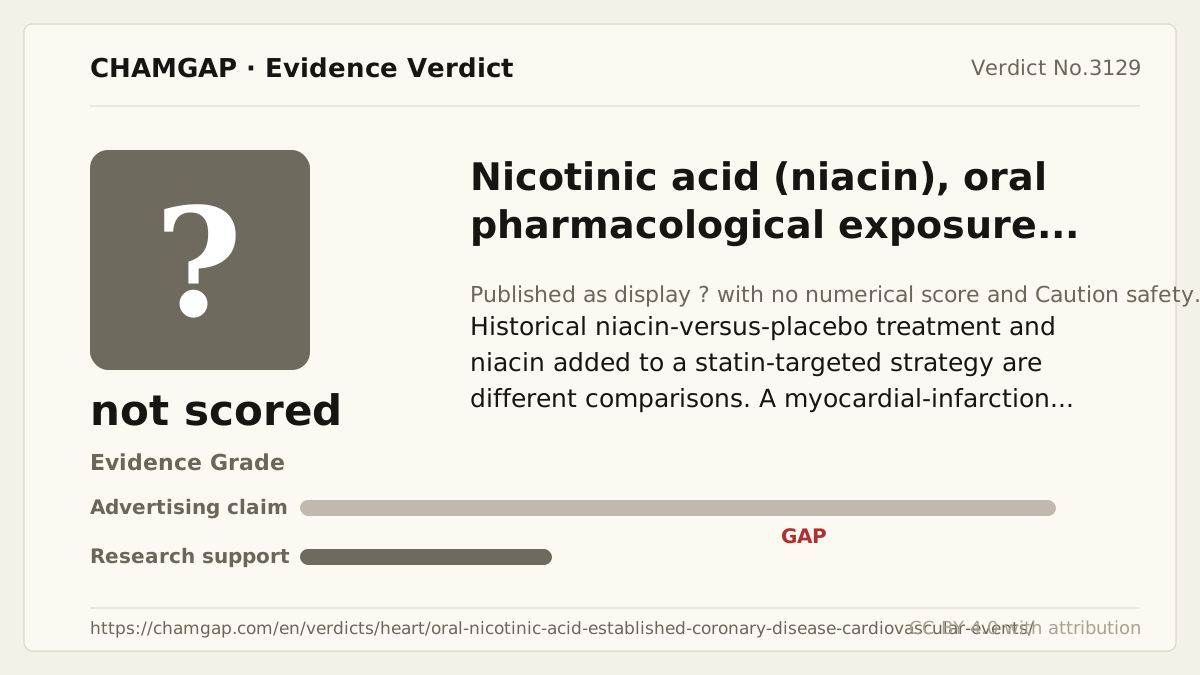
[Chamgap] Does nicotinic acid reduce cardiovascular events in adults with coronary disease? — Evidence Grade ?. 18 cited sources checked. Source: https://chamgap.com/en/verdicts/heart/oral-nicotinic-acid-established-coronary-disease-cardiovascular-events/ · CC BY 4.0CC BY 4.0 — free to use with attribution; do not distort grades, numbers, or verdict meaning.
What this document does and does not do
Chamgap is an information source. It reports what research has and has not confirmed; it does not tell readers what to take or buy. That decision belongs to readers and, when needed, medical or legal professionals. This verdict reflects literature available up to the search date and may change as new research appears. Nothing here is medical advice.