
First-180-day oral-anticoagulant prescription coverage above 80% versus 80% or less,
does it really help with Increased ischemic stroke and systemic embolism in atrial fibrillation?
research showsThe grade is C with 56 points. In Korean insurance data from 84,227 new oral-anticoagulant users with atrial fibrillation, two-year ischemic-stroke incidence was 5.61% with first-180-day prescription coverage above 80% and 7.68% with coverage of 80% or less; the weighted hazard ratio was 0.71. Prescription coverage records available medication days, not actual ingestion, and this retrospective cohort cannot eliminate healthy-adherer differences in behavior or healthcare access. Systemic embolism was not reported as a separate outcome.
ads claimVerdict 773 is B with 77 points for edoxaban itself preventing stroke or systemic embolism in nonvalvular atrial fibrillation. This verdict instead compares first-180-day prescription coverage above 80% versus 80% or less. The cohort directly reported ischemic stroke, not a stroke-or-systemic-embolism composite.
Useful facts when choosing a product
- The comparison was first-180-day prescription coverage above 80% versus 80% or less.
- Prescription coverage is calculated from claims and dispensing, not observed ingestion.
- People with stroke, major bleeding, death, or drug switching during the first 180 days were excluded from subsequent outcome analysis.
- Systemic embolism was not reported separately or as a composite, so this dataset cannot provide that estimate.
Chamgap Semantic Classification Code
Candidate index · review held
M.oral-anticoagulant-prescription-coverage-of-80-percent-or-less-during-the-first.oral.ischemic-stroke-and-systemic-embolism-in-atrial-fibrillation.increase.UNKMedicinal interventions > Oral-anticoagulant prescription coverage of 80% or less during the first > Oral > ischemic stroke and systemic embolism in atrial fibrillation > Increase claim > Unknown
An automated migration candidate, not an issued permanent code; exact claim scope remains under review. This machine-generated migration candidate helps retrieval but is not a permanent assignment. The original verdict ID and URL remain authoritative.
What the research actually shows
Lee and colleagues retrospectively analyzed Korean National Health Insurance claims from 2010 through 2018 for 84,227 new oral-anticoagulant users with nonvalvular atrial fibrillation and CHA2DS2-VASc scores of at least 2. They compared 50,178 people with first-180-day prescription coverage above 80% and 34,049 with coverage of 80% or less from day 181 for up to two years. Weighting included age, sex, hypertension, diabetes, heart failure, myocardial infarction, coronary and peripheral vascular disease, thromboembolic history, anemia, kidney disease, alcohol problems, risk scores, and multiple concomitant drugs. Diet, exercise, smoking, health engagement, socioeconomic conditions, and healthcare access were unavailable. The authors explicitly discussed the healthy-adherer effect, especially for mortality, but could not remove it from the stroke estimate. Korea's National Research Foundation funded the study, with no funder role.
Why this is classified as C (56)
Absolute and relative ischemic-stroke differences were clear, but dispensing-based exposure, residual confounding, and 180-day survivor selection in one retrospective cohort give C with 56 points.
Counterpoint. Ischemic stroke was 5.61% (95% CI 5.17 to 6.07) with first-180-day prescription coverage above 80% versus 7.68% (7.08 to 8.33) with coverage of 80% or less. Major bleeding moved oppositely: 4.49% (4.11 to 4.85) versus 3.61% (3.16 to 4.06).
Rejudgment record. Cross-check applied — The 84,227-person claims cohort, prescription-coverage definition, absolute two-year ischemic-stroke and major-bleeding rates, measured and unmeasured confounding, healthy-adherer discussion, and public funding were applied
| Endpoint | H | Hard endpoint - actual events such as death |
| Replication | R1 | Single confirmatory trial |
| Independence | I2 | Decisive evidence is publicly or non-profit funded |
| Effect size | E+ | Meets the clinically important threshold |
Stored derived and displayed grades match; this is not a current recalculation or validity check (C).
Sub-claim grades by effect
This ingredient is marketed for several effects. A single overall grade blends strong and weak claims together, so each effect is graded separately here. The overall grade reflects the strongest disconfirming or core claim.
| Effect (sub-claim) | Grade | Basis |
|---|---|---|
| Increased ischemic stroke | C | Rates were 7.68% with first-180-day prescription coverage of 80% or less versus 5.61% with coverage above 80%, with residual observational confounding. |
| Increased systemic embolism | ? | The study did not report systemic embolism separately or in a composite. |
| Change in major bleeding | C | Major bleeding was higher with first-180-day prescription coverage above 80%, 4.49% versus 3.61%. |
Cross-check — AI research and Codex final gate
Evidence Table
| Study | Design | Sample | Funding | Endpoint | Result | Weight |
|---|---|---|---|---|---|---|
| Lee WK et al. 2023 | Retrospective Korean National Health Insurance claims cohort | 84,227 people: 50,178 with first-180-day prescription coverage above 80% and 34,049 with coverage of 80% or less | Funded by the Korean government's National Research Foundation; funder had no role | Ischemic stroke, major bleeding, and death from day 181 through two years | Ischemic stroke 5.61% versus 7.68%, weighted HR 0.71 (95% CI 0.67 to 0.76); major bleeding 4.49% versus 3.61%, HR 1.27 (1.18 to 1.38) | Decisive single observational study |
Receipt — 1 References
All 1 cited sources were verified for existence at the original page (as of 2026-08-05).
Final verification and publication gate: Codex · Evidence date: 2026-08-05 · Corrections: none
Cite this verdict
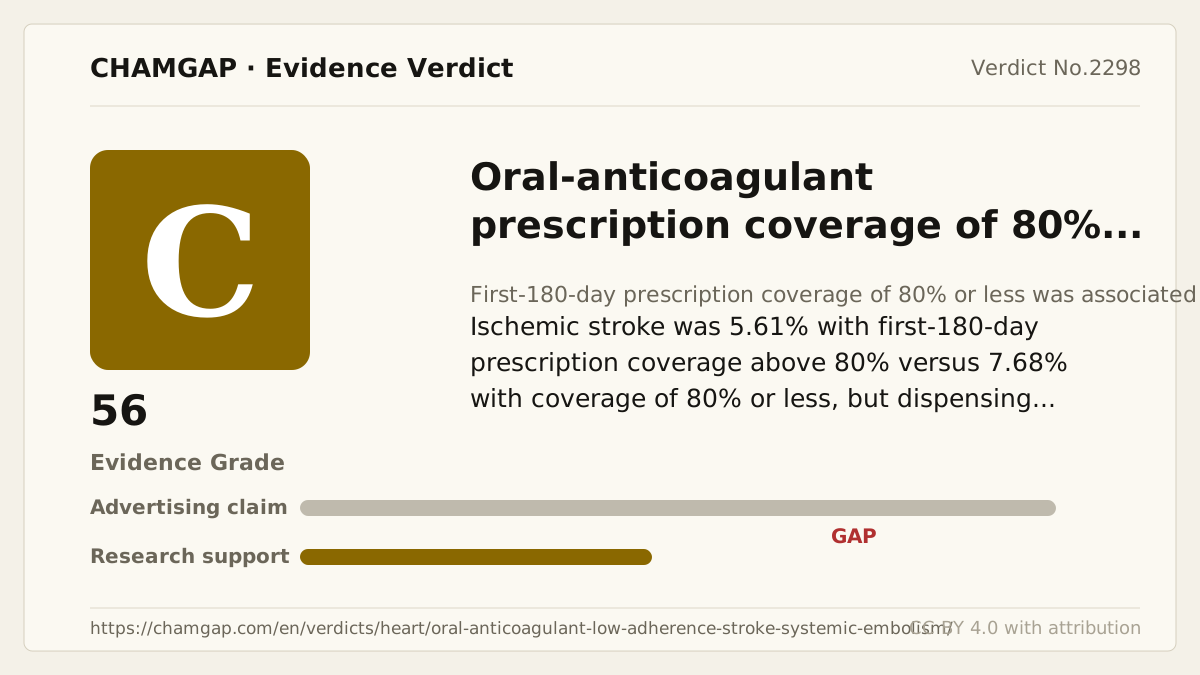
[Chamgap] First-180-day oral-anticoagulant prescription coverage above 80% versus 80% or less x stroke and systemic embolism — Evidence Grade C·56. 1 cited sources checked. Source: https://chamgap.com/en/verdicts/heart/oral-anticoagulant-low-adherence-stroke-systemic-embolism/ · CC BY 4.0CC BY 4.0 — free to use with attribution; do not distort grades, numbers, or verdict meaning.
What this document does and does not do
Chamgap is an information source. It reports what research has and has not confirmed; it does not tell readers what to take or buy. That decision belongs to readers and, when needed, medical or legal professionals. This verdict reflects literature available up to the search date and may change as new research appears. Nothing here is medical advice.