
Post-discharge transitional nursing,
does it really help with Reduced heart-failure-specific readmission within six months after discharge?
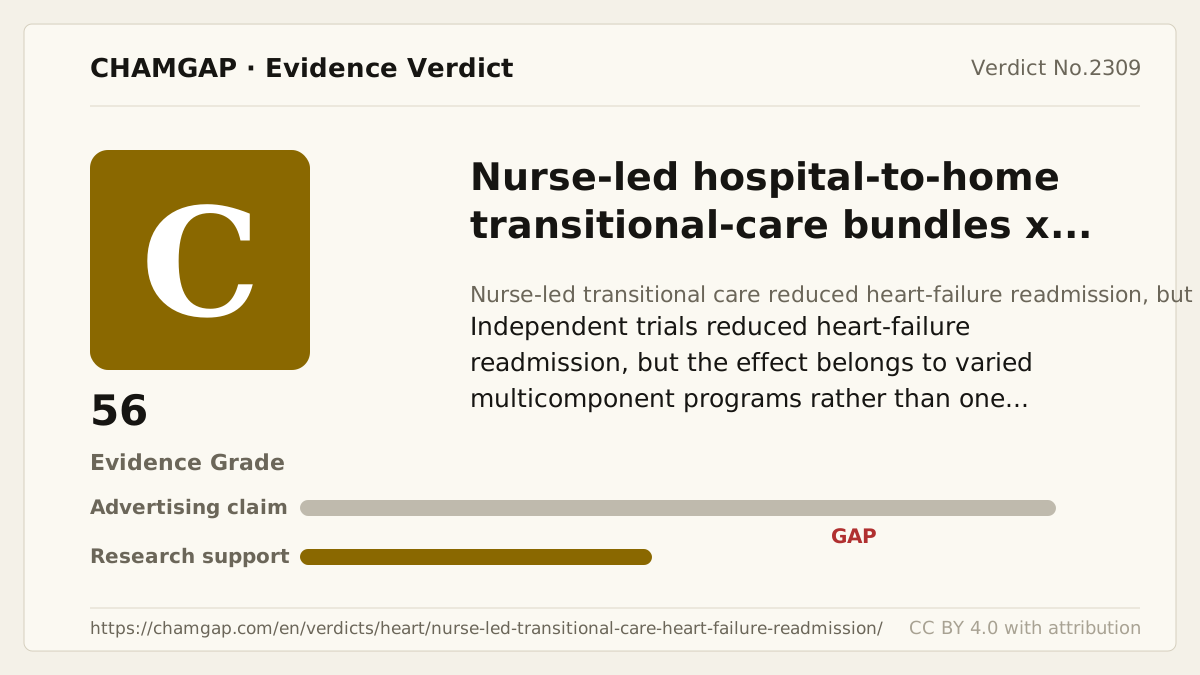
research showsThe grade is C. A 2021 meta-analysis included 25 randomized trials and 8,422 participants. Ten trials found heart-failure-specific readmission within six months at RR 0.71 (95% CI 0.60 to 0.84), I-squared 0%, and NNT 15. Absolute readmission rates for the two arms were not reported in the original meta-analysis. Programs and usual care varied, and most trials had reporting problems in randomization, allocation concealment, and outcome-assessor masking, giving C with 56 points.
ads claimThe pooled benefit cannot be assigned to home visits, telephone calls, education, or medication reconciliation alone. It is the average effect of different multicomponent and intensity programs.
Useful facts when choosing a product
- The review included 25 trials and 8,422 participants, 22 individually randomized and three cluster randomized.
- Heart-failure-specific readmission across ten trials was RR 0.71 with I-squared 0%.
- All-cause readmission across 19 trials was RR 0.91 with I-squared 46%.
Chamgap Semantic Classification Code
Candidate index · review held
UNK.nurse-led-hospital-to-home-transitional-care-bundles.UNK.heart-failure-specific-readmission-within-after-discharge.reduce.UNKUnknown > Nurse-led hospital-to-home transitional-care bundles > Unknown > heart-failure-specific readmission within after discharge > Reduction claim > Unknown
An automated migration candidate, not an issued permanent code; exact claim scope remains under review. This machine-generated migration candidate helps retrieval but is not a permanent assignment. The original verdict ID and URL remain authoritative.
What the research actually shows
Eligible programs began during the heart-failure admission or within one week and lasted up to six months. Components varied across needs assessment, discharge planning, education, counseling, medication reconciliation, follow-up booking, telephone monitoring, home visits, treatment adjustment, and extended follow-up. Usual-care descriptions also varied. Twenty-two trials randomized individuals and three randomized clusters. The methods prespecified cluster adjustment or sensitivity analysis when required, but no implemented adjustment estimate or cluster-exclusion sensitivity analysis was reported.
Why this is classified as C (56)
The pooled relative risk favored fewer heart-failure readmissions, but arm-specific absolute rates were unreported and direct replication and bias limitations remained, giving C with 56 points.
Counterpoint. Mortality was outside the 2021 utilization meta-analysis. A separate review found borderline lower three-to-six-month mortality for home-visiting programs, RR 0.77 (0.60 to 0.996), but that should not be generalized to every transitional-care bundle.
Rejudgment record. Cross-check applied — Heart-failure-specific and all-cause readmission were separated; unreported arm-specific rates, differing individual-trial endpoints, and unreported cluster adjustment were retained
| Endpoint | H | Hard endpoint - actual events such as death |
| Replication | R1 | Single confirmatory trial |
| Independence | I2 | Decisive evidence is publicly or non-profit funded |
| Effect size | E+ | Meets the clinically important threshold |
Stored derived and displayed grades match; this is not a current recalculation or validity check (C).
Sub-claim grades by effect
This ingredient is marketed for several effects. A single overall grade blends strong and weak claims together, so each effect is graded separately here. The overall grade reflects the strongest disconfirming or core claim.
| Effect (sub-claim) | Grade | Basis |
|---|---|---|
| Reduced heart-failure-specific readmission within six months | C | Ten trials found RR 0.71 and NNT 15; arm-specific absolute rates were not reported. |
| Reduced all-cause readmission within six months | C | Nineteen trials found RR 0.91 with I-squared 46%, a smaller and heterogeneous effect. |
| Reduced emergency-department visits | D | Five trials were null, RR 0.96 (0.84 to 1.10). |
Cross-check — AI research and Codex final gate
Evidence Table
| Study | Design | Sample | Funding | Endpoint | Result | Weight |
|---|---|---|---|---|---|---|
| Li et al. 2021 | Meta-analysis of randomized trials of nurse-led transitional care | 25 trials and 8,422 participants; 10 trials for heart-failure-specific readmission | Sichuan provincial and university funding for the review; varied trial funders | Heart-failure-specific and all-cause readmission within six months | Heart failure RR 0.71 (0.60 to 0.84), I-squared 0%, NNT 15; all cause RR 0.91 (0.82 to 0.99), I-squared 46%, NNT 27 | Decisive pooled evidence |
| Naylor et al. 2004 | Individual randomized trial at six hospitals | 239 participants, 118 versus 121 | Public funding from the US National Institute of Nursing Research | Time to first all-cause readmission and total readmissions through 52 weeks; death was censored | 104 versus 162 total readmissions; longer time to first readmission or death, P=0.026 | Individual trial with a different endpoint and follow-up period |
| Blue et al. 2001 | Individual randomized trial of specialist-nurse home follow-up | 165 participants | UK health-system and regional research support | Twelve-month composite of all-cause death or readmission for worsening heart failure, plus heart-failure admission counts | Death or heart-failure readmission 31 (37%) versus 45 (53%), HR 0.61 (0.33 to 0.96); heart-failure admissions 19 versus 45 | Individual trial with a different endpoint and follow-up period |
Receipt — 3 References
All 3 cited sources were verified for existence at the original page (as of 2026-08-05).
Final verification and publication gate: Codex · Evidence date: 2026-08-05 · Corrections: none
Cite this verdict
[Chamgap] Post-discharge transitional nursing x heart-failure readmission — Evidence Grade C·56. 3 cited sources checked. Source: https://chamgap.com/en/verdicts/heart/nurse-led-transitional-care-heart-failure-readmission/ · CC BY 4.0CC BY 4.0 — free to use with attribution; do not distort grades, numbers, or verdict meaning.
What this document does and does not do
Chamgap is an information source. It reports what research has and has not confirmed; it does not tell readers what to take or buy. That decision belongs to readers and, when needed, medical or legal professionals. This verdict reflects literature available up to the search date and may change as new research appears. Nothing here is medical advice.