
Napping once or twice weekly,
does it really help with Prevention of fatal and nonfatal cardiovascular events such as myocardial infarction and stroke?
research showsThe grade is C with 54 points. In a Swiss cohort of 3,462 adults without prior cardiovascular disease followed for a mean 5.3 years, napping once or twice weekly was associated with lower adjudicated cardiovascular-event hazard than no naps, HR 0.52 (95% CI 0.28-0.95). However, exposure was one week of self-report, nap duration was unrelated to events, and daily napping showed no adjusted benefit.
ads claimFeeling refreshed after a nap and preventing myocardial infarction or stroke years later are different claims. The study does not support increasing nap duration or napping every day.
Useful facts when choosing a product
- Nap frequency and duration were measured by one week of self-report, not actigraphy.
- The HR was 0.52 for one or two naps weekly, but 0.89 after adjustment for six or seven, while nap duration was unrelated to events.
- Verdict 2192 is C with 54 points for cognitive decline and dementia. It uses the same broad exposure but a different endpoint.
Chamgap Semantic Classification Code
Candidate index · review held
UNK.self-reported-habitual-napping-once-or-twice.UNK.fatal-and-nonfatal-cardiovascular-events-such-as-myocardial-infarction-and-stroke.prevent.UNKUnknown > Self-reported habitual napping once or twice > Unknown > fatal and nonfatal cardiovascular events such as myocardial infarction and stroke > Occurrence-prevention claim > Unknown
An automated migration candidate, not an issued permanent code; exact claim scope remains under review. This machine-generated migration candidate helps retrieval but is not a permanent assignment. The original verdict ID and URL remain authoritative.
What the research actually shows
Participants reported nap frequency and average duration over the preceding week. Prior cardiovascular disease was excluded, and models adjusted for major cardiovascular risks, nighttime sleep, sleep apnea, and daytime sleepiness. An analysis excluding events in the first one or two years was not reported in the article. The Wang meta-analysis included 21 cohorts, while its text inconsistently reports 371,306 and 374,306 participants. Its risk increase concerned naps of at least one hour, so it does not directly replicate this frequency contrast. CoLaus/HypnoLaus had mixed public and GlaxoSmithKline support.
Why this is classified as C (54)
A large association with actual cardiovascular events is offset by one observational cohort, one-week self-report, multiple exposure comparisons, and reverse-causation concerns, giving C with 54 points.
Counterpoint. Independent cohorts should prespecify no naps, one or two weekly, and daily naps, repeatedly measure exposure with actigraphy, and exclude early events.
Rejudgment record. Cross-check applied — The Heart article was cross-checked for frequency- and duration-specific hazard ratios, denominator, self-reported exposure, covariate adjustment, and funding; early-event exclusion was classified as not reported, and the Wang article was checked for cohort count, inconsistent participant totals, and its one-hour threshold
| Endpoint | H | Hard endpoint - actual events such as death |
| Replication | R1 | Single confirmatory trial |
| Independence | I1 | Mixed funding sources |
| Effect size | E+ | Meets the clinically important threshold |
Stored derived and displayed grades match; this is not a current recalculation or validity check (C).
Sub-claim grades by effect
This ingredient is marketed for several effects. A single overall grade blends strong and weak claims together, so each effect is graded separately here. The overall grade reflects the strongest disconfirming or core claim.
| Effect (sub-claim) | Grade | Basis |
|---|---|---|
| Prevention of cardiovascular events by one or two naps weekly | C | This is a protective association in one self-reported cohort. |
| Daily napping prevents cardiovascular events | D | The adjusted HR was 0.89 (0.58-1.38), with no confirmed benefit. |
Cross-check — AI research and Codex final gate
Evidence Table
| Study | Design | Sample | Funding | Endpoint | Result | Weight |
|---|---|---|---|---|---|---|
| Häusler N et al., Heart, 2019 | Population-based prospective cohort | 3,462 analyzed; mean 5.3 years; 155 cardiovascular events | Mixed Swiss public, university, and GlaxoSmithKline support for CoLaus/HypnoLaus | Adjudicated fatal and nonfatal cardiovascular events | One or two weekly versus none: HR 0.52 (95% CI 0.28-0.95); six or seven adjusted HR 0.89 (0.58-1.38); duration null | Core direct observational evidence for the specific frequency |
| Wang M et al., PLOS One, 2024 | Meta-analysis of self-reported napping cohorts | 21 cohorts; article inconsistently reports 371,306 and 374,306 participants | No specific funding | Cardiovascular and all-cause mortality | Naps of at least one hour were associated with higher risk; shorter naps were not | Duration-focused context, not direct replication of one or two weekly naps |
Receipt — 2 References
All 2 cited sources were verified for existence at the original page (as of 2026-08-04).
Final verification and publication gate: Codex · Evidence date: 2026-08-04 · Corrections: none
Cite this verdict
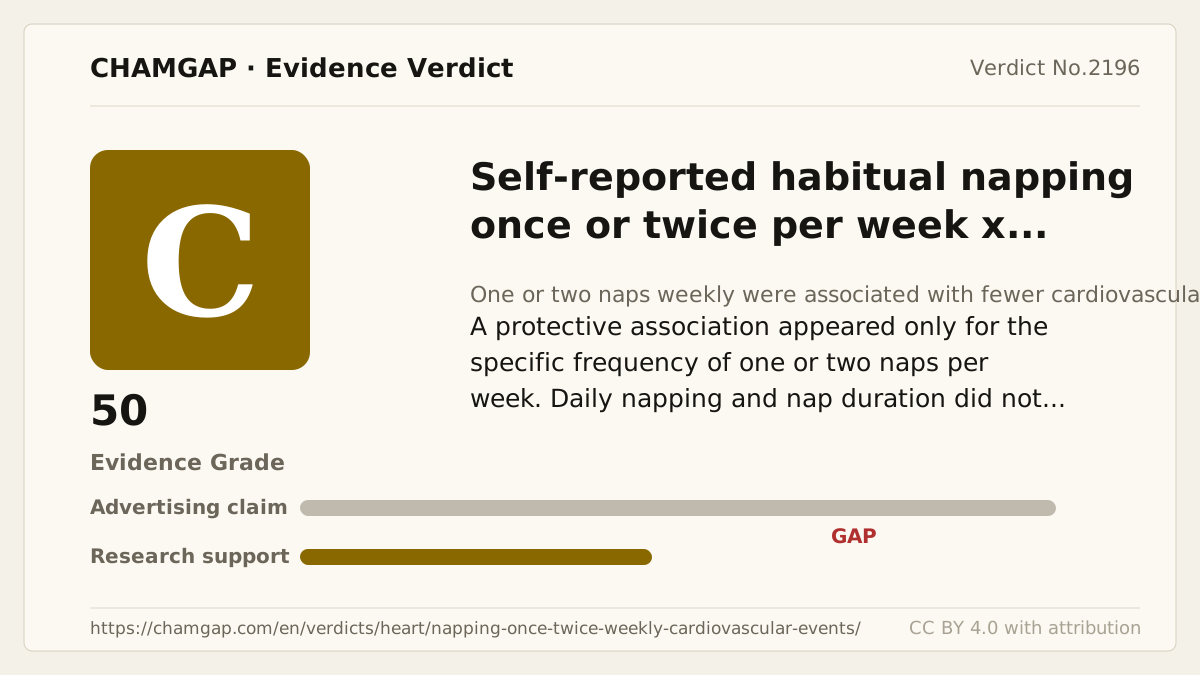
[Chamgap] Napping once or twice weekly x cardiovascular event prevention — Evidence Grade C·54. 2 cited sources checked. Source: https://chamgap.com/en/verdicts/heart/napping-once-twice-weekly-cardiovascular-events/ · CC BY 4.0CC BY 4.0 — free to use with attribution; do not distort grades, numbers, or verdict meaning.
What this document does and does not do
Chamgap is an information source. It reports what research has and has not confirmed; it does not tell readers what to take or buy. That decision belongs to readers and, when needed, medical or legal professionals. This verdict reflects literature available up to the search date and may change as new research appears. Nothing here is medical advice.