
N95 particulate respirator,
does it really help with Lower blood pressure and improved heart-rate variability?
research showsThe grade is D with 28 points. The Shanghai crossover trial randomized 30 people but analyzed only the 24 who completed both periods; systolic pressure was 2.7 mmHg lower and high-frequency HRV was 12.5% higher while masked. Yet a meta-analysis of eight randomized trials and 312 participants found a null systolic-pressure difference of -0.78 mmHg (95% CI -2.06 to 0.50) and null RMSSD difference of 1.51 ms (-0.43 to 3.46). These are surrogate measurements, not cardiovascular events.
ads claimA 95% filtration specification does not itself prove lower blood pressure or heart protection. Laboratory filter efficiency, facial fit, wear time, personal inhaled dose, short-term biomarkers, and long-term events are separate steps.
Useful facts when choosing a product
- The paper identifies the 3M 8210V as a NIOSH N95 respirator filtering at least 95% of 0.3-micrometer non-oil test particles.
- Mean outdoor PM2.5 was 74.2 micrograms/m3, but personal inhaled and inside-mask concentrations were not measured.
- Qualitative fit testing was performed without a quantitative fit factor; wear time was self-reported rather than device-logged.
- Verdict 1437 is D with 30 points and concerns exercise effects of an altitude-training mask; verdict 1758 is D with 35 points and concerns allergic-rhinitis symptoms from HEPA filtration. Both indications differ from the cardiovascular measurements here.
Chamgap Semantic Classification Code
Candidate index · review held
UNK.3m-8210v-n95-particulate-respirator-worn.UNK.blood-pressure-and-improved-heart-rate-variability.reduce.UNKUnknown > 3M 8210V N95 particulate respirator worn > Unknown > blood pressure and improved heart-rate variability > Reduction claim > Unknown
An automated migration candidate, not an issued permanent code; exact claim scope remains under review. This machine-generated migration candidate helps retrieval but is not a permanent assignment. The original verdict ID and URL remain authoritative.
What the research actually shows
Shi randomized 30 healthy students in an open crossover study conducted from March 21 to April 13, 2014; six withdrew and 24 completed both periods. Wear time was not device-logged: participants self-reported more than 90% of outdoor time and an average 82% of indoor time. A three-maneuver qualitative bitter-agent fit test with the 3M FT-30 was performed, but no quantitative fit factor was obtained. The exposure concentration measured by the study was mean outdoor PM2.5 of 74.2 micrograms/m3; personal inhaled and inside-mask concentrations were not measured. NCT02238028 lists blood pressure and HRV measures as primary outcomes, but its September 11, 2014 posting followed the March-April trial, making registration retrospective. The original trial reported public and nonprofit support, but funding for every trial in the later meta-analysis was not individually verified.
Why this is classified as D (28)
Pooled blood pressure and most HRV findings across eight randomized trials were null, and the evidence is limited to small, brief measurement studies, giving D with 28 points.
Counterpoint. D does not deny N95 particle filtration. It grades the separate claim that wearing one produces clinically meaningful blood-pressure and HRV improvement.
Rejudgment record. Cross-check applied — Separated certified filtration from the clinical claim and prioritized the null pooled blood-pressure and mostly null HRV evidence across eight randomized trials over one small positive study
| Endpoint | S | Surrogate marker - laboratory or imaging measures |
| Replication | R1 | Single confirmatory trial |
| Independence | I1 | Mixed funding sources |
| Effect size | E0 | Null |
| Precision | C0 | The confidence interval leaves room for benefit |
Stored derived and displayed grades match; this is not a current recalculation or validity check (D).
Sub-claim grades by effect
This ingredient is marketed for several effects. A single overall grade blends strong and weak claims together, so each effect is graded separately here. The overall grade reflects the strongest disconfirming or core claim.
| Effect (sub-claim) | Grade | Basis |
|---|---|---|
| Lower systolic blood pressure | D | The pooled eight-trial difference was -0.78 mmHg and its confidence interval included zero. |
| Broad improvement in heart-rate variability | D | High-frequency power was positive, but pooled RMSSD, SDNN, and most other measures were null. |
Cross-check — AI research and Codex final gate
Evidence Table
| Study | Design | Sample | Funding | Endpoint | Result | Weight |
|---|---|---|---|---|---|---|
| Shi J et al. 2017 | Open-label randomized crossover trial | 30 randomized, 6 withdrew, 24 completers analyzed | Chinese public grants, Cyrus Tang Foundation, China Medical Board, and other nonprofit support | Twenty-four-hour ambulatory blood pressure and heart-rate variability | Systolic pressure was 2.7 mmHg lower (95% CI 0.1 to 5.2 lower), and high-frequency HRV was 12.5% higher (3.8% to 21.2%). | Positive but small, brief completer-only trial |
| Faridi et al. 2022 systematic review and meta-analysis | Meta-analysis of eight randomized trials | Eight trials, 312 participants | Funding for the review and every included trial was not fully verified from the public materials checked | Blood pressure and seven heart-rate-variability measures | Systolic pressure was -0.78 mmHg (-2.06 to 0.50), diastolic pressure -0.49 (-1.37 to 0.38), and RMSSD +1.51 ms (-0.43 to 3.46); only high-frequency power was positive at +38.92 ms2 (1.07 to 76.77). | Decisive body of randomized evidence |
Receipt — 3 References
All 3 cited sources were verified for existence at the original page (as of 2026-08-04).
Final verification and publication gate: Codex · Evidence date: 2026-08-04 · Corrections: none
Cite this verdict
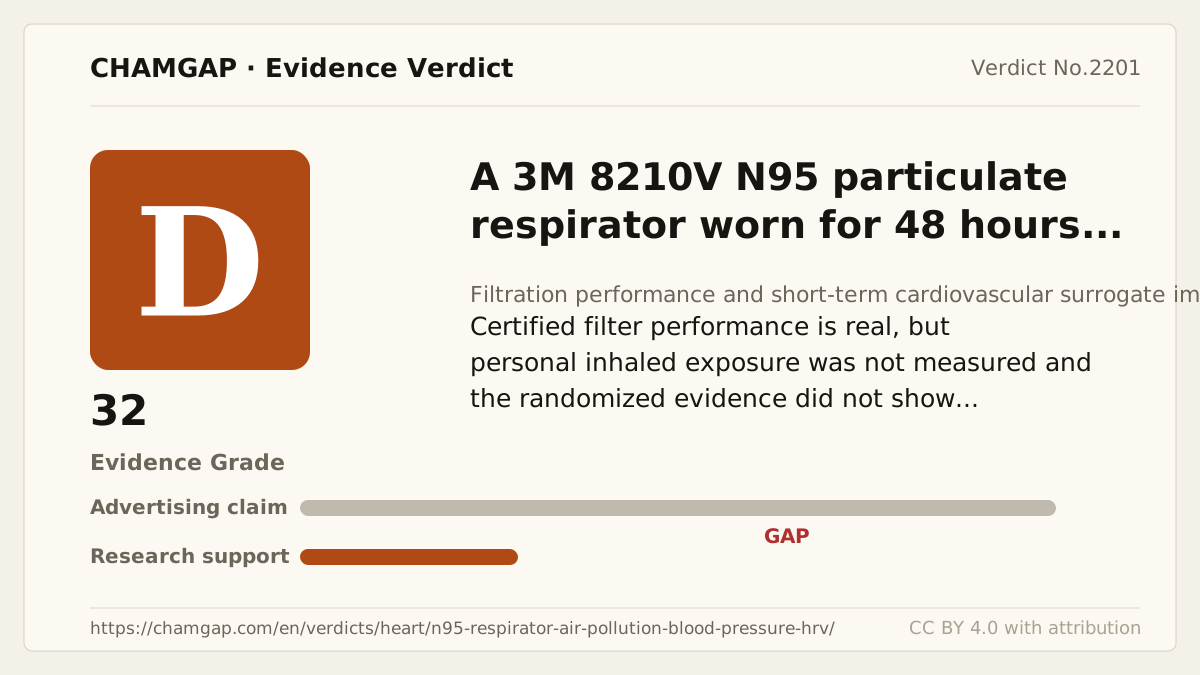
[Chamgap] N95 particulate respirator x blood pressure and heart-rate variability during pollution exposure — Evidence Grade D·28. 3 cited sources checked. Source: https://chamgap.com/en/verdicts/heart/n95-respirator-air-pollution-blood-pressure-hrv/ · CC BY 4.0CC BY 4.0 — free to use with attribution; do not distort grades, numbers, or verdict meaning.
What this document does and does not do
Chamgap is an information source. It reports what research has and has not confirmed; it does not tell readers what to take or buy. That decision belongs to readers and, when needed, medical or legal professionals. This verdict reflects literature available up to the search date and may change as new research appears. Nothing here is medical advice.