
Mobile integrated care pathway,
does it really help with Reduced composite thromboembolism, death, and rehospitalization in atrial fibrillation?
research showsThe grade is B. In all 3,324 mAFA-II participants, the composite of ischemic stroke or systemic thromboembolism, all-cause death, and rehospitalization occurred in 32/1,646 (1.9%) versus 101/1,678 (6.0%), HR 0.39 (95% CI 0.22-0.67). The absolute difference was -4.1 points, about one event per 24 treated, but rehospitalization drove most of the effect; this was one open cluster trial and allocation concealment was not described, giving B with 70 points.
ads claimThe trial did not show that a smartphone alone prevents events. The app operationalized anticoagulation, symptom control, and comorbidity management as one care pathway.
Useful facts when choosing a product
- The intervention combined anticoagulation, symptom control, and comorbidity management in the ABC pathway.
- Huawei-related photoplethysmography was rhythm-assessment technology, distinguished from the integrated-care intervention.
- Follow-up and subgroup reports from the same registration were not counted as new trials.
Chamgap Semantic Classification Code
Candidate index · review held
UNK.mobile-health-supported-abc-integrated-care-pathway.UNK.composite-thromboembolism-death-and-rehospitalization-in-atrial-fibrillation.reduce.UNKUnknown > Mobile health-supported ABC integrated care pathway > Unknown > composite thromboembolism, death, and rehospitalization in atrial fibrillation > Reduction claim > Unknown
An automated migration candidate, not an issued permanent code; exact claim scope remains under review. This machine-generated migration candidate helps retrieval but is not a permanent assignment. The original verdict ID and URL remain authoritative.
What the research actually shows
Forty Chinese hospitals were cluster randomized, with all 1,646 versus 1,678 allocated participants analyzed. The report states, "Randomization was done using a computer-generated randomisation list," but did not adequately describe allocation concealment, and investigators and site personnel were not masked. The registry and publication used the same primary composite. Enrollment was 3,324 rather than the protocol target of 3,660, but this was not stopping at an efficacy or harm boundary. Funding came from the National Natural Science Foundation of China, the National Key Research and Development Project of China, the Heilongjiang health commission, and the UK NIHR, while the Huawei research team provided photoplethysmography-based rhythm monitoring as a component of the intervention. Public research funding and company technical support in kind were mixed. Relevant consulting, speaking, and institutional research disclosures by Lip and Lane were also reported.
Why this is classified as B (70)
A 3,324-person hard-outcome trial mixing public research funding with company technical support in kind found a large absolute difference, but no independent replication and unreported allocation concealment give B with 70 points.
Counterpoint. Cluster imbalance, open treatment, and a composite driven mainly by rehospitalization temper interpretation.
Rejudgment record. Cross-check applied — Cross-checked the main article, protocol, and same-trial follow-up for the all-3,324 analysis, composite and absolute results, cluster randomization, allocation-concealment reporting, funding, and Huawei's role
| Endpoint | H | Hard endpoint - actual events such as death |
| Replication | R1 | Single confirmatory trial |
| Independence | I1 | Mixed funding sources |
| Effect size | E+ | Meets the clinically important threshold |
Stored derived and displayed grades match; this is not a current recalculation or validity check (B).
Sub-claim grades by effect
This ingredient is marketed for several effects. A single overall grade blends strong and weak claims together, so each effect is graded separately here. The overall grade reflects the strongest disconfirming or core claim.
| Effect (sub-claim) | Grade | Basis |
|---|---|---|
| Reduced composite clinical events | B | The absolute difference was -4.1 points and HR 0.39. |
| No increase in bleeding | B | Extracranial bleeding was 1.9% versus 2.1%. |
Cross-check — AI research and Codex final gate
Evidence Table
| Study | Design | Sample | Funding | Endpoint | Result | Weight |
|---|---|---|---|---|---|---|
| Guo Y et al. 2020 mAFA-II | Open cluster-randomized trial across 40 Chinese hospitals | 3,324 randomized and analyzed by intention to treat, 1,646/1,678 | Chinese national and provincial public grants plus UK NIHR; Huawei provided rhythm monitoring as an intervention component - mixed public funding and company support in kind | Composite of ischemic stroke or systemic thromboembolism, all-cause death, and rehospitalization | 32/1,646 (1.9%) versus 101/1,678 (6.0%), HR 0.39 (95% CI 0.22-0.67), absolute difference -4.1 points | Large publicly funded single hard-outcome trial |
Receipt — 1 References
All 1 cited sources were verified for existence at the original page (as of 2026-08-18).
Final verification and publication gate: Codex · Evidence date: 2026-08-18 · Corrections: none
Cite this verdict
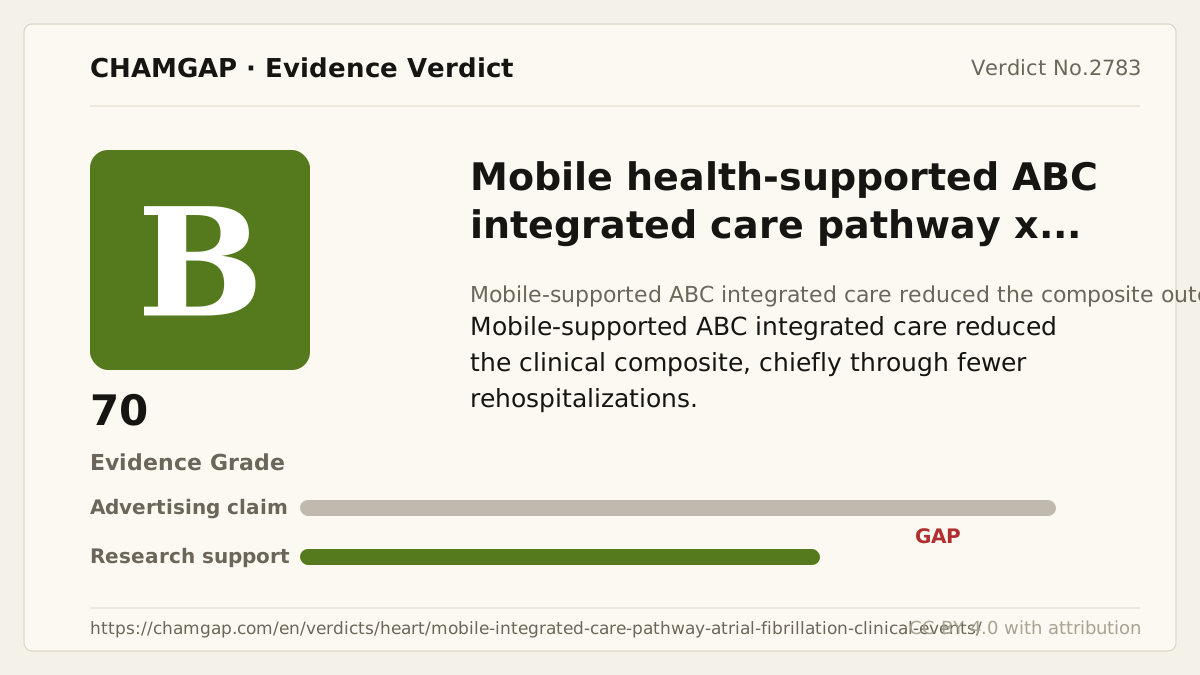
[Chamgap] Mobile integrated care pathway x atrial fibrillation — Evidence Grade B·70. 1 cited sources checked. Source: https://chamgap.com/en/verdicts/heart/mobile-integrated-care-pathway-atrial-fibrillation-clinical-events/ · CC BY 4.0CC BY 4.0 — free to use with attribution; do not distort grades, numbers, or verdict meaning.
What this document does and does not do
Chamgap is an information source. It reports what research has and has not confirmed; it does not tell readers what to take or buy. That decision belongs to readers and, when needed, medical or legal professionals. This verdict reflects literature available up to the search date and may change as new research appears. Nothing here is medical advice.