
Milled flaxseed, 30 g daily,
does it really help with Lower blood pressure in peripheral artery disease?
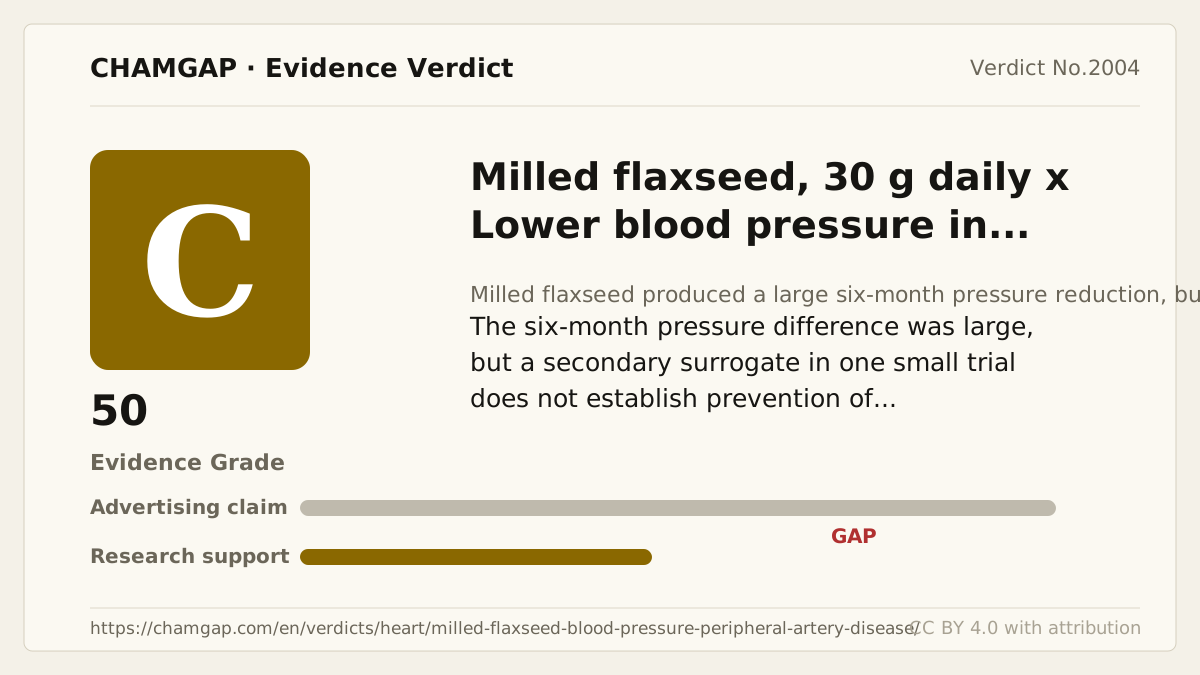
research showsThe grade is C with 50 points. A six-month trial randomized 110 people with peripheral artery disease and reported systolic and diastolic pressures about 10 and 7 mmHg lower with milled flaxseed than control. The originally registered primary one-year cardiovascular-event outcome was not reported, while the paper foregrounded blood pressure, a registered secondary outcome.
ads claimA blood-pressure reduction should not be converted directly into fewer myocardial infarctions, strokes, or deaths. This six-month pressure analysis did not establish those events.
Useful facts when choosing a product
- The intervention was 30 g daily milled flaxseed incorporated into foods, not intact seeds. Milling breaks the hard seed coat and improves digestive access compared with whole seeds.
- Flaxseed is dense in energy, fat, and dietary fiber. Direct measured energy, fat, and fiber values for the trial product were unconfirmed in the publicly checked material.
- The historical term Hu Ma can refer to sesame or flax depending on the document, so a classical record is left unconfirmed here.
- Verdict 096 is C with 54 points for a bundled flaxseed claim involving menopausal symptoms, constipation, and cholesterol. Verdict 2004 asks a different question about blood pressure in peripheral artery disease.
Chamgap Semantic Classification Code
Candidate index · review held
F.milled-flaxseed.food.blood-pressure-in-peripheral-artery-disease.reduce.placeboFoods and beverages > Milled flaxseed > Food consumption > blood pressure in peripheral artery disease > Reduction claim > Placebo
An automated migration candidate, not an issued permanent code; exact claim scope remains under review. This machine-generated migration candidate helps retrieval but is not a permanent assignment. The original verdict ID and URL remain authoritative.
What the research actually shows
The 2013 Hypertension paper and abstract by Rodriguez-Leyva and colleagues, the FLAX-PAD design report, and NCT00781950 were cross-checked. The design-paper DOI is 10.1016/j.cct.2011.05.005. The program reported support from the Canadian Institutes of Health Research, Western Grains Research Foundation, Agri-Food Research and Development Initiative, and SaskFlax. Glanbia Nutritionals provided the trial flaxseed and wheat, while Canada Bread, the Canadian International Grain Institute, SaskFlax, and the Food Development Centre supported preparation of trial foods.
Why this is classified as C (50)
Blood-pressure differences of about 10 and 7 mmHg were large, but pressure was a registered secondary surrogate. The registered one-year cardiovascular-event outcome was not reported, registration had timing defects, and only 77 of 110 randomized participants entered the six-month pressure analysis. It receives C with 50 points.
Counterpoint. A large independent trial with blood pressure as the registered primary outcome, explicit analysis counts, and clinical-event follow-up is needed.
Rejudgment record. Cross-check applied — Hypertension report, abstract, design paper, and registry cross-checked to separate 110 randomized from 77 analyzed, the unreported registered primary outcome, secondary blood-pressure status, registration timing, funding, and in-kind support
| Endpoint | S | Surrogate marker - laboratory or imaging measures |
| Replication | R1 | Single confirmatory trial |
| Independence | I1 | Mixed funding sources |
| Effect size | E+ | Meets the clinically important threshold |
Stored derived and displayed grades match; this is not a current recalculation or validity check (C).
Sub-claim grades by effect
This ingredient is marketed for several effects. A single overall grade blends strong and weak claims together, so each effect is graded separately here. The overall grade reflects the strongest disconfirming or core claim.
| Effect (sub-claim) | Grade | Basis |
|---|---|---|
| Milled flaxseed is more digestively accessible than intact seed and is dense in energy, fat, and fiber | ? | These are processing and composition facts, not graded clinical outcomes. |
| Milled flaxseed at 30 g daily lowers blood pressure in peripheral artery disease | C | The difference was large, but it was a registered secondary surrogate in one small trial. |
Cross-check — AI research and Codex final gate
Evidence Table
| Study | Design | Sample | Funding | Endpoint | Result | Weight |
|---|---|---|---|---|---|---|
| Rodriguez-Leyva D et al., Hypertension, 2013, FLAX-PAD | Six-month double-blind placebo-controlled randomized trial | 110 randomized, 58/52; six-month pressure analysis of 77, 41 flaxseed and 36 control | Public CIHR and agricultural-sector WGRF, ARDI, and SaskFlax funding; flaxseed and wheat from Glanbia Nutritionals and trial-food preparation support from Canada Bread, CIGI, SaskFlax, and the Food Development Centre | Registered secondary systolic and diastolic blood pressure; registered primary one-year cardiovascular-event outcome unreported | About 10 and 7 mmHg lower than control; no direct between-group CI in public abstract | Large difference but a secondary surrogate in one trial with reporting and registration defects |
Receipt — 3 References
All 3 cited sources were verified for existence at the original page (as of 2026-08-02).
Final verification and publication gate: Codex · Evidence date: 2026-08-02 · Corrections: none
Cite this verdict
[Chamgap] Milled flaxseed, 30 g daily x blood pressure in peripheral artery disease — Evidence Grade C·50. 3 cited sources checked. Source: https://chamgap.com/en/verdicts/heart/milled-flaxseed-blood-pressure-peripheral-artery-disease/ · CC BY 4.0CC BY 4.0 — free to use with attribution; do not distort grades, numbers, or verdict meaning.
What this document does and does not do
Chamgap is an information source. It reports what research has and has not confirmed; it does not tell readers what to take or buy. That decision belongs to readers and, when needed, medical or legal professionals. This verdict reflects literature available up to the search date and may change as new research appears. Nothing here is medical advice.