
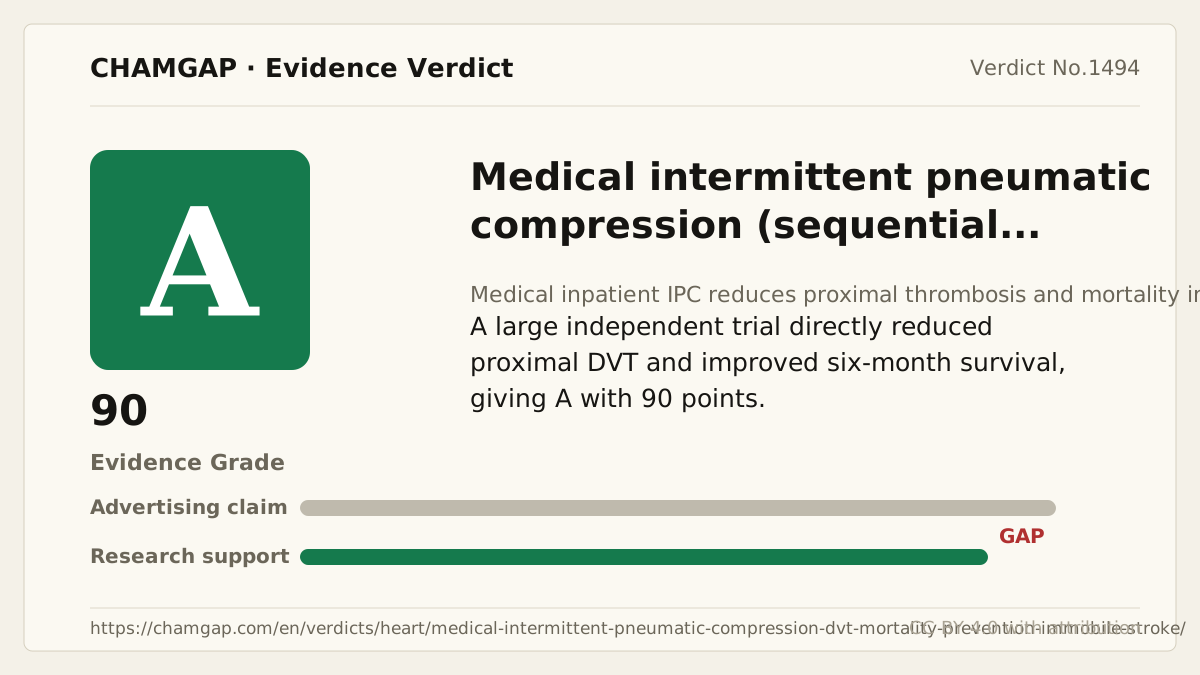
Medical intermittent pneumatic compression,
does it really help with Prevention of proximal deep-vein thrombosis and death in immobile patients with acute stroke?
research showsMedical IPC is rated A because it reduces proximal deep-vein thrombosis and death in immobile hospitalized patients with acute stroke. In the independent 2,876-participant CLOTS 3 trial, proximal DVT by 30 days fell from 12.1% to 8.5%, an absolute reduction of 3.6 percentage points, and six-month survival improved significantly. This evidence concerns thigh-length inpatient VTE-prevention equipment, not exercise-recovery boots.
ads claimConsumer recovery-boot marketing can transfer this inpatient evidence to post-exercise recovery, swelling removal, or general circulation claims. CLOTS 3 tested clinician-applied VTE-prevention equipment in immobile acute-stroke patients.
Useful facts when choosing a product
- CLOTS 3 used bilateral thigh-length sequential-compression sleeves with a powered controller for up to 30 days, stopping at independent mobility or discharge.
- Correct sizing, daily skin inspection, sleeve repositioning, and management of actual wear time are important for effectiveness and safety.
- Skin injury, discomfort, warmth, and occasional fall risk can occur; severe peripheral arterial disease, major skin disease, and limb conditions require contraindication screening or specialist judgment.
- This evidence applies to medical inpatient thromboprophylaxis IPC, not pneumatic boots marketed for exercise recovery.
Chamgap Semantic Classification Code
Candidate index · review held
P.medical-intermittent-pneumatic-compression.device.proximal-deep-vein-thrombosis-and-death-in-immobile-patients-with-acute-stroke.prevent.UNKProcedures, devices and tests > Medical intermittent pneumatic compression > Device delivered > proximal deep-vein thrombosis and death in immobile patients with acute stroke > Occurrence-prevention claim > Unknown
An automated migration candidate, not an issued permanent code; exact claim scope remains under review. This machine-generated migration candidate helps retrieval but is not a permanent assignment. The original verdict ID and URL remain authoritative.
What the research actually shows
CLOTS 3 enrolled immobile stroke patients within three days of hospital admission at 94 United Kingdom hospitals from 2008 to 2012. The IPC group used bilateral thigh-length Kendall SCD Express sleeves for up to 30 days or until independent mobility or discharge. Proximal DVT by 30 days occurred in 122 of 1,438 versus 174 of 1,438, an absolute difference of -3.6 percentage points. Six-month deaths numbered 320 versus 361, with adjusted HR 0.86. Skin breaks were more frequent with IPC.
Why this is classified as A (90)
An independent 2,876-participant trial produced a device-specific 3.6-percentage-point absolute reduction in proximal DVT and significantly lower six-month mortality, giving A with 90 points.
Counterpoint. Skin injury and application burden matter, but direct thrombosis and survival benefits provide strong evidence for selected immobile stroke patients.
Rejudgment record. New verdict — Applied the device-specific evidence from the large independent CLOTS 3 trial, in which inpatient thigh-length IPC reduced the direct hard endpoints of proximal DVT and six-month mortality in immobile patients with acute stroke
Sub-claim grades by effect
This ingredient is marketed for several effects. A single overall grade blends strong and weak claims together, so each effect is graded separately here. The overall grade reflects the strongest disconfirming or core claim.
| Effect (sub-claim) | Grade | Basis |
|---|---|---|
| Prevention of proximal deep-vein thrombosis in immobile patients with acute stroke | A | CLOTS 3 found 8.5% versus 12.1%, an absolute reduction of 3.6 percentage points. |
| Reduction in six-month mortality in immobile patients with acute stroke | A | Six-month mortality was 22.3% versus 25.1%, with adjusted HR 0.86. |
| Prevention of all deep-vein thrombosis, including proximal and calf DVT | A | The full CLOTS 3 report also found fewer DVTs overall, while pulmonary-embolism reduction was not definitive. |
Cross-check — AI research and Codex final gate
Evidence Table
| Study | Design | Sample | Funding | Endpoint | Result | Weight |
|---|---|---|---|---|---|---|
| Dennis M et al. CLOTS 3, 2013 | Multicenter randomized open-treatment trial with blinded outcome assessment | 2,876 immobile acute-stroke patients at 94 United Kingdom hospitals | NIHR Health Technology Assessment and Chief Scientist Office; controllers and sleeves supplied by Covidien | Proximal DVT by 30 days and survival at six months | Proximal DVT was 8.5% versus 12.1%, adjusted OR 0.65; six-month mortality was 22.3% versus 25.1%, HR 0.86. | Key large independent direct hard-endpoint evidence |
| Dennis M et al. CLOTS 3 HTA report, 2015 | Full randomized-trial report and economic evaluation | 2,876 participants with more than 98% six-month follow-up | NIHR Health Technology Assessment | DVT, death, symptomatic VTE, disability, quality of life, skin injury, and cost | Confirmed DVT and survival benefits, no difference in disability or quality of life, and increased skin injury. | Complete-report and safety supporting evidence |
| Lacut K et al. VICTORIAh, 2005 | Randomized open-treatment trial with blinded outcome assessment (elastic stockings alone versus stockings plus IPC) | 151 French patients with acute intracerebral hemorrhage; 133 evaluated at day 10 | Not ascertained (no funding statement in the abstract or EuropePMC record); investigators independent of the NIHR and Covidien behind CLOTS 3 | Combined day-10 endpoint of symptomatic VTE, PE-related death, and asymptomatic DVT on compression ultrasonography | Asymptomatic DVT occurred in 3 (4.7%) versus 11 (15.9%), relative risk 0.29 (95% CI 0.08 to 1.00, borderline upper limit); proximal DVT was 0 versus 3, no death was definitely related to PE, and no mortality benefit was shown. | Independent directional-replication supporting evidence from a separate group and funding source; the proximal-DVT and mortality endpoints still rest on CLOTS 3 alone |
Receipt — 3 References
All 3 cited sources were verified for existence at the original page (as of 2026-08-11).
Final verification and publication gate: Codex · Evidence date: 2026-08-11 · Corrections: none
Cite this verdict
[Chamgap] Medical intermittent pneumatic compression x prevention of proximal DVT and death in immobile acute stroke — Evidence Grade A·90. 3 cited sources checked. Source: https://chamgap.com/en/verdicts/heart/medical-intermittent-pneumatic-compression-dvt-mortality-prevention-immobile-stroke/ · CC BY 4.0CC BY 4.0 — free to use with attribution; do not distort grades, numbers, or verdict meaning.
What this document does and does not do
Chamgap is an information source. It reports what research has and has not confirmed; it does not tell readers what to take or buy. That decision belongs to readers and, when needed, medical or legal professionals. This verdict reflects literature available up to the search date and may change as new research appears. Nothing here is medical advice.