
Marine omega-3 EPA and DHA,
does it really help with Prevention of incident atrial fibrillation and protection of heart rhythm?
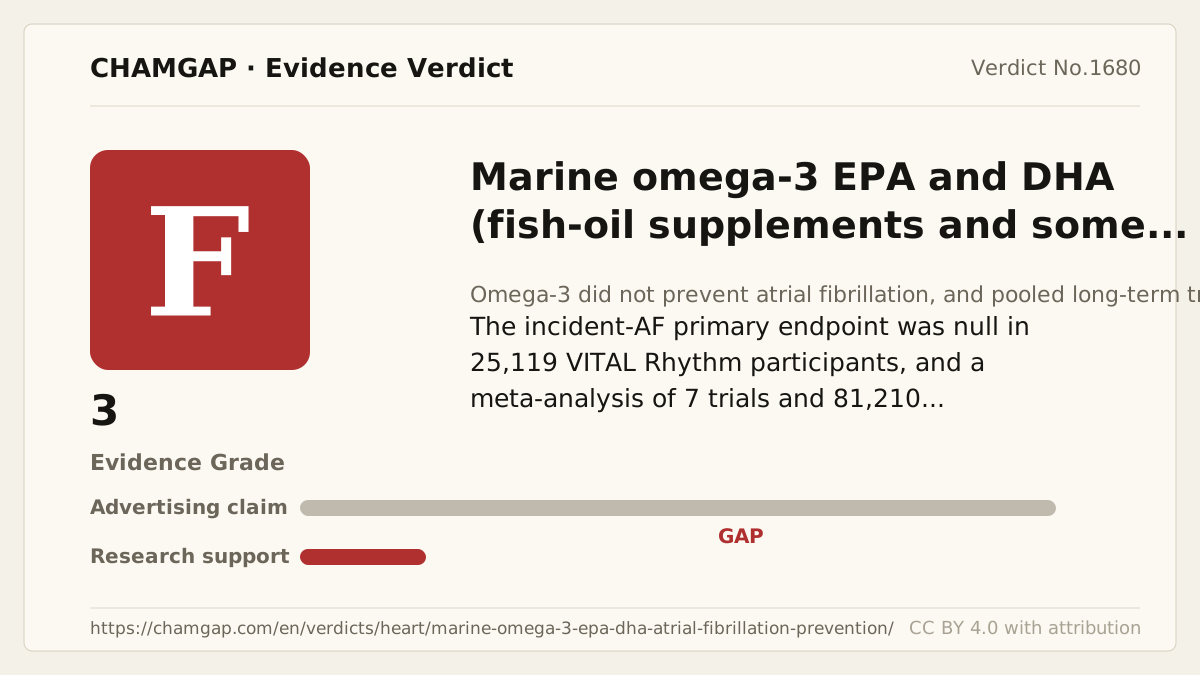
research showsThe incident-AF primary endpoint was null in 25,119 VITAL Rhythm participants, and a meta-analysis of 7 trials and 81,210 participants found increased risk with HR 1.25, supporting F with 3 points.
ads claimMarketing extends effects on triglycerides or blood flow into stabilization of heart rhythm and prevention of arrhythmia. Evidence for triglycerides or other cardiovascular indications does not establish prevention of incident AF.
Useful facts when choosing a product
- VITAL Rhythm used 1 g/day of fish oil providing EPA 460 mg and DHA 380 mg.
- The AF increase was larger in long-term trials using more than 1 g/day, and meta-regression found a dose-response relationship.
- Other indications for prescription high-dose omega-3 must be separated from an AF-prevention claim for supplements; people with an arrhythmia history should review dose and indication with a clinician.
Chamgap Semantic Classification Code
Candidate index · review held
UNK.marine-omega-3-epa-and-dha.UNK.incident-atrial-fibrillation-and-protection-of-heart-rhythm.prevent.MULTIUnknown > Marine omega-3 EPA and DHA > Unknown > incident atrial fibrillation and protection of heart rhythm > Occurrence-prevention claim > Multiple: primary unresolved
An automated migration candidate, not an issued permanent code; exact claim scope remains under review. This machine-generated migration candidate helps retrieval but is not a permanent assignment. The original verdict ID and URL remain authoritative.
What the research actually shows
Albert 2021 VITAL Rhythm drew from the parent VITAL trial, in which 25,871 participants were randomized, and used 25,119 after excluding prior AF and missing baseline information as the actual AF primary-analysis cohort. Incident AF occurred in 469 of 12,542 assigned omega-3 and 431 of 12,577 assigned placebo, HR 1.09 (95% CI, 0.96 to 1.24; P=0.19), so the prevention primary endpoint failed. STRENGTH randomized 13,078 participants and found increased rather than prevented atrial fibrillation, HR 1.69 (95% CI, 1.29 to 2.21). Gencer 2021 synthesized 7 long-term cardiovascular trials with 81,210 participants and 2,905 AF events; omega-3 increased AF risk, HR 1.25 (95% CI, 1.07 to 1.46; P=0.013). Trials above 1 g/day had HR 1.49, with a dose-response relationship. The same AF-prevention claim is repeatedly null, and the pooled direction is harmful rather than preventive.
Why this is classified as F (3)
The incident-AF primary endpoint was null in 25,119 VITAL Rhythm participants, and a meta-analysis of 7 trials and 81,210 participants found increased risk with HR 1.25, supporting F with 3 points. Failure of the prespecified incident-AF primary endpoint in a large prevention trial and the increased-risk synthesis across 7 long-term randomized trials converge on the same claim, supporting F; repeated failure of preventive efficacy, rather than the safety signal alone, drives the grade.
Counterpoint. VITAL Rhythm alone did not prove increased risk at 1 g/day because its confidence interval included no effect. It nevertheless failed to prevent AF, and the broader randomized-trial synthesis found a significant increase with dose response, leaving no basis to raise the efficacy grade.
Rejudgment record. Cross-check applied — The null VITAL Rhythm prevention endpoint, increased AF in 13,078 randomized STRENGTH participants with HR 1.69 (95% CI, 1.29 to 2.21), and increased risk in the 7-trial, 81,210-participant meta-analysis with HR 1.25 (1.07 to 1.46) converge on a harmful rather than preventive direction, supporting F
Sub-claim grades by effect
This ingredient is marketed for several effects. A single overall grade blends strong and weak claims together, so each effect is graded separately here. The overall grade reflects the strongest disconfirming or core claim.
| Effect (sub-claim) | Grade | Basis |
|---|---|---|
| Prevention of incident atrial fibrillation in generally healthy adults | F | The prespecified VITAL Rhythm primary endpoint failed with HR 1.09 and P=0.19. |
| Prevention of atrial fibrillation with high-dose omega-3 | F | Trials above 1 g/day showed increased rather than prevented AF, with HR 1.49. |
| Long-term protection of heart rhythm with omega-3 | F | Across 7 long-term randomized trials, AF events increased significantly, refuting a rhythm-protection claim. |
Cross-check — AI research and Codex final gate
Evidence Table
| Study | Design | Sample | Funding | Endpoint | Result | Weight |
|---|---|---|---|---|---|---|
| Albert CM et al. 2021 VITAL Rhythm | Large double-blind 2-by-2 factorial randomized placebo-controlled ancillary trial | 25,871 randomized in the parent trial; actual AF primary analysis included 25,119 | Public NIH and NHLBI funding; Pronova BioPharma/BASF donated study agents and placebo but did not lead the analysis | Primary endpoint of incident atrial fibrillation | 469/12,542 versus 431/12,577, HR 1.09 (95% CI, 0.96 to 1.24; P=0.19); the prevention primary endpoint failed. | Key large direct null trial |
| Nicholls SJ et al. STRENGTH | Large randomized double-blind placebo-controlled cardiovascular outcomes trial | 13,078 randomized | Manufacturer-funded cardiovascular outcomes trial | Atrial fibrillation adverse event | AF HR 1.69 (95% CI, 1.29 to 2.21), indicating increased risk rather than prevention. | Large trial with direction opposite to prevention |
| Gencer B et al. 2021 | Systematic review and meta-analysis of long-term cardiovascular randomized trials | 7 trials, 81,210 participants, and 2,905 AF events | Public and academic research support; included trials had mixed public and industry funding, and meta-analysis funders had no role in design or analysis | Long-term incident or hospitalized atrial fibrillation events | Overall HR 1.25 (95% CI, 1.07 to 1.46; P=0.013), with HR 1.49 above 1 g/day, indicating increased rather than prevented AF. | Repeated refutation with dose response |
Receipt — 2 References
All 2 cited sources were verified for existence at the original page (as of 2026-07-24).
Final verification and publication gate: Codex · Evidence date: 2026-07-24 · Corrections: none
Cite this verdict
[Chamgap] Marine omega-3 EPA and DHA x prevention of incident atrial fibrillation and protection of heart rhythm — Evidence Grade F·3. 2 cited sources checked. Source: https://chamgap.com/en/verdicts/heart/marine-omega-3-epa-dha-atrial-fibrillation-prevention/ · CC BY 4.0CC BY 4.0 — free to use with attribution; do not distort grades, numbers, or verdict meaning.
What this document does and does not do
Chamgap is an information source. It reports what research has and has not confirmed; it does not tell readers what to take or buy. That decision belongs to readers and, when needed, medical or legal professionals. This verdict reflects literature available up to the search date and may change as new research appears. Nothing here is medical advice.