
Lycopene,
does it really help with Cardiovascular, prostate?
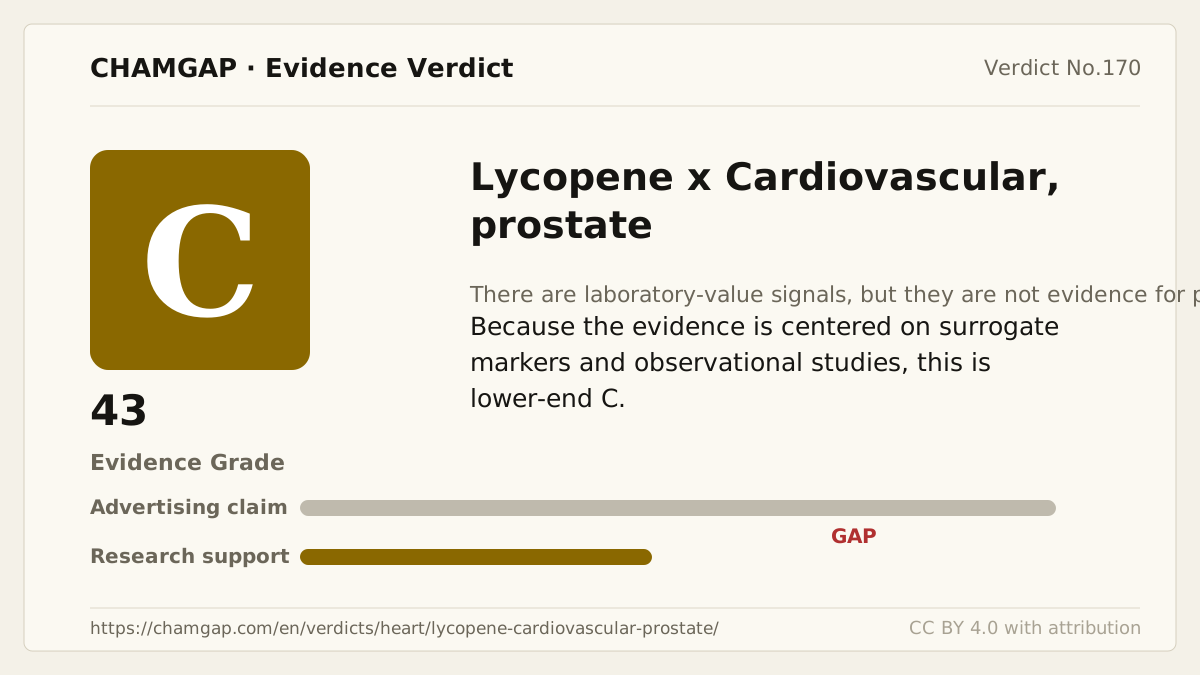
research showsThere are human studies of tomato foods and lycopene supplements that examined markers such as lipids, blood pressure, endothelial function, and PSA, but the results are mixed and mostly involve surrogate markers. For cardiovascular outcomes, null results in healthy people and endothelial-function signals in CVD patients are mixed; for prostate cancer, the evidence is only observational and food-intake signals, so it is not approved evidence for cancer treatment or prevention.
ads claimAdvertising mentions 'prostate health,' 'men's health,' 'antioxidant,' 'vascular health,' and 'LDL oxidation inhibition.' The actual evidence is mainly surrogate markers such as blood values, vascular function, and PSA.
Useful facts when choosing a product
- Tomato foods, tomato extracts, and synthetic lycopene capsules differ in accompanying components and absorption.
- Because it is fat-soluble, absorption can vary when taken with fat.
- Clinical benefit from long-term high-dose intake is not established, and yellow skin discoloration (lycopenemia) can be reported.
- Adjunctive use in people being treated for prostate cancer should be judged separately with clinicians.
- Anticancer or cancer-prevention claims are considered separately from the cardiovascular surrogate-marker C verdict and are viewed as insufficiently supported (D/unknown).
Chamgap Semantic Classification Code
Candidate index · review held
UNK.lycopene.UNK.cardiovascular-prostate.assess.placeboUnknown > Lycopene > Unknown > Cardiovascular, prostate > Association or change assessment > Placebo
An automated migration candidate, not an issued permanent code; exact claim scope remains under review. This machine-generated migration candidate helps retrieval but is not a permanent assignment. The original verdict ID and URL remain authoritative.
What the research actually shows
A 2017 Atherosclerosis meta-analysis reported that tomato/lycopene supplementation improved some blood lipid and blood-pressure markers. A 2020 Advances in Nutrition RCT review concluded that evidence on cardiovascular risk factors was conflicting. A 2014 PLoS ONE RCT showed a signal of improved endothelial function in patients with cardiovascular disease, but it was not clear in healthy people. On the prostate side, evidence centers on dietary-intake observational studies and PSA/tissue biomarker studies, and the FDA and NCI do not approve or recognize lycopene as effective for cancer treatment or prevention.
Why this is classified as C (43)
Because human studies exist, this is not unknown or D, but the core evidence is surrogate markers and conflicting findings. Cardiovascular evidence centers on lipid, blood-pressure, and endothelial-function surrogate markers and mixes null results in healthy people with endothelial signals in CVD patients. Prostate cancer remains at the level of observational/food-intake signals, so anticancer/cancer-prevention efficacy is separated lower at D/unknown; overall this is lower-end C, 43 points.
Counterpoint. Diet studies including tomato foods and studies of lycopene as a single supplement should be considered together but not treated as identical.
Rejudgment record. Final — Cardiovascular evidence centers on lipid, blood-pressure, and endothelial-function surrogate markers, while prostate-cancer evidence consists of observational/food-intake signals and non-approval by regulators, so anticancer/cancer-prevention claims are separately insufficiently supported
Cross-check — AI research and Codex final gate
Evidence Table
| Study | Design | Sample | Funding | Endpoint | Result | Weight |
|---|---|---|---|---|---|---|
| Cheng HM et al. 2017 | Systematic review and meta-analysis | Academic/unknown | Risk factors such as blood lipids and blood pressure | Reported improvements in some lipid and blood-pressure markers. | Core | |
| Tierney A et al. 2020 | Systematic review and meta-analysis | Academic/unknown | Cardiovascular risk factors | Concluded that lycopene effects on cardiovascular risk factors were conflicting. | Core | |
| Gajendragadkar PR et al. 2014 | Randomized placebo-controlled trial | 36 | Unknown/academic | Endothelial function | Endothelial function improved in patients with cardiovascular disease, but not clearly in healthy people. | Supporting |
Receipt — 5 References
All 5 cited sources were verified for existence at the original page (as of 2026-07-09).
Final verification and publication gate: Codex · Evidence date: 2026-07-09 · Corrections: none
Cite this verdict
[Chamgap] Lycopene × cardiovascular, prostate — Evidence Grade C·43. 5 cited sources checked. Source: https://chamgap.com/en/verdicts/heart/lycopene-cardiovascular-prostate/ · CC BY 4.0CC BY 4.0 — free to use with attribution; do not distort grades, numbers, or verdict meaning.
What this document does and does not do
Chamgap is an information source. It reports what research has and has not confirmed; it does not tell readers what to take or buy. That decision belongs to readers and, when needed, medical or legal professionals. This verdict reflects literature available up to the search date and may change as new research appears. Nothing here is medical advice.