
Working at least 55 hours per week,
does it really help with Increased incidence of first stroke?
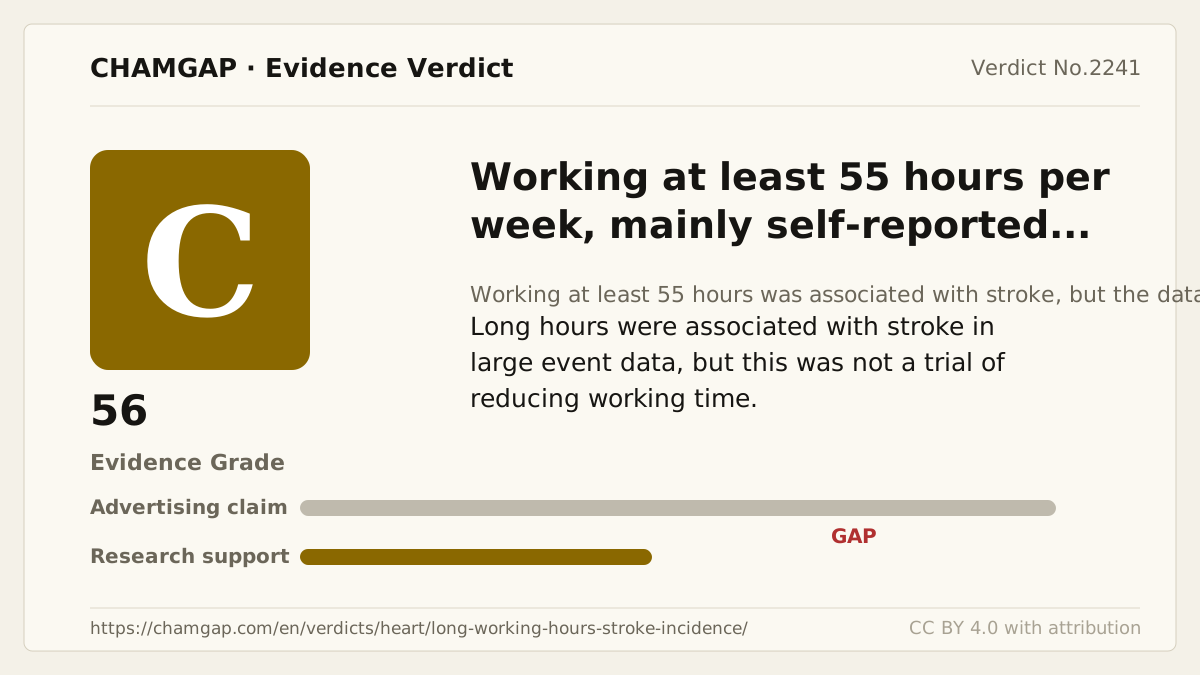
research showsThe grade is C with 56 points. The overall review covered 25 studies in 24 cohorts; the stroke analysis included 17 studies, 528,908 participants, 1,722 events, and 7.2 years of mean follow-up. Compared with 35 to 40 hours, at least 55 hours was associated with RR 1.33 (95% CI 1.11 to 1.61). The event endpoint and dose-response are strengths, but hours were usually a single self-report observational exposure, so causality and the effect of reducing hours remain unproven.
ads claimAn observed 33% higher relative risk is not evidence that cutting an individual's hours prevents 33% of strokes.
Useful facts when choosing a product
- The paper compared less than 35, 35-40, 41-48, 49-54, and at least 55 hours per week.
- The stroke analysis had 17 studies, 528,908 participants, 1,722 events, and RR 1.33 (1.11 to 1.61).
- Exposure was mainly a one-time self-report rather than consistent payroll records.
Chamgap Semantic Classification Code
Candidate index · review held
UNK.working-at-least.UNK.incidence-of-first-stroke.increase.UNKUnknown > Working at least > Unknown > incidence of first stroke > Increase claim > Unknown
An automated migration candidate, not an issued permanent code; exact claim scope remains under review. This machine-generated migration candidate helps retrieval but is not a permanent assignment. The original verdict ID and URL remain authoritative.
What the research actually shows
Kivimäki et al. 2015 reviewed 25 studies in 24 cohorts across coronary disease and stroke. The stroke analysis used 17 studies, 528,908 people, 1,722 events, and 7.2 years of mean follow-up. Relative risks across 41-48, 49-54, and at least 55 hours were 1.10, 1.27, and 1.33 versus 35-40 hours. Outcomes ranged from records to self-report, and working hours were self-reported once. Verdict 2187 is D with 34 points for sedentary time and mortality, a different exposure and endpoint. Verdict 2250 is C with 50 points and separately addresses an organizational intervention that actually reduced hours without cutting pay.
Why this is classified as C (56)
Large hard-event and dose-response evidence is limited by self-reported observational exposure, selection, and residual confounding, giving C with 56 points.
Counterpoint. Lagged and additional adjusted analyses weaken but do not remove reverse causation, and they do not establish intervention benefit.
Rejudgment record. Cross-check applied — Hard stroke events, dose-response and lagged analysis balanced against self-reported observational exposure and residual confounding
| Endpoint | H | Hard endpoint - actual events such as death |
| Replication | R1 | Single confirmatory trial |
| Independence | I2 | Decisive evidence is publicly or non-profit funded |
| Effect size | E+ | Meets the clinically important threshold |
Stored derived and displayed grades match; this is not a current recalculation or validity check (C).
Sub-claim grades by effect
This ingredient is marketed for several effects. A single overall grade blends strong and weak claims together, so each effect is graded separately here. The overall grade reflects the strongest disconfirming or core claim.
| Effect (sub-claim) | Grade | Basis |
|---|---|---|
| Observed association between at least 55 work hours and incident stroke | C | RR was 1.33 versus 35-40 hours. |
| Stroke prevention from reducing working hours remains unproven | ? | This synthesis did not test a working-time reduction intervention. |
Cross-check — AI research and Codex final gate
Evidence Table
| Study | Design | Sample | Funding | Endpoint | Result | Weight |
|---|---|---|---|---|---|---|
| Kivimäki M et al. Lancet 2015 | Systematic review and individual-data synthesis of prospective cohorts | Overall 25 studies in 24 cohorts; stroke analysis 17 studies, 528,908 participants, and 1,722 events | Public and nonprofit support from MRC, ESRC, EU, European agencies, NIH, and foundations | First stroke over 7.2 years mean follow-up | At least 55 versus 35-40 hours: RR 1.33 (95% CI 1.11-1.61); per category RR 1.11 (1.05-1.17); excluding first three years 1.42 (0.98-2.05) | Core large observational event evidence |
Receipt — 1 References
All 1 cited sources were verified for existence at the original page (as of 2026-08-05).
Final verification and publication gate: Codex · Evidence date: 2026-08-05 · Corrections: none
Cite this verdict
[Chamgap] Working at least 55 hours per week x incident stroke — Evidence Grade C·56. 1 cited sources checked. Source: https://chamgap.com/en/verdicts/heart/long-working-hours-stroke-incidence/ · CC BY 4.0CC BY 4.0 — free to use with attribution; do not distort grades, numbers, or verdict meaning.
What this document does and does not do
Chamgap is an information source. It reports what research has and has not confirmed; it does not tell readers what to take or buy. That decision belongs to readers and, when needed, medical or legal professionals. This verdict reflects literature available up to the search date and may change as new research appears. Nothing here is medical advice.