
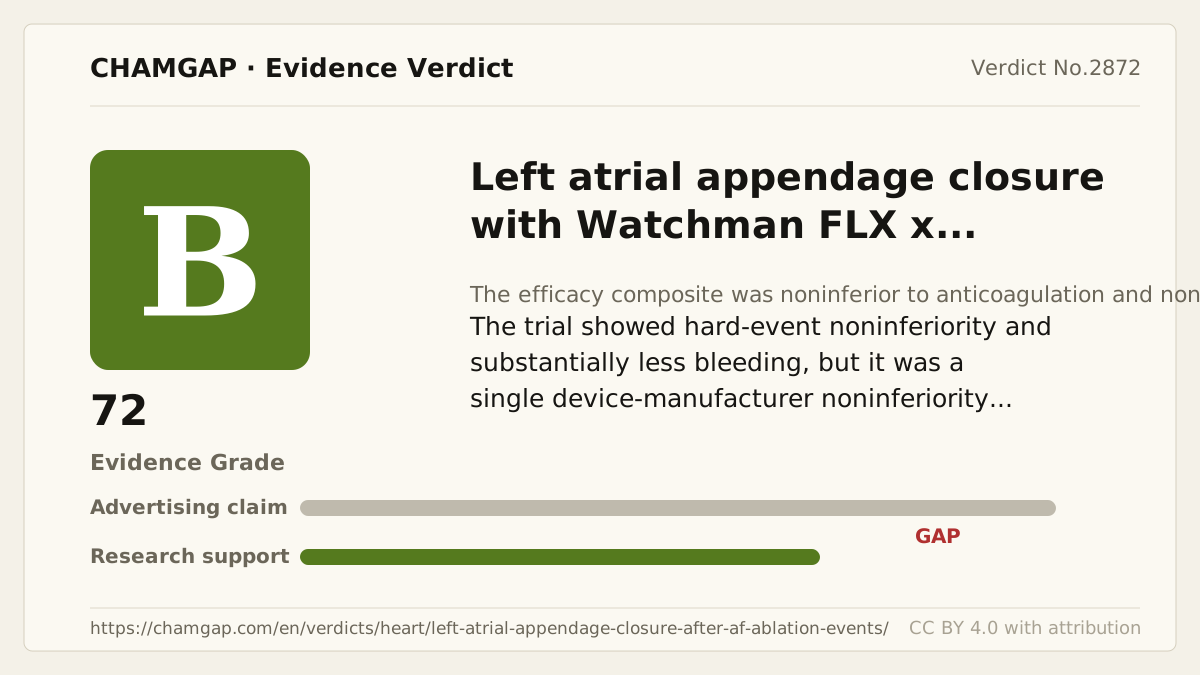
Left atrial appendage closure with Watchman FLX,
does it really help with Noninferior death, stroke, or systemic embolism versus anticoagulation after atrial fibrillation ablation?
research showsThe grade is B. At 36 months in OPTION, death, stroke, or systemic embolism occurred in 41/803 (5.3%) versus 44/797 (5.8%). The one-sided 97.5% upper limit of 1.8 points was below the prespecified 5-point margin. Nonprocedural major or clinically relevant nonmajor bleeding was 8.5% versus 18.1%, an absolute reduction of 9.6 points.
ads claimThe principal value is lower bleeding, not superior protection from death or stroke. In Korea, both AF ablation and LAA closure are performed, but reimbursement eligibility and substantial selective-benefit cost sharing make indication and cost central to the decision.
Useful facts when choosing a product
- Watchman FLX mechanically closes the left atrial appendage.
- The efficacy composite was noninferior and the bleeding safety endpoint was superior.
- Device- or procedure-related complications occurred in 23 patients.
Chamgap Semantic Classification Code
Candidate index · review held
UNK.left-atrial-appendage-closure-with-watchman-flx.UNK.death-stroke-or-systemic-embolism.noninferior.UNKUnknown > Left atrial appendage closure with Watchman FLX > Unknown > death, stroke, or systemic embolism > Noninferiority claim > Unknown
An automated migration candidate, not an issued permanent code; exact claim scope remains under review. This machine-generated migration candidate helps retrieval but is not a permanent assignment. The original verdict ID and URL remain authoritative.
What the research actually shows
The international trial randomized 1,600 patients, 803 to closure and 797 to anticoagulation, with 36-month follow-up. ① Defect name: noninferiority design. ② Listed item: noninferiority design. ③ Original evidence that its requirement was met: "The primary efficacy end point, tested for noninferiority" and "with a noninferiority margin of 5 percentage points." ④ Avoidable: yes. Superiority testing was possible, but the chosen efficacy question allowed up to 5 points of inferiority. Events were analyzed by intention-to-treat time-to-event methods; censoring is not attrition. The paper states "Funded by Boston Scientific" and included company-employed authors.
Why this is classified as B (72)
A 1,600-patient hard-outcome RCT and large absolute bleeding reduction are strengths, but lack of independent replication, Boston Scientific-only funding, and noninferiority design give B with 72 points.
Counterpoint. Procedure complications, postimplant antithrombotic therapy, peridevice leak, and individual stroke risk must be weighed against bleeding reduction.
Rejudgment record. Cross-check applied — Direct review of the 36-month ITT efficacy composite, 5-point margin, bleeding endpoint, and Boston Scientific funding
| Endpoint | H | Hard endpoint - actual events such as death |
| Replication | R1 | Single confirmatory trial |
| Independence | I0 | Evidence comes only from manufacturer studies |
| Effect size | E+ | Meets the clinically important threshold |
Stored derived and displayed grades match; this is not a current recalculation or validity check (B).
Sub-claim grades by effect
This ingredient is marketed for several effects. A single overall grade blends strong and weak claims together, so each effect is graded separately here. The overall grade reflects the strongest disconfirming or core claim.
| Effect (sub-claim) | Grade | Basis |
|---|---|---|
| Noninferior death, stroke, or systemic embolism | B | The 1.8-point upper limit did not cross the 5-point margin. |
| Reduced nonprocedural major or clinically relevant nonmajor bleeding | B | Rates were 8.5% versus 18.1%, an absolute reduction of 9.6 points. |
Cross-check — AI research and Codex final gate
Evidence Table
| Study | Design | Sample | Funding | Endpoint | Result | Weight |
|---|---|---|---|---|---|---|
| Wazni et al. 2025 OPTION | International randomized open-procedure noninferiority trial versus anticoagulation | 1,600 randomized, 803 versus 797, with intention-to-treat time-to-event analysis | Original statement: "Funded by Boston Scientific"; company-employed authors included | 36-month composite of all-cause death, stroke, or systemic embolism, alongside nonprocedural major or clinically relevant nonmajor bleeding | Efficacy 41/803 (5.3%) versus 44/797 (5.8%), one-sided 97.5% upper limit 1.8 points below 5; bleeding 65 (8.5%) versus 137 (18.1%), absolute -9.6 points | Pivotal hard-outcome and safety evidence |
Receipt — 2 References
All 2 cited sources were verified for existence at the original page (as of 2026-08-18).
Final verification and publication gate: Codex · Evidence date: 2026-08-18 · Corrections: none
Cite this verdict
[Chamgap] Benefit of Left Atrial Appendage Closure for Noninferior Death, Stroke, or Systemic Embolism after Atrial Fibrillation Ablation — Evidence Grade B·72. 2 cited sources checked. Source: https://chamgap.com/en/verdicts/heart/left-atrial-appendage-closure-after-af-ablation-events/ · CC BY 4.0CC BY 4.0 — free to use with attribution; do not distort grades, numbers, or verdict meaning.
What this document does and does not do
Chamgap is an information source. It reports what research has and has not confirmed; it does not tell readers what to take or buy. That decision belongs to readers and, when needed, medical or legal professionals. This verdict reflects literature available up to the search date and may change as new research appears. Nothing here is medical advice.